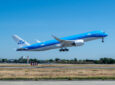

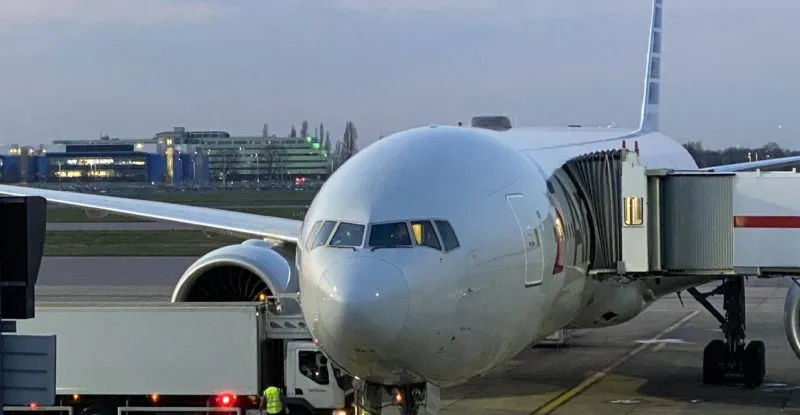

On October 8, three airlines revealed fresh commitments for SpaceX’s Starlink inflight Wi-Fi. Existing customer American expanded its contract and will offer the high-speed service on its entire mainline fleet, KLM said it will outfit its intercontinental network, and Royal Air Maroc (RAM) confirmed a fleet-wide deal. Additionally, Amtrak has added Starlink connectivity to the backhaul mix on its new Airo trainset plying the Pacific Northwest Cascades route, as part of a trial reported by RGN.
To describe Starlink’s rapid rise and order momentum as impressive would be an understatement. Less than four years after launching its Low Earth Orbit (LEO) satellite-powered inflight connectivity service on JSX, SpaceX is now closing in on the 50-customer mark in commercial aviation, including with some of the biggest names in the industry: United, IAG Group, Lufthansa Group, Emirates, Qatar Airways, Alaska Air Group, and Korean Air to name a few.
With American earmarking more than 1,000 mainline aircraft to Starlink (500 more jets than before, now including widebodies), KLM’s intercontinental widebody fleet standing at roughly 69 jets (sister Air France is already in the midst of fleet-wide equipage), and Royal Air Maroc counting over 60 jets under its wing, the momentum is undeniable. All three carriers will begin rollouts in 2027.
Factor in the recent 1,000-plus-tail commitment from U.S. low-cost carrier Frontier and other operators in the Indigo Partners portfolio, plus Starlink’s wins in business aviation, and it is clear that this industry disruptor is well on its way to hitting, by 2034, the 10,000-aircraft tally predicted by Valour Consultancy.
So far, the lion’s share of Starlink customers in commercial aviation are using, or intend to use the service to power free Wi-Fi for loyalty members (American and KLM among them), or offer free Wi-Fi outright (airBaltic and Emirates, for example.)
Copa Airlines is notably pursuing a hybrid model that will see it offer complimentary access to high-status loyalty members and business class passengers, and to Starlink Residential and Starlink Roam subscribers, plus a paid tier for other passengers.
Given that SpaceX has ambitions to become a major mobile carrier in the U.S. — it has announced plans to acquire a nationwide low-band spectrum license portfolio of up to 14 megahertz of paired spectrum in the 800 MHz band for Starlink Mobile — the aerospace giant’s Starlink subsidiary could in time be positioned to offer fresh options to U.S. airlines and their passengers around Wi-Fi sponsorships, not unlike how T-Mobile does today.
Coverage gaps and the India question
Starlink is certainly cooking with gas. However, there are some key gaps in its coverage map, including over China and Russia, which ban Starlink outright, as well as parts of North Africa, and India where the satellite operator does not yet have clearance.
On some routes, a brief blackout might be a minor annoyance to passengers. Other routes are more exposed, and will require airlines to manage passenger expectations around gate-to-gate service.
Starlink’s global availability map suggests that the go-live date for service in Morocco and other parts of North Africa is “unknown at this time.” That hasn’t stopped Casablanca-based Royal Air Maroc from signing on as a Starlink customer, though it operates short- and medium-haul routes to key destinations in North Africa.
Korean Air and Asiana’s services to and overflying China, and Vietnamese low-cost carrier VietJet’s flights to China and India also stand out, as previously reported. Flying to, from and over India, British Airways and Virgin Atlantic are Starlink customers.
Some passengers have noticed the India gap.
“This is really quite frustrating, even for visitors to India. Starlink on my flight from BLR to LHR wasn’t active whilst flying over India, which wasn’t ideal,” avid traveler and popular aviation geek Speedbird Julie posted on X in response to the BBC’s October 8 article about Why Elon Musk is taking on India’s richest man over Starlink.
Beyond inflight Wi-Fi, Musk has made a broader case for receiving Indian clearance, highlighting on X that Starlink can provide connectivity in rural areas.

It’s important to note that inflight connectivity in India is still relatively new. In early 2020, just before the COVID pandemic hit, Panasonic started availing of Nelco Limited’s license with the Indian government, which allowed international operators to flip the switch on service over India.
That enabled Panasonic’s airline partners, including KLM and American, to offer a paid inflight Wi-Fi service to passengers over India; American returned to Delhi in 2021.
Regardless of India’s next move vis-à-vis Starlink, there is wisdom in offering complimentary Wi-Fi to passengers if coverage gaps will be meaningful on any given route.
Technology is not the impediment. There are, for example, multi-network and multi-orbit architectures that could address these issues by augmenting the pipe with a state-approved or state-owned satcom service over a separate antenna system.
Related Articles:
- Inside Amtrak Airo as trainset enters service on Cascades route
- VietJet adopts Starlink despite coverage gaps in China and India
- United pipes live football via DISH to Starlink-enabled seatback IFE
- American talks RFP as it readies to bring screens to narrowbody fleet
- British Airways goes super premium on A380 superjumbos
- When Starlink on airBaltic A220 is highlight of Air Serbia A320 PaxEx
- Coverage gap of note as Korean Air and Asiana offer Starlink
- Q&A: Axinom and Rosen Aviation talk connected seatback platform
- Rise in sovereign satcom presents GEO-capable hardware opportunity
- Panasonic, Spacesail to launch multi-network LEO IFC in 2027
Featured image credited to Jason Rabinowitz