
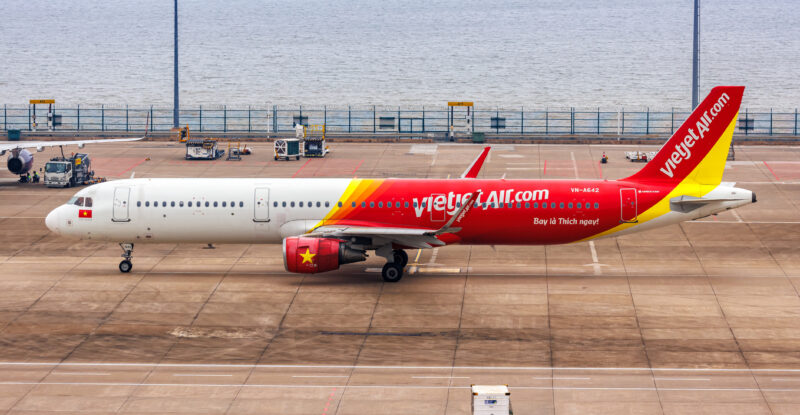

Vietnamese low-cost carrier VietJet, which boasts a substantial and expanding presence in China and India, has selected SpaceX’s Starlink Low Earth Orbit (LEO) satellite-powered inflight connectivity service for an initial 120 aircraft even though Starlink does not have landing rights in either country.
The deal was inked by Starlink, VietJet, and VietJet’s digital technology and telecommunication sisters under the Sovico Group — Galaxy Holdings and Galaxy Telecom — in the presence of Vietnam’s General Secretary and President To Lam during a working visit to the United States.
It covers 100 Airbus A321 and Boeing 737 narrowbodies, plus 20 Airbus A330 widebodies.
“Vietjet also plans to equip all future aircraft deliveries with high-speed Internet, extending connectivity across its Vietnam domestic and international network,” the airline says, noting that the pact “marks the beginning of a long-term technology relationship between VietJet and SpaceX.”
Financial terms have not been disclosed.
China and India represent key international growth markets for VietJet, making the move “a curious one,” suggests Craig Foster, co-founder and senior research consultant at Valour Consultancy, which closely tracks the IFC market and predicts Starlink could secure over 10,000 tails by 2034.
“What’s more, many other routes will overfly this airspace — airspace where use of Starlink is restricted,” Foster notes in a statement published on LinkedIn.
VietJet is certainly not the only carrier to accept Starlink coverage gaps. As RGN reported last week, Korean Air and Asiana Airlines have started progressively rolling out Starlink on their aircraft, but are alerting passengers to expect coverage gaps including over China and India.
As we asked at the time, do market differentiation and other factors now take priority over coverage when selecting IFC?
According to Grok, the AI assistant built by SpaceXAI, geopolitical and national-security factors make near-term approval of Starlink in China “highly unlikely; no negotiations, applications progress, or target dates have been reported.”
More progress has been made in India, Grok notes, though final clearances must still be granted.

There are of course a variety of ways for operators to plug the coverage gaps, including by augmenting service with state-approved connectivity.
To that end, Valour Consultancy’s Foster wonders whether VietJet might be planning to ultimately add China’s Spacesail LEO service as part of a future dual LEO-LEO setup onboard aircraft.
Spacesail is working to build out a mega-constellation of LEO satellites. (It has already teamed with Panasonic Avionics on a future LEO-LEO IFC offering. And Airbus last year announced it would integrate Spacesail connectivity as part of its linefit, supplier-furnished HBCplus IFC ecosystem.)
VietJet, meanwhile says in a statement that its Starlink service will provide “high-speed, low-latency connectivity and coverage over oceans, polar regions and remote areas,” enabling passengers to “work, stay connected, stream entertainment and access online content throughout their journey.”
It says it will offer “complimentary Wi-Fi for passengers on all Vietjet-branded flights.”
Related Articles:
- China coverage gap of note as Korean Air and Asiana offer Starlink
- United pipes live football via DISH to Starlink-enabled seatback IFE
- Now critical, IFC needs resiliency, security: Eutelsat’s Bisgaard
- Panasonic, Spacesail to launch multi-network LEO IFC in 2027
- Hughes stays flexible with ESA, double-ESA and hybrid ESA-VICTS IFC
- Airbus open to IFC orchestration should multi-vendor take off
- China Southern picks SES as MSP for 30 A350s contracted for HBCplus
- Press Release: IFE newbie Vietjet Thailand selects Bluebox Wow
Featured image credited to istock.com/Boarding1Now