


Obtaining offerability for a product in an airframer’s catalog and then ultimately seeing that product factory-fit to aircraft on the assembly line can take several years.
Yet, Embraer has managed to support the linefit process for SES’s multi-orbit electronically steerable antenna (ESA)-based inflight connectivity system on the E-Jet E2 in what feels like record time.
Just eighteen months ago, the Brazilian manufacturer agreed to install the compact IFC solution on the E2 during aircraft production under a pact with Intelsat, which was later acquired by Luxembourg-based SES. The kit is offered as an option to E2 buyers.
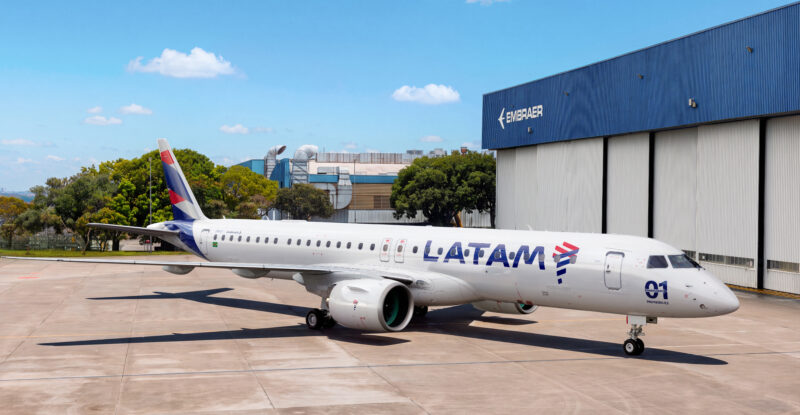
Now, an E195-E2 has emerged from the factory with SES’s ESA-based IFC system fitted. And the twinjet is undergoing the final steps required before entering service with LATAM Airlines Brazil.
That’s an impressive turnaround time, and speaks to Embraer’s interest in ensuring that its customers can offer an improved passenger experience as soon as an E2 is delivered.
The new E195-E2 will not only bolster LATAM’s connectivity expansion across its Brazilian route network, but will also support another kind of connectivity — low-latency, high-speed inflight Internet for passengers.
Members of LATAM’s loyalty program, LATAM Pass, will be able to access the Wi-Fi for free by connecting to the service onboard, accessing the LATAM Play browser, and signing in using their LATAM Pass username and password.
With speeds of up to 275 Mbps, the SES IFC system utilizes Gilat Satellite Networks’ Stellar Blu Sidewinder ESA. It ferries data over Eutelsat OneWeb’s Low Earth Orbit (LEO) satellite service, for which SES is a distribution partner in aero, and the satellite operator’s own geostationary satellite network.
The low-latency LEO network ensures that the delay between sending and receiving data is minimal, while the GEO network is ideal for more densely populated areas, like big cities.
São Paulo-based LATAM’s IFC deal with SES was announced in July, and also covers equipage of the IFC system to A320neo and A321XLR narrowbodies.

The airline is expected to shortly complete certification to operate the E195-E2 with Brazil’s National Civil Aviation Agency (ANAC), just one year after parent LATAM Airlines Group revealed the aircraft order.
That timeline is also an achievement for both parties, given that the firm order for 24 E195-E2s, with options for a further 50, was only placed by the Group one year ago.
“The timeline was reduced thanks to joint effort across various departments of both the airline and Embraer,” Embraer explains in a statement, adding:
In an unprecedented move, LATAM deployed a manufacturer demonstration aircraft, known as the “Profit Hunter,” for evacuation demonstrations, evaluation flights, and the training and qualification of pilots and flight attendants. This strategy reduced the time needed to complete these procedures by roughly half, while maintaining all operational safety requirements and standards.
A dozen E195-E2s are expected to be delivered to LATAM by the end of this year.

Blink and you might miss the slimline ESA hardware fitted atop the E2. All images credited to Embraer