

For years, aviation industry observers warned that the introduction of blazing-fast Wi-Fi onboard aircraft would ultimately spell the death knell of embedded IFE systems. Not only have those predictions not come to fruition, but quite the opposite paradigm has emerged: Low Earth Orbit (LEO) and multi-orbit inflight connectivity, together with fundamental advancements in edge caching and cloud computing, are driving innovation in seatback IFE and fueling new business propositions.
Case in point: Rosen Aviation, which is perhaps best known for providing advanced cabin electronics to the business aviation community, and German software firm Axinom have teamed up to offer a new lightweight, wireless Connected Seatback Platform for airlines.
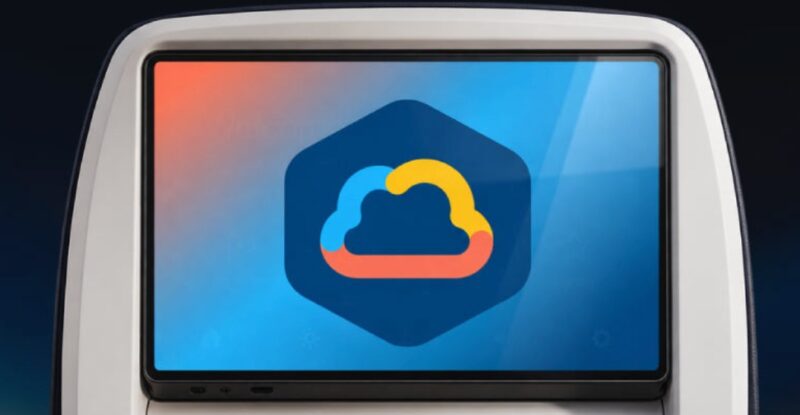
The system does away with the head-end server and miles of wiring found in traditional IFE systems. Instead, it transforms each seatback monitor into an edge node of the airline’s own cloud, which in turn holds the content, the application logic and the passenger data. Wiring to the seat carries power only, and each screen receives its data wirelessly over LEO satellite connectivity.
The Connected Seatback Platform is billed by both firms as being “open to any use case and application the airline chooses” — naturally within the framework of whatever partnerships and licensing agreements the airline has forged with content creators, third-party OTT services and social networks.
Here’s how it works. The passenger pairs their own device over the cloud with the seat, and the screen loads their profile from the cloud over its own connection. This profile includes their loyalty tier, preferences, watch history, past purchases, and the context of the flight they are on.
Crucially, however, the phone “stays the trusted device for authentication, so logins and payments happen there rather than on a shared surface, and the account is available at the seat for the duration of the flight, or for as long as the passenger stays logged in. Anyone who prefers not to sign in keeps a fully functional seat, without the personalization,” Axinom CEO Ralph Wager explains to Runway Girl Network.
He continues:
What that produces is a personalized version of the airline’s own experience: the home screen re-ranks, the catalog reflects what the passenger watched before, and commerce, upgrades, and offers are put in front of someone the airline knows.
Every client is connected to the same cloud ecosystem which knows the passenger’s identity, so the journey can run seamlessly across pre-, in-, and post-flight.
Identity, context, and entitlements travel with the passenger instead of being re-established at every touchpoint, so each one picks up where the previous left off rather than starting over. Across those touchpoints, the platform lets the airline offer passengers the content and services that are relevant in their respective phase of the journey.
Axinom is certainly no stranger to the wireless IFE realm. Its software stack powered the first bring-your-own-device wireless IFE system, Lufthansa Systems’ BoardConnect, and the company later delivered the digital solution behind Delta Flight Product’s wireless seatback IFE system. A key software partner to a raft of heavy-hitters in industry, the firm’s Axinom On-Board Cloud platform connects an airline’s ground cloud infrastructure directly to the aircraft cabin.
Eugene, Oregon-based Rosen Aviation, meanwhile, says it sources displays from all major manufacturers and carries out the avionics engineering, electronics development, and structural integration in-house, “so the display is built to the airline’s specification rather than chosen from a catalog.” That also means that large, connected displays — as large as 97″ — can be brought to shared cabin surfaces, which in turn supports use cases around digital signage and digital windows.
Together, the two companies reckon they are uniquely positioned to change the game in IFE, and give stalwart players some fresh competition.
“Move the brain to the cloud and everything changes,” says Wagner. “The screen stops being an entertainment terminal and becomes a device the airline can build on, the catalog stops arriving on a loading schedule, and the passenger at the seat is finally someone the airline knows rather than an anonymous session. Rosen is the ideal partner for this, with all the industry-specific knowledge and capabilities needed to rethink the cabin from the ground up.”
This industry-specific knowledge will also come in handy when Rosen and Axinom seek to certify their system across aircraft types. As RGN readers are aware, aviation faces a number of challenges: a seat supply bottleneck, a more exacting environment on the linefit front for integrated IFE/seats, a chip crunch as a lot of memory chips are being directed at AI, and a stringent regulatory environment especially around head impact and neck injury criterion for seats.
Sufficiently intrigued by Rosen and Axinom’s Connected Seatback Platform proposition, we sought additional color. Please enjoy our Q&A with Wagner and Rosen Aviation senior VP strategy, Lee Clark.
RGN: Can these wireless monitors be described as seat-centric? How much local storage do they have? Do Axinom and Rosen envisage that a certain amount of content will be locally stored in the event that the LEO connectivity is not available?
Wagner: Seat-centric is an accurate description, and so is passenger-centric. In this architecture the seatback screen is the central entity rather than a terminal at the end of a wire. Each screen is an edge node of the airline’s cloud, and that is what makes everything else possible. The passenger has access to everything relevant to them.
Clark: Both the storage question and the connectivity question come down to caching, up to currently available limits of 8 TB per display. Every screen caches, so content sits where it is actually watched, at the seat. If the connection drops, the system keeps running in a fallback mode on the cached content.
RGN: Is Axinom and Rosen sharing any weight stats; what’s the “all-in” weight to bring the system to, say, a 180-seat A320 for example?
Clark: We are very confident it’s the lightest system on the market overall, providing an enormous opportunity for airlines to save on fuel costs, carry additional passengers and much more. Critically, the display itself is also lighter than anything else out there, making for a safer seat structure and passing the required tests more easily.
RGN: Are Axinom and Rosen targeting any specific market (low cost, regional, narrowbodies, widebodies, retrofit, linefit, all)? Any specific geographic region?
Clark: No specific segment and no specific region. What it takes is an airline that sees the many benefits of seatback screens in its cabin, an aircraft with LEO connectivity, and the ambition to own the passenger experience and the data that comes with it. Whether that is a low cost carrier, a regional operator, or a widebody fleet does not change the architecture.
Wagner: What does differ is what an airline wants to do with it. A low cost carrier might put more weight on monetization and ancillaries, while another carrier leads with premium content or loyalty. That is exactly what the platform is built for: the applications on the screen are chosen and built by the airline based on its own model. The same goes for the hardware, where the displays are built to the airline’s specification, with almost infinite customization. While the product underneath is the same for everyone, what each airline makes of it is unique.
RGN: Do you anticipate that adopters of this new system will retain their content service providers or will this model enable airlines to offer entertainment without a CSP?
Wagner: Our focus is on the technology that puts the decision about content partnerships with the airline. Content sourced through a CSP is ingested and presented in this system, and we expect that to remain the main case for the time being. What the platform adds is room for the airline to go further, with other strategic partnerships and integrated OTT streaming services alongside its own licensed catalog.
RGN: Do you envisage that airlines will forge direct content licensing agreements with streaming platforms (studio owned) to entertain their passengers via this LEO-connected IFE system? And to that end, are Axinom and Rosen involved in any of the discussions? Will guests’ social media apps, like Instagram and TikTok, comprise some of the entertainment on the screen?
Wagner: Any application the airline wants, and has an agreement for, can run on the seatback screen. Airline-built services, third-party apps, streaming services, games, maps, and social apps are all the same kind of thing to the platform. Which of them appear on the screen is the airline’s decision, and the commercial arrangement behind each one is between the airline and that provider. There is no technical constraint on our side on who can be integrated.
The airline’s platform logic always sits on top of those applications. A passenger announcement, for example, pauses whatever is running, third-party apps included, and the same applies to any other event the airline wants the cabin to react to.
Apps are handled from the ground like everything else on the platform. The airline assigns them in the management system to a whole fleet, a route, an aircraft, or a single screen, and they are delivered and updated over the air.

RGN: Are you offering this wireless, LEO-powered, cloud-supported IFE system for a fraction of the cost of traditional embedded IFE? And have any discussions with airframers for linefit offerability started?
Clark: Installing and maintaining wireless, cloud-powered screens requires less effort than a wired system does, and the processes around them run over the air, with content, updates, and configuration all arriving from the ground rather than as work on the aircraft. Using standardized components and infrastructure instead of proprietary solutions leads to simplified and efficient management and maintenance processes. These processes are handled centrally from the ground and are automated as far as possible, which takes manual steps and coordination out of day-to-day operations.
Related Articles:
- RAVE and Lufthansa Technik reimagine the passenger control unit
- BBC Studios, Panasonic could offer IFE over-the-top via BBC Player
- Aircraft seat certification delays spur testing tweak request
- American talks RFP as it readies to bring screens to narrowbody fleet
- Thales’ new Tandem OLED-based FlytEDGE Aura IFE shines bright
- Do fast Wi-Fi and the shift in media consumption portend BYOL IFE?
- Fast-growing RAVE Aerospace identifies industry choke points
- Panasonic enjoys rapid IFE growth as connected seatback takes wing
Featured image credited to Axinom and Rosen Aviation