
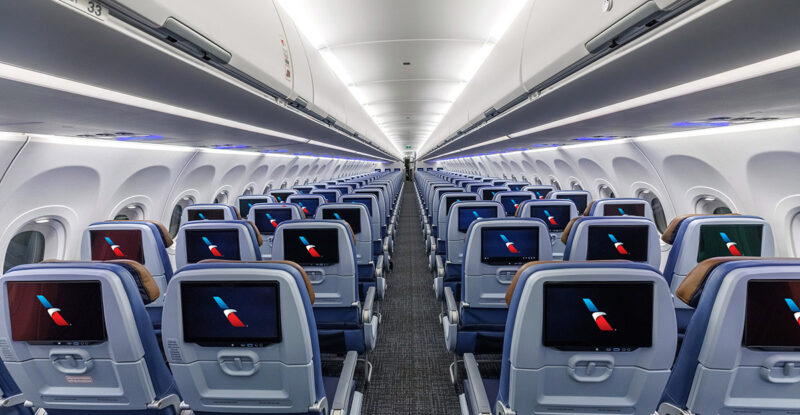

What’s old is new again. After taking delivery of its first single-aisle aircraft with seatback screens in 2013, followed by nearly a decade of removing those displays, American Airlines will bring back seatback IFE screens to its narrowbody fleet.
But don’t stop bringing your own entertainment just yet.
The oneworld alliance member will take new Airbus and Boeing narrowbody deliveries with seatback IFE in 2028, and implement a massive retrofit of its narrowbody fleet.
Refurbishing the existing fleet of several hundred narrowbodies could run through the early 2030s.
No vendor has been announced, and there’s a reason for that. The RFP is still in play, Runway Girl Network can confirm.
An American Airlines spokesperson tells RGN:
We are evaluating several leading technology providers and will select the partner that delivers the best customer experience and value for American.
Beyond meeting today’s needs, we are looking for a partner with a modern, scalable platform that can evolve alongside technology advancements, enabling continuous enhancements to the customer experience while creating incremental revenue opportunities for American.
American is vowing to offer all the features that have become table stakes for a modern seatback IFE system. Large 4K displays — so large, in fact, that they are expected to be “industry leading” in North America — plus USB-C fast charging, Bluetooth audio, and the promise of a personalized experience more or less to match what American is already offering on its A321XLR twinjets today.
American’s IFE on the A321XLR is Thales’ current-gen, QLED-based AVANT Up platform. But the wording in its press release about fleet-wide adoption of seatback IFE is cautiously written, given that management is still evaluating the choices. “More to come,” promises AA.
(For the nerds, if American had announced OLED screens, we’d know that Panasonic Avionics’ Astrova hardware had been selected; Tandem OLED would be Thales’ next-gen FlytEDGE platform, and miniLED LCD would be RAVE Aerospace’s RAVE Ultra or Rave 5 displays.)
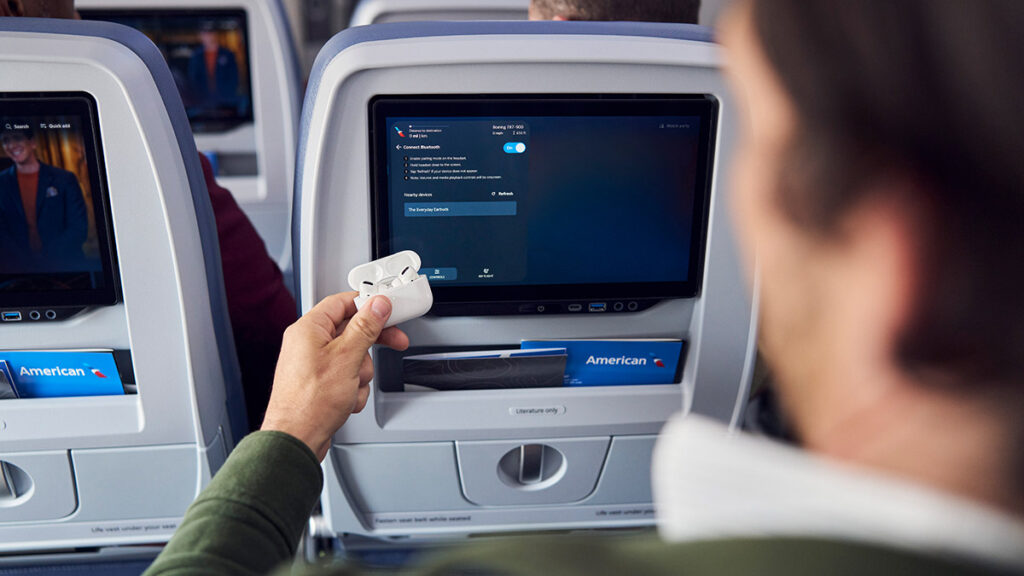
American will offer access to a broad selection of movies, TV, music, games and content and says seatback IFE will enable it to introduce new experiences and partnerships.
American will begin its journey to bring seatback screens to narrowbodies just as United Airlines is wrapping up its own program to do the same.
United dealt with major post-COVID supplier constraints, leading to years of delays. It remains to be seen how the current RAM and SSD price surge and availability issues might delay current and future aircraft retrofit programs.

Early this year, American suddenly revealed it would finally offer free Wi-Fi to its passengers after years of demand. It also later tapped Space’s Starlink Low Earth Orbit (LEO) satellite-powered connectivity for 500-plus Airbus narrowbodies.
Combined with current and future retrofit programs that will see it add more premium cabin seating to its fleet, American has seemingly turned a corner and plans to better compete in the lucrative premium space (as it is already doing on the longhaul front.)
That arena sees rivals Delta and United driving passenger well-being benefits and stronger Net Promoter Scores with seatback IFE.
Let the games begin!
Related Articles:
- American pivots to Starlink for 500-plus Airbus narrowbodies
- American’s premium push continues with A321XLR arrival, 777 retrofits
- American Airlines’ 787-9 ups the ante for Premium Economy
- Amazon Leo to serve as launchpad for more Delta brand experiences
- United, Delta tout NPS and wellbeing benefits of seatback IFE
- Fast-growing RAVE Aerospace identifies industry choke points
- After impressive Elevated reveal, United surprises with basic tier
- Flagship Suite Preferred impresses on American 787-9P inaugural
All images credited to American Airlines