

Inflight VoIP and video conference calls have long been technically feasible. Cast your minds back to December 2013, when aviation journalists put JetBlue’s high-capacity Ka-band geostationary satellite-based inflight connectivity to the test by FaceTiming each other from seat to seat (the airline banned the practice shortly thereafter).
But as non-geostationary satellite-powered IFC solutions arrive on the scene, together with the ability to support a snappy high-speed Internet experience for more concurrent users, airlines face an important question: should they allow passengers to make Wi-Fi calls and host Teams meetings or not?
The industry is fragmented on the issue, with airlines and regulators continuing to have mixed feelings about — and mixed protocols around — inflight voice calls, depending on who and where you’re flying.
British Airways and Emirates, for instance, are each permitting calls over Starlink, though BA stipulates that you should “keep your voice low and use headphones.”
Starlink customer Lufthansa Group, on the other hand, says passengers are required to refrain from making “voice and video calls, and not to broadcast live streams from aboard the aircraft.” It cites passenger preferences as the reason for its decision.
In the United States, lawmakers are pushing for a formal federal ban under the newly proposed Quiet Skies Act, arguing that inflight voice calls are annoying for passengers and a “dangerous distraction” for flight attendants. United, which is rolling out Starlink fleet-wide, already prohibits voice and video calls, saying simply that they are “not supported.”
Like others who have tracked the fascinating evolution of inflight connectivity, the latest brouhaha around inflight voice calls has given this journalist a serious case of déjà vu.
Nearly 19 years ago, onboard GSM systems — featuring picocells installed down the length of the aircraft — debuted, enabling passengers to make voice calls via their mobile phones when flying on equipped aircraft (if voice call functionality was explicitly sanctioned by the airline, and switched on by the crew).
But it wasn’t all smooth sailing for the relevant hardware and service providers. Flight attendants in the United States voiced massive opposition when the Federal Communications Commission in 2013 proposed lifting traditional mobile restrictions that would have set the stage for inflight GSM. And there was no shortage of passenger outcry about the FCC’s proposal. This in turn stymied take-up in the U.S.
Suppliers encountered less resistance in the Middle East, where onboard GSM saw early adoption by Emirates and others, and indeed the UK, where Virgin Atlantic still supports inflight calls on Airbus A330s and A350s within reason.
Little wonder, then, that Emirates is now permitting calls via Starlink without much fanfare, as it equips its fleet with the LEO satcom solution, and Virgin, while disallowing video calls on Starlink-fitted jets, is permitting audio-only VoIP with this caveat: “short voice calls only, headphones always, yes, always.”
(Aviation historians will take you back even further to when GTE Airfone units were installed on seatbacks in the 1980s, but exorbitant prices kept passenger utilization low, and thus, the nuisance factor.)
What is different today is that, unlike legacy air-to-ground and satcom solutions, next-gen inflight Internet as powered by LEO and multi-orbit networks can support multiple crisp conversations and multi-person meetings at the same time. Passengers seated shoulder to shoulder in economy class don’t seem to relish the idea of adding chatty Kathy to the mix down back, let alone chatty Kathy’s Zoom friends.
Even business travelers have concerns.
“Our members manage travel for millions of employees, and they have been clear with us that the cabin should remain a place to work, rest and think, and not become a group phone booth for dozens of simultaneous private conversations at 35,000 feet,” declared Global Business Travel Association (GBTA) CEO Suzanne Neufang after a bipartisan group of U.S. representatives proposed the Quiet Skies Act this summer.
But is it really necessary to regulate inflight etiquette on this level? In a world where technology is advancing at an exponential rate, surely there are creative solutions to this conundrum?
French firm Skyted has proffered one: it sells a sound-absorbing headset solution that facilitates virtually silent VoIP and video calls, and already counts French sister airlines Air Caraïbes and French bee as clients.
Boeing, meanwhile, has developed an artfully analog answer to what is a very digital problem.
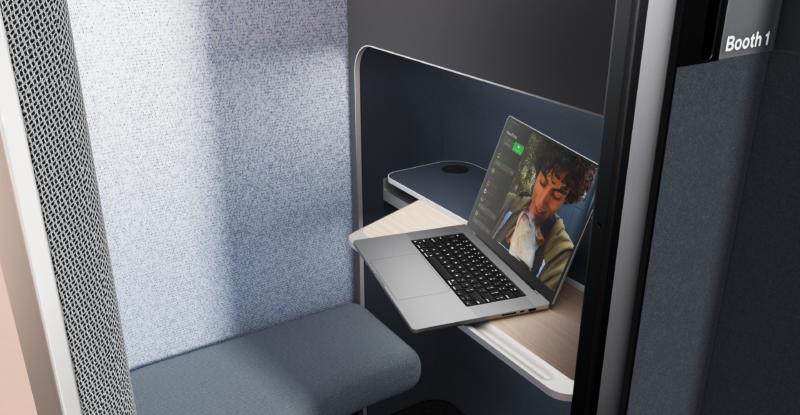
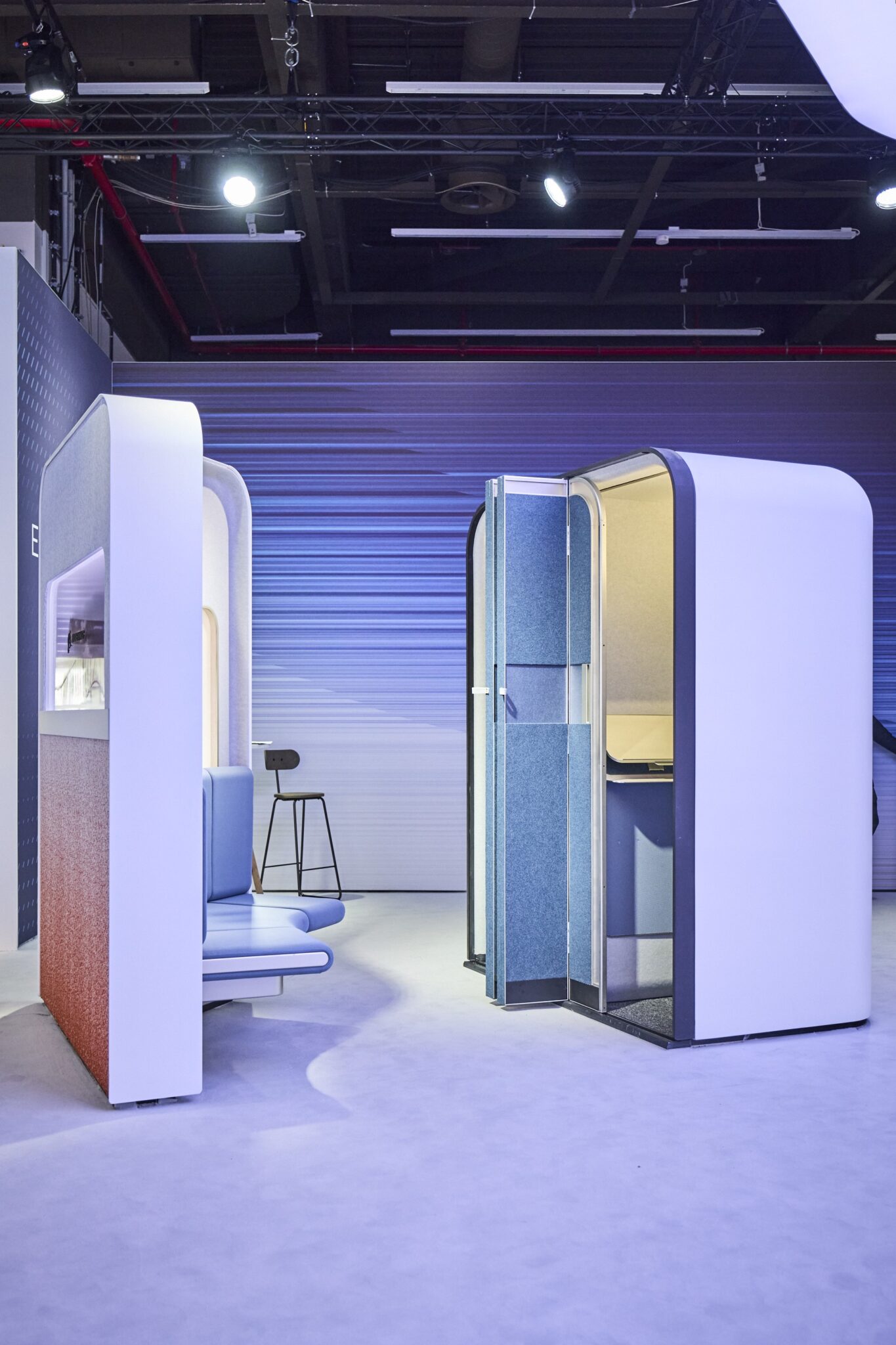
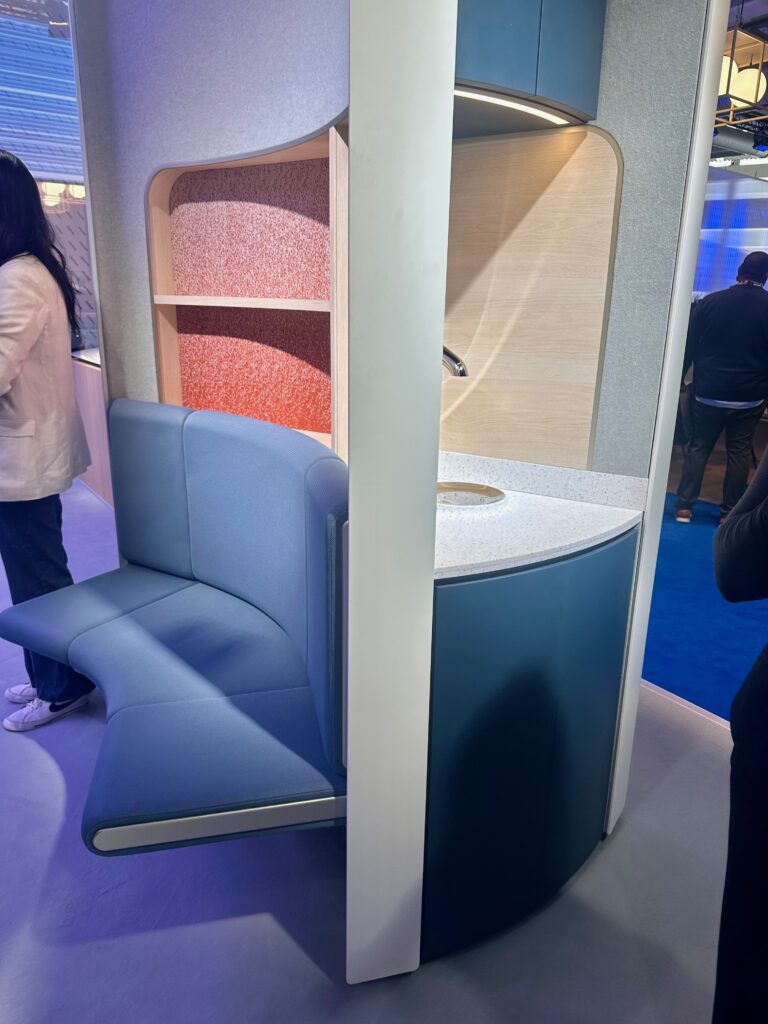
During the Aircraft Interiors Expo in Hamburg, the US airframer’s EnCore interiors subsidiary showcased a variety of ideas for “third spaces” on widebody aircraft, including an E-Lounge concept that features booths with sound dampening material to accommodate working passengers and their video conference calls; as well as those who want to engage in interactive gaming or even just have some personal time.
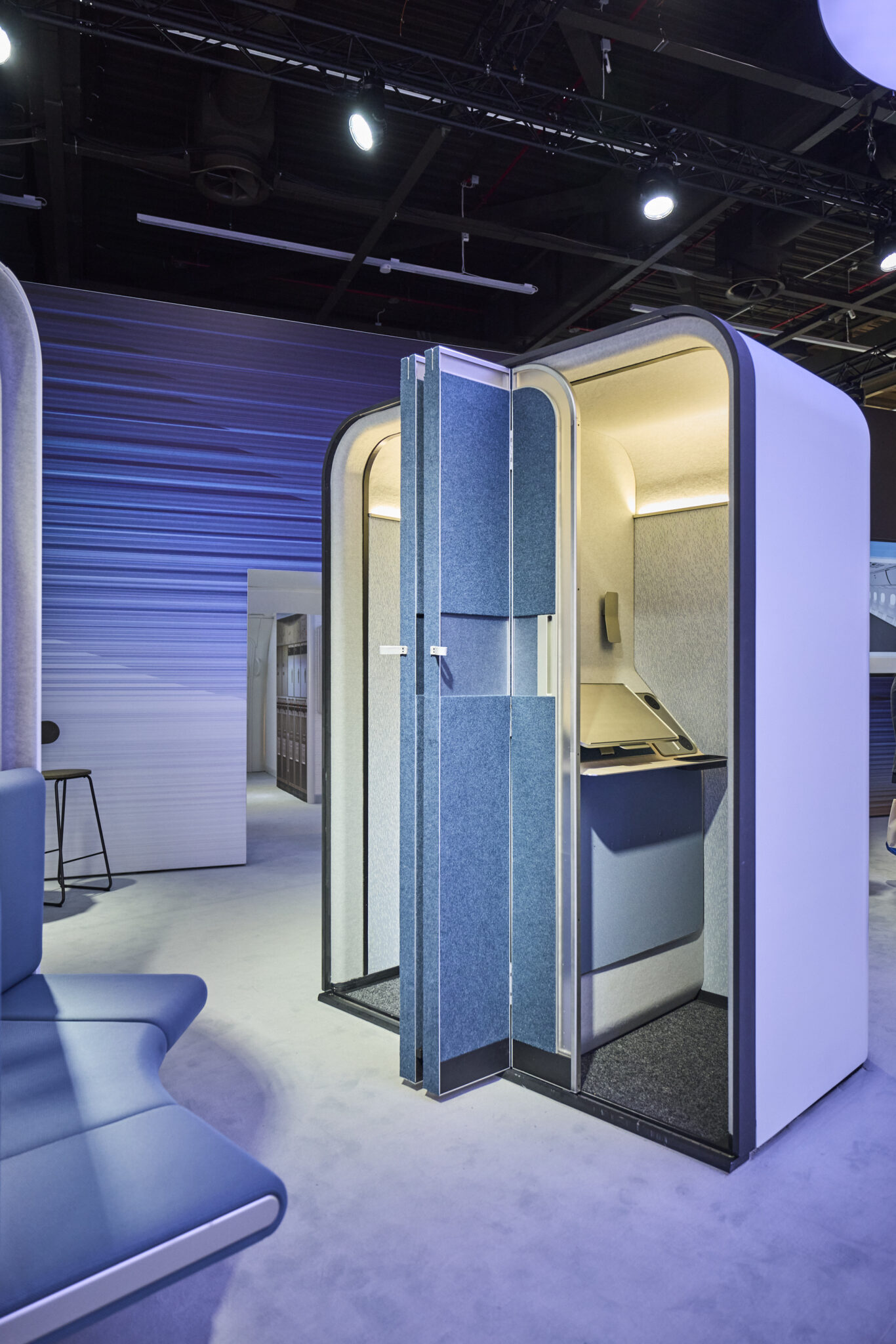
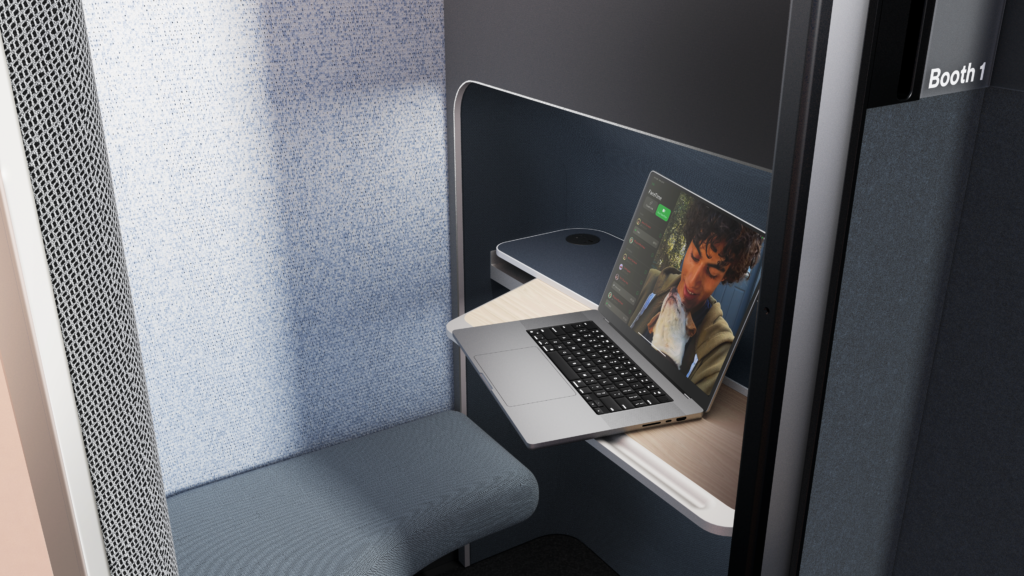
“You have this moment where suddenly high-speed connectivity comes into the aircraft, and yet your opportunity to use it, maybe in the way you’d like to, is restricted because it’s very hard — particularly in the economy class cabin — to sit beside a fellow passenger and be on a Teams meeting, or speaking to a loved one,” EnCore chief designer, cabin and interiors Tom Eaton explained to Runway Girl Network.
“And then we actually see people going to the lavatory too…it’s the only place you can actually be in privacy. So, what we need is something as simple as an old-school phone booth. And so we designed it with that in mind, just a simple place where people can go… It’s not a high-technology solution. It’s actually a very low-technology solution. It’s like a closet. We’ve got two booths here, and it takes up the same space as four economy class seats, ” Eaton said of the E-Lounge Door 2-area monument complex.
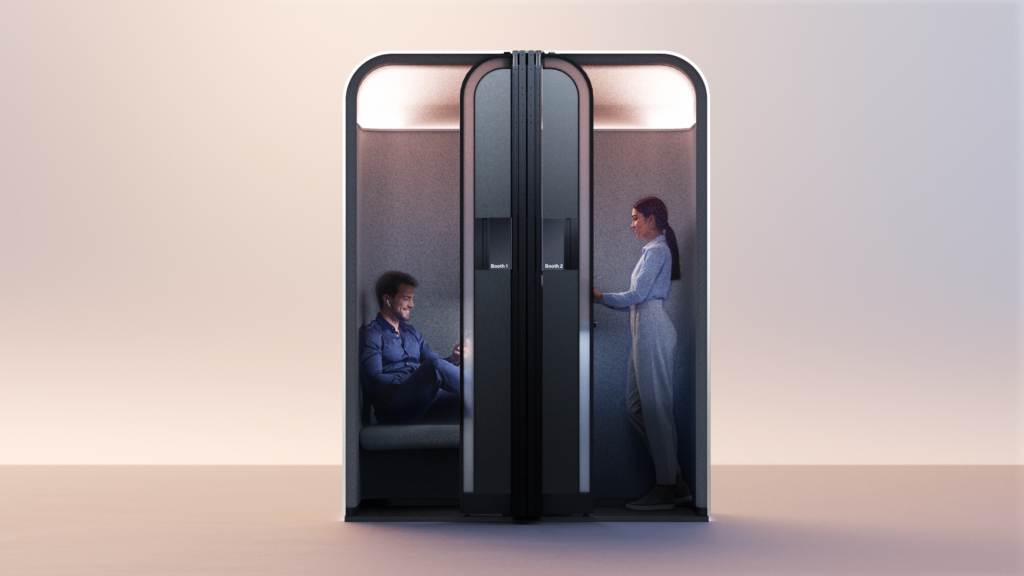
Airlines have flexibility in how they position the space. E-Lounge could simply be a new feature that enhances their brand and the general passenger experience or it could drive ancillary revenue by enabling airlines to rent a booth for, say, 20-minute or half-hour sessions, thereby offsetting the cost of using cabin real estate that would otherwise be utilized for revenue-generating seats.
“We believe you can certainly offset the cost of those four economy class seats,” Eaton suggested, while noting that airlines lately have been talking to Boeing about how to create more “experiential” and “hero moments” inside the aircraft — extended moments “that actually bring real value.”
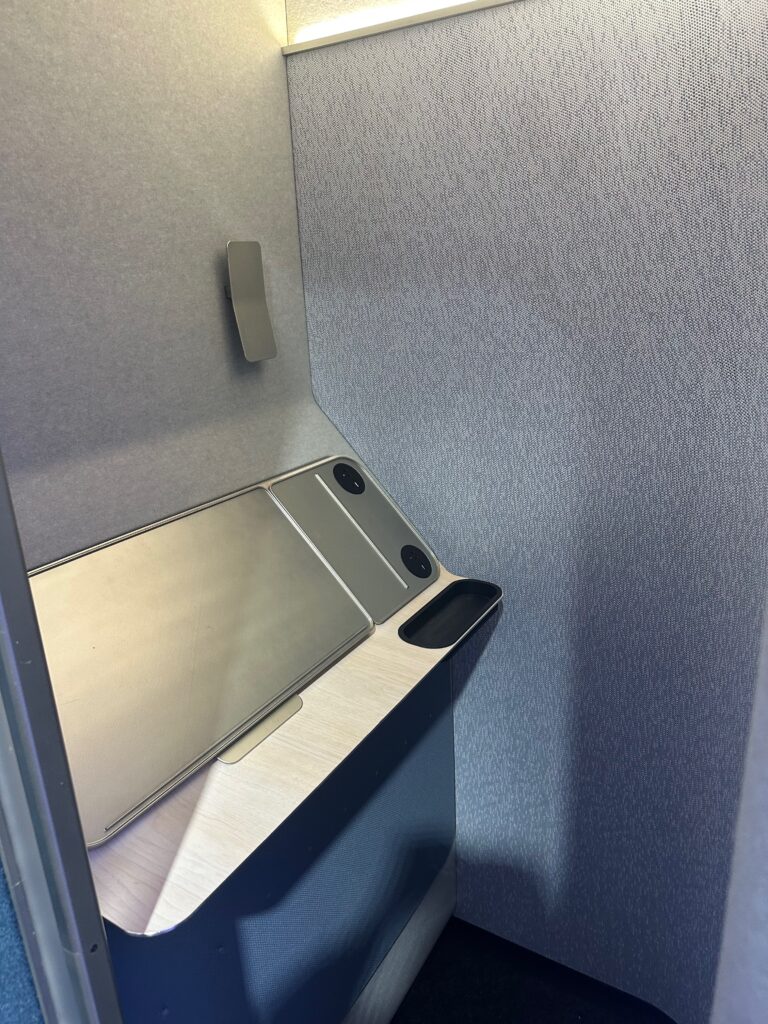
At a time when passengers are increasingly focused on their health and well-being, the ability to have a moment of relief from a confined seat, and to move elsewhere in the cabin for a “change of scenery” also holds appeal, the EnCore executive said.
That’s why engineers added a cushioned bench option as part of the E-Lounge concept, which in turn also creates a more social atmosphere.
A quiet call could ostensibly be taken whilst seated on the bench, as the passenger can still create privacy by turning their body away to take the call, Eaton added. “There’s many varying levels of privacy that can be experienced in this complex of monuments.”
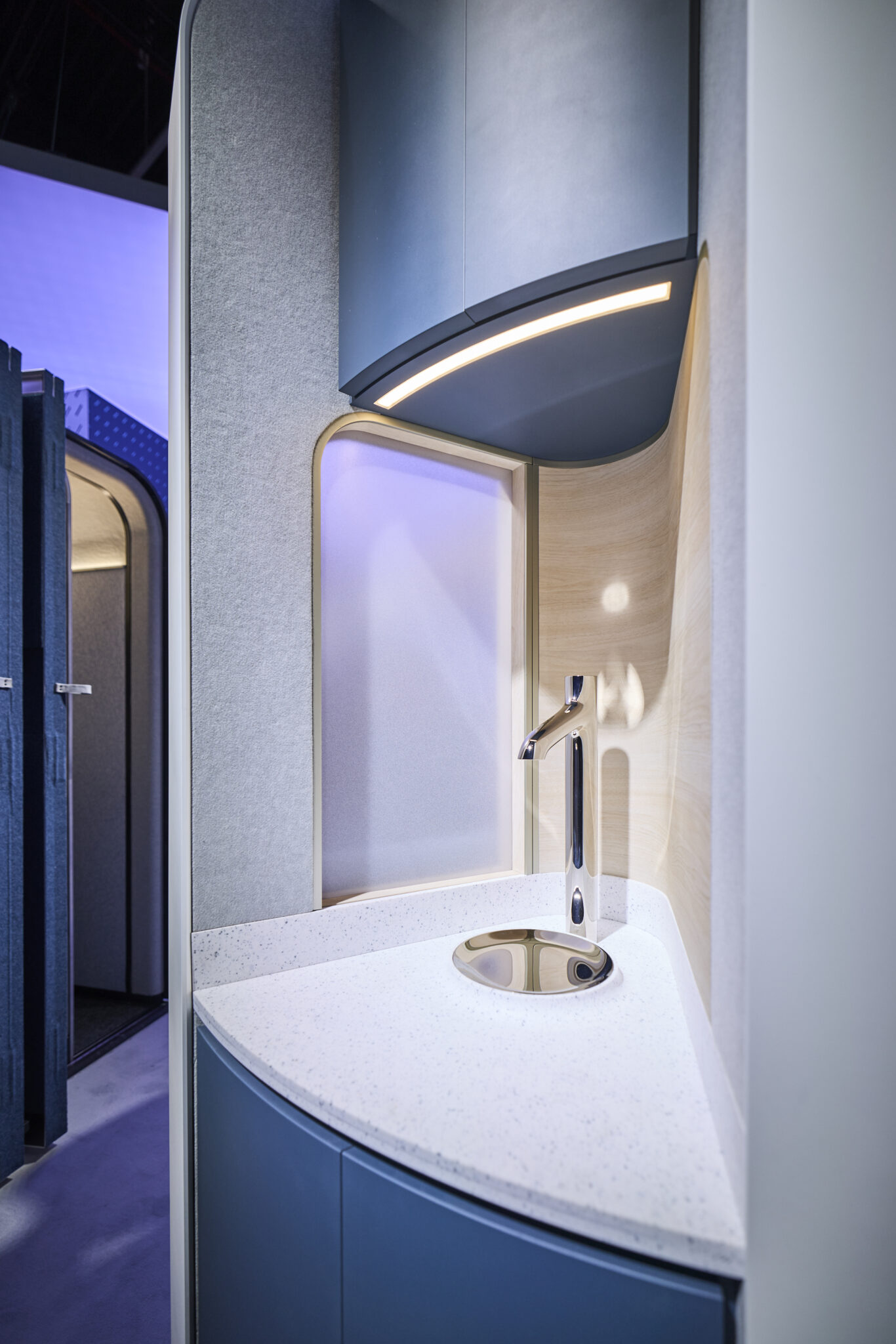
As part of its exploration into “third spaces” and indeed its wider work to drive sustainability in the cabin, Boeing also sees an opportunity to enable passengers to fill up their water bottles at a dedicated potable water station, utilizing a solution from International Water Guard.
Another simple, yet powerful idea is to offer a non-digital branding panel which uses a series of acrylic sheets to create 3D pieces of artwork that can evoke joy, calm or personality in the cabin. This solution could be particularly appealing to those Tier One airlines that want to embed their cultural identity inside the aircraft.
“So, what we’re trying to do here is to really inspire the airlines to think differently about how they might want to express their brands as a piece of artwork,” Eaton explained.
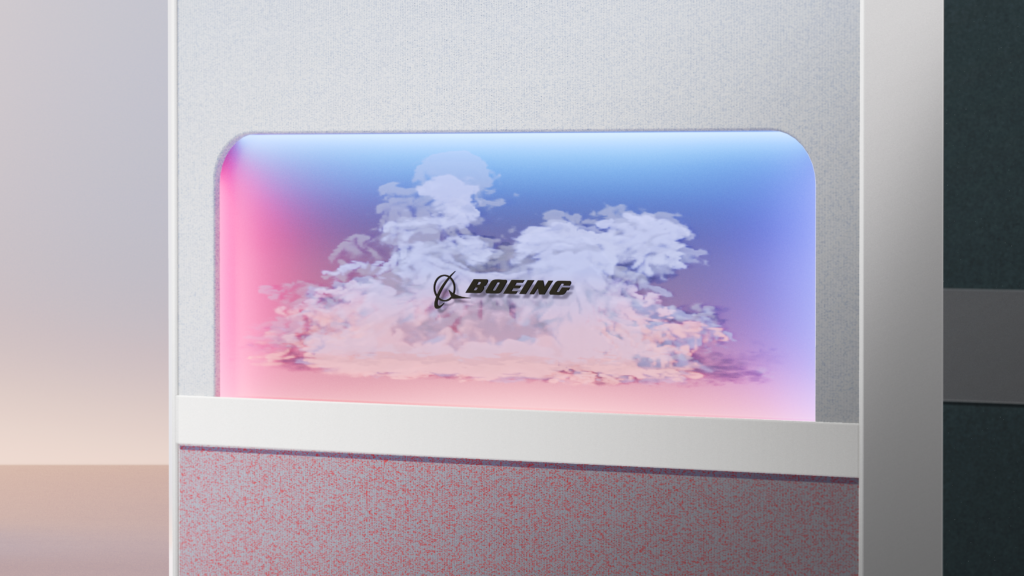
Leaving Boeing’s stand at AIX in Hamburg, I was struck by the dichotomy of where we’re headed in the future. On the one hand, inflight entertainment screens are getting larger (much larger and very immersive in some instances) and next-gen NGSO and hybrid NGSO/GEO IFC is enabling passengers to be better connected than ever before.
But the more digital we become, the more some of us crave the ability to digitally detox, if even briefly.
It is notable that E-Lounge is an antithetical idea to the screen-heavy Boeing Perch concept showcased two years ago at AIX 2024.

Boeing and its EnCore unit are very much in the exploratory phase with E-Lounge. “We feel this is a concept to probe, to provoke, and the airlines to respond to us because this is not meant to be a [definitive] solution,” Eaton told RGN.
In short, not only is the space versatile, but Boeing and EnCore are staying flexible in their approach.
It is perhaps not out of the realm of possibility that a modified version of the phone booth could be considered for narrowbody aircraft as well, if airlines expressed strong interest.
Broadly, E-Lounge touches upon “different emotional moments, and some airlines might want to have smaller spaces, some might want to have larger ones,” Eaton said. “Some [might go] lower cost, others maybe more ornate. So it’s a moment for us just to ask them, what resonates, what meets their needs.”
 Related Articles:
- Boeing works to bring more sustainable materials on board
- Lufthansa installs Starlink on A320neo for August 19 debut
- Air Canada delivers virtually flawless Wi-Fi experience on E175
- Diehl on why its nose-to-tail content doesn’t include seats
- Boeing stays flexible to support ESA installs for next-gen IFC
- Airbus enters development phase for ultra-luxe First Class Experience
- RAVE sets the scene for deeply immersive inflight experiences
- Panasonic Avionics sees Astrova Curve debuting in first class
- Boeing Perch welcome space asks big questions about big OLED screens
- How Boeing Commercial Services is supporting Starlink installs on 787s
All images, except for the third and eighth embedded photos, are courtesy of Boeing/credit https://koljaschmidt.com/