



Skyband Systems, a Kirkland, Washington-based start-up founded by former Starlink Aviation engineers and executives, has developed a nimble aviation-grade solution to address a rising threat in industry: the jamming and spoofing of global navigation satellite systems (GNSS) on aircraft.
Lightweight, compact, and easy to install, Skyband’s M100-branded line replacement unit (LRU) fuses independent onboard inertial sensing with Iridium’s new positioning, navigation and timing (PNT) ASIC chip — whose secure signal is 1,000 times more powerful than GNSS systems like traditional GPS — to alert flight crews to jamming and spoofing events via their tablet-based electronic flight bag (EFB).
The resilient system does not replace GPS. Rather, it augments GPS with a dissimilar, reinforcing PNT layer that helps aircraft verify GPS and respond to failure modes, whether large-scale jamming or harder-to-detect spoofing events, enabling pilots to fly with confidence when GPS is contested.
Carried in an aircraft’s E&E bay, the physical M100 unit does not need to integrate into the flight deck avionics (it has an LED-enunciated power switch in the cockpit.)
Consequently, it has “a much faster path to supplemental type certification (STC), a faster path to installation and doesn’t require fuselage changes,” Skyband co-founder and president Robert Wiggenhorn told Runway Girl Network during an extensive interview.
The system is paired with Skyband’s own EFB application and has the ability to integrate with third-party apps like Jeppesen’s FliteDeck Pro, and ForeFlight.
“We think that that actually is going to be the way that we can deliver the most amount of capability in the fastest amount of time because we don’t have to go deal with integrating into the flight deck,” said Wiggenhorn, who designed the app, and together with CEO William Seidel co-founded Skyband on January 1, 2026 with the explicit purpose of solving the GPS jamming and spoofing problem.
The app shows pilots exactly where they are flying based on all the navigation data within the M100, and provides timely alerts, situational awareness (including terrain awareness), and advisory guidance when navigation confidence is affected. Weekly test flights have validated the app’s performance.
While every M100 features a high-quality inertial measurement unit, Skyband is not meant to be a drop-in replacement for certified primary navigation on aircraft, such as the systems offered by Honeywell Aerospace and other OEMs.
Ensuring that M100 is in no way dependent on GPS, even for clock-timing, was crucial. “Our box has its own IMU so that it can’t be poisoned or corrupted with anything else happening to GPS on the aircraft. And the timing for our product is all based on timing measurements that we get from Iridium,” Wiggenhorn explained.
“So we don’t need GPS anywhere in the loop for our box to function independently, and that’s what’s going to allow it to be that trusted third-party validator of [whether] GPS is working or not on the aircraft.”
With tens of thousands of aircraft in the world fleet already equipped with an Iridium antenna to support cockpit communications and safety services, it’s notable for operators that Skyband is capable of using whatever Iridium antenna is already installed.
“Many aircraft have quad- or double-port antennas, and we’re agnostic; we just need to plug into any existing Iridium antenna TSO’d on the vehicle,” explained Seidel, who previously spent 13 years at SpaceX, where he led Starlink Aviation from its first customer installation to over $1 billion in annual revenue, with certifications across commercial and business jet types. He is also a pilot.
“The goal would be no penetrations on the vehicle that are new, which really makes things a lot easier for the user, and it makes the STC path [for M100] simpler. You know, putting a large antenna on a vehicle is difficult. We’re testing to make sure we covered ground for any kind of potential interference. We haven’t seen any problems yet, and I know people have done non-aviation installs using transmit, regular Iridium, and PNT next to each other without problems. But we want to make sure that we fully understand everything ourselves, so we’re independently verifying that ourselves,” the Skyband CEO said.

Skyband co-founder and CEO William Seidel holds up a 3D-printed version of M100 during a Teams call with RGN. The production unit is being machined now.
The firm will first seek to obtain STC for M100 on the Embraer Praetor 600 business jet, with its sisters, the Praetor 500, Legacy 500, and Legacy 450 also naturally in focus.
“We have the aircraft identified that we hope to go into the prototype install in about two months,” Seidel revealed. STCs for other bizjets and commercial aircraft will be sought based on customer demand.

For this first STC, Skyband is only certifying M100 as supplementary situational awareness. The LRU will specifically stream the location and the enunciation of GPS issues to the EFB app.”The only flight deck integration we have to start is basically when you have an issue, the light on your power switch for Skyband M100 will enunciate ‘GPS issue,’ and then you can pull up your app.”
Because M100 uses standard Internet TCP/IP-type protocols, it is able to plug into the aircraft’s existing network for telemetry, software updates and connectivity to the EFB.
Skyband is already working with one ODA, Mukilteo, Washington-based AeroMech, which will be functioning as a reseller. “We’re happy to work with other MROs as resellers and dealers, and we’re also open to conversations with any OEM, which we’ve been kicking off for the past few months,” Seidel revealed. “We’re trying to be maximally collaborative in our commercial efforts.”
In short, the firm wants to get the product to market as quickly as possible to address the GPS jamming and spoofing threat.
Noted Seidel:
Our basic corporate philosophy is one of high collaboration and high openness. So we are very happy to work pretty much with anyone. This is a real safety problem. Our core mission is really to solve this.
Boasting a global network of L-band LEO satellites and uniquely valuable mobile satellite service (MSS) spectrum rights, Iridium started offering secure, Rx-only PNT service in various verticals after acquiring Satelles, a deep-tech specialist in PNT, in April 2024.
Last month, the LEO satellite operator, which is being acquired by Rocket Lab, made its PNT ASIC chip commercially available, including in business and commercial aviation where it named Skyband as a value-added reseller.
With its VAR status, Skyband can “manufacture hardware, resell their parts as part of our hardware, and we resell the service as well,” Seidel said.
Iridium is “a legendary provider for critical FAA-certified hardware, and with their global availability, it actually seemed kind of amazing that this [PNT] service was coming out,” he said. “The timing was incredibly good for us.”
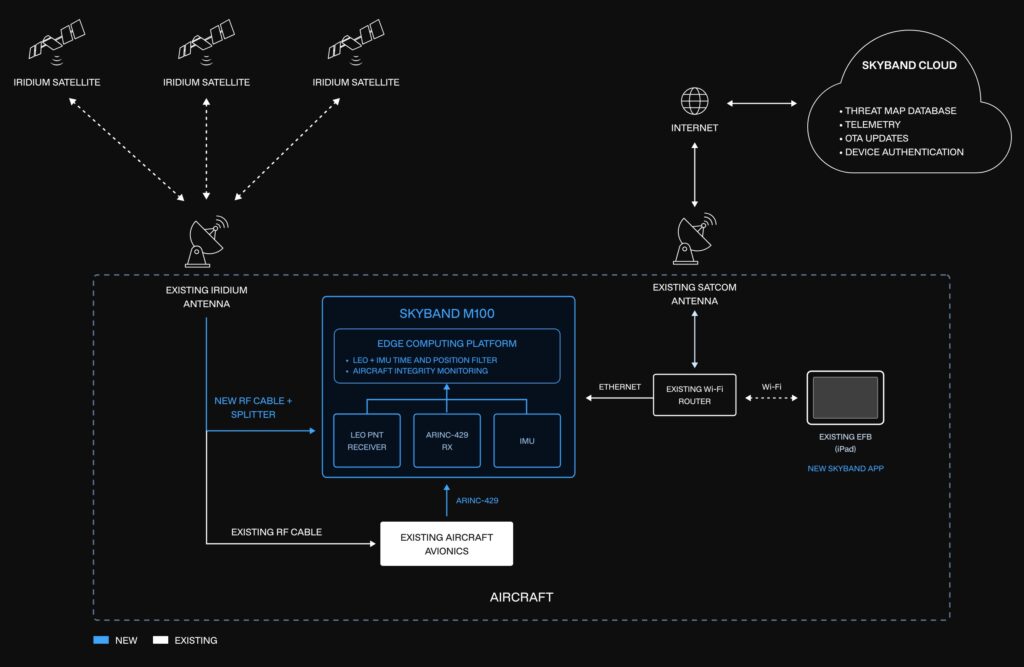
M100 features an ARINC 429 Tx/Rx module. As certified out of the gate, it will be receive-only, read-only from the aircraft. But, together with Skyband’s software, it can offer expanded functionality, should a prospective avionics partner be interested in certifying it as a nav source.
Related Articles:
- EASA updates GNSS jamming and spoofing guidance, citing spike
- Rocket Lab CEO vows commitment to aero as firm buys Iridium
- Tiny Iridium PNT ASIC could arrive in aero as carry-on equipment
- IRIS² laser links will benefit PaxEx but you likely won’t notice
- Flightradar24, Aireon partnership sees ADS-B data streams combined
- GPS jamming in aviation underscores industry need for Iridium STL
- EASA warns of GPS jamming around conflict zone
All images credited to Skyband. Featured image shows Skyband’s GPS threat map, which is based on public ADS-B data.