

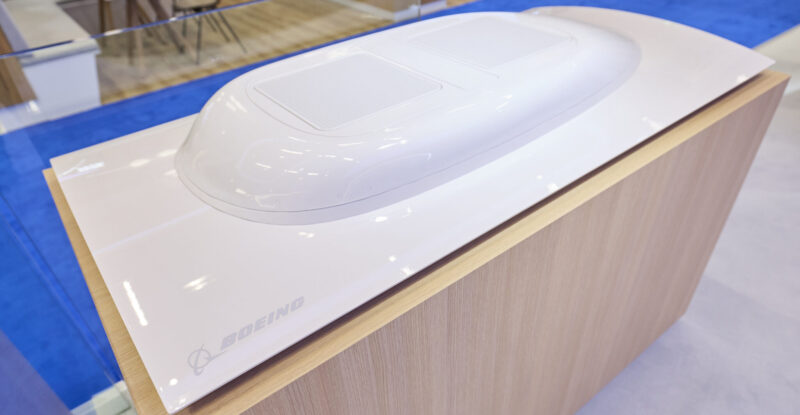

As non-geostationary satellite services disrupt the inflight connectivity sector, Boeing is providing the necessary specs to enable airlines to retrofit their Boeing twinjets with next-gen IFC. The US airframer also confirms to Runway Girl Network that it’s in talks to expand its linefit buyer furnished equipment (BFE) catalog to meet the evolving IFC needs of its airline customers.
“We’re currently supporting the Starlink antenna and the Stellar Blu antenna” with the Boeing Aerodynamic Shroud — the new fairing that’s designed to accommodate the next generation of electronically steered phased array antennas, Boeing marketing director Steve Jaffe told RGN whilst standing beside a 50% scale model of the Shroud at this year’s Aircraft Interiors Expo (AIX) in Hamburg.
The Shroud enables up to two electronically steerable antennas (ESAs) to be efficiently integrated with Boeing commercial aircraft, firstly via aircraft retrofits but in time via linefit.
Whereas Starlink is LEO-based and features two ESAs on Boeing aircraft, the multi-orbit Stellar Blu ‘Sidewinder’ ESA from Gilat Satellite Networks supports SES or Panasonic Avionics’ respective LEO/GEO IFC offerings, with the LEO portion powered by Eutelsat OneWeb in both instances.
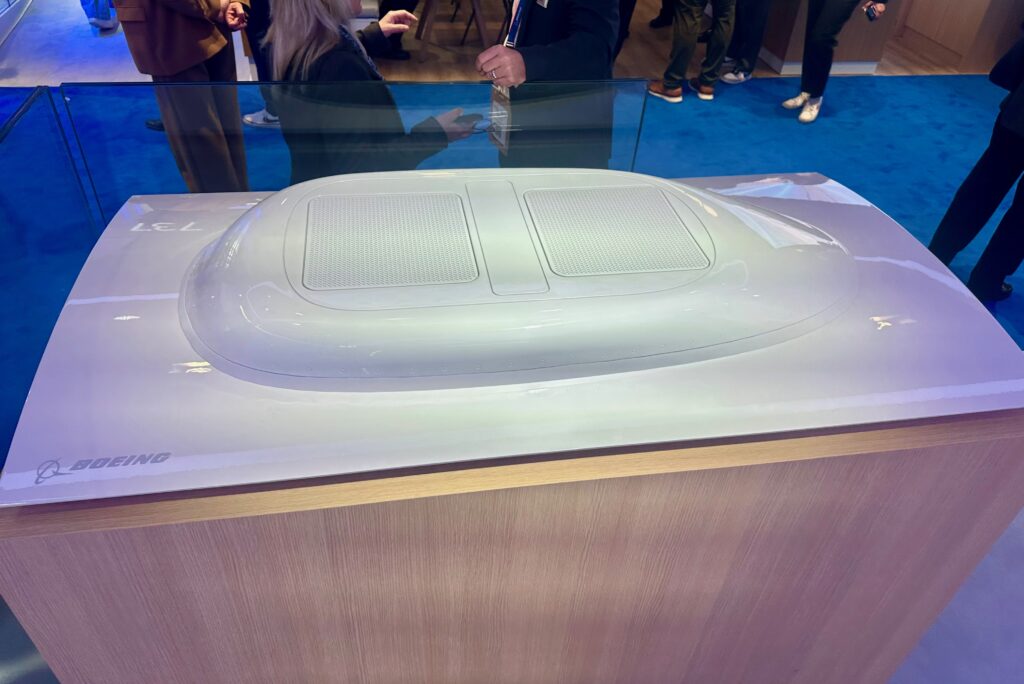
A 50% scale model of the Boeing Aerodynamic with Starlink was on display at Boeing’s stand at AIX. The Shroud can currently accommodate Starlink or Gilat Sidewinder ESAs, but Boeing is looking to support other ESAs in time. Image: Mary Kirby
Retrofit now, factory-fit soon
The Boeing Aerodynamic Shroud first broke cover early this year on Qatar Airways’ Boeing 787s, followed by 787s operated by ZIPAIR and British Airways — all Starlink customers.
Boeing Commercial Services provided the Service Bulletin, but Boeing is staying flexible when it comes to the actual touch-labor modification. Airlines can use their MRO of choice, Jaffe confirmed to RGN. Boeing is also happy to accommodate installs at its Victorville, California or Shanghai, China MRO facilities, he said.
As to when the US airframer will factory-fit the Shroud and ESAs to Boeing production aircraft, Jaffe said the linefit in-service dates are evolving but that “we’ll be rolling out in sequence as they’re developed.”
In the interim, Boeing is reaching unique agreements to support its customers. For example, a new pact between Boeing and SES allows airlines to take delivery of new aircraft with SES’s in-cabin network hardware in place, initially on 737s followed by 787s.
SES director of program management Rob Baird explained to RGN at AIX that the in-cabin network “can be selected and installed but then Boeing will provide the technical STC solution to install the outside equipment. So, the airline can buy a complete solution from Boeing, but the outside equipment, if the aircraft are in 2027, would be installed by Boeing after transfer title. Or an airline can say, ‘hey look, we want to do our own mods anyway, so we’ll install the antenna’ or ‘hey, you know what, we want you, Boeing, to do it for us,’ and Boeing is being flexible and offering both selections.”
In the 2028 timeframe, the outside equipment installation will move to the pre-transfer title stage as opposed to post-transfer, Baird said. “And at the end of the day, the airline flies home with a fully connected aircraft either way.”
Japan Airlines has selected SES’s multi-orbit IFC solution for linefit installation on new 737-8s and new 787-9s, and will retrofit existing 787-9s with the kit. Some of the 737s are expected to see a split install, with the in-cabin network fitted at the factory and the outside equipment fitted post-delivery, in 2027, but the objective is “with JAL and with Boeing, to get everything back into the full production,” Baird said.
During Gilat’s first quarter 2026 earnings conference call on 13 May, management provided color about the firm’s work packages, revealing that it expects to start delivering ESAs to the Boeing linefit program in the fourth quarter of this year.

Boeing has long supported Ku- and Ka-band GEO satellite-based IFC solutions, including its own long-ago Connexion by Boeing offering. But while the airframer still sees a market for traditional gimbaled antenna hardware, “the industry has spoken in that there’s a tremendous amount of excitement toward the ESA and that does represent the future,” Jaffe told RGN.
For example, even though Viasat uses a gimbaled antenna terminal, and delivery of aircraft with the GM-40-branded kit continue at Boeing, the airframer is now evaluating Viasat’s AERA multi-beam ESA for possible inclusion in its BFE catalog.
Meanwhile, as new Low Earth Orbit (LEO) and Medium Earth Orbit satellite constellations are set to emerge in the not-too-distant future, Boeing is in discussions with suppliers “to accommodate their antennas. So, our goal is to continually expand the array of suppliers and integrators for our customers,” Jaffe said.
Related Articles:
- Amazon Leo ESA, ThinKom Nexus and new Starlink kit break cover
- SES advances work on multi-band ESA for meoSphere + LEO IFC
- Viasat readies for new AERA with ViaSat-3, multi-beam ESA
- Gilat confident on entering Airbus catalog
- How Airbus is working to facilitate Delta Air Lines’ IFC vision
- Qatar Airways becomes first in the world to bring Starlink to 787s
- How Boeing Commercial Services is supporting Starlink installs on 787s
Featured image credited to Boeing