
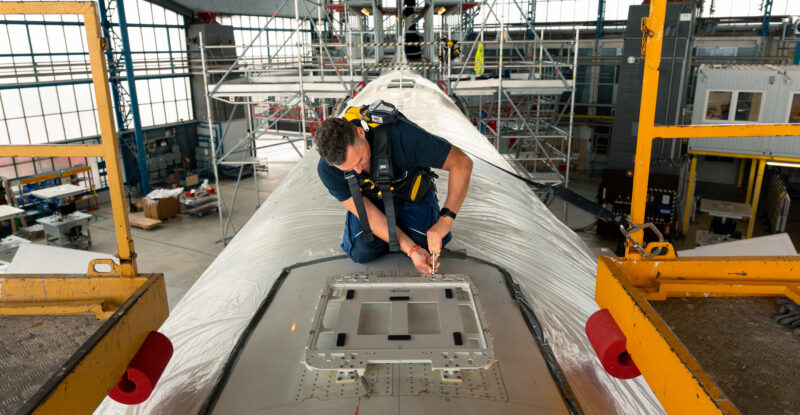

Lufthansa Group has started fitting its fleet with SpaceX’s Starlink Ku-band Low Earth Orbit (LEO) satellite-supported inflight connectivity, and a Lufthansa-operated Airbus A320neo is first in line for the service.
Sharing images of the installation process across its public relations and social media channels, Lufthansa Group says the Starlink-equipped A320neo (D-AINM) will go live with the service on August 19.
The broadband connectivity service will be available free-of-charge to all Miles & More status members and Travel ID users.
“Enjoy fast, stable Internet thanks to Starlink technology — free of charge and available in every travel class. Watch your favorite shows, stay in touch with your friends and family, or collaborate on documents in real time. With a connection that stays with you seamlessly from gate to destination,” beckons Lufthansa Group.
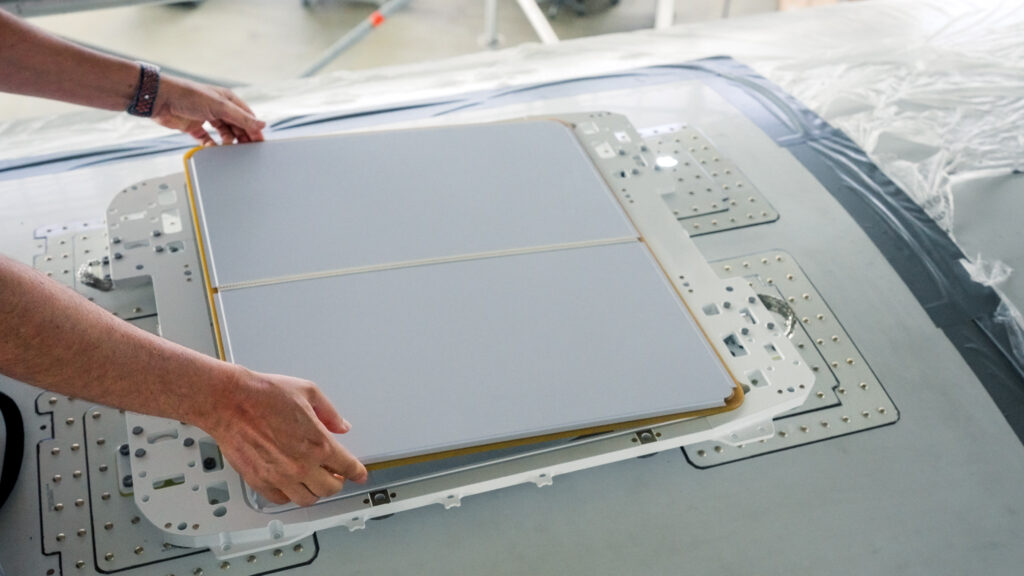
Starlink uses phased array antennas and favors a two-antenna install atop the fuselage of large aircraft like the Lufthansa A320neo.
Before getting online, however, passengers will have to agree to some ‘terms of use,’ which were developed based on passenger surveys and reflect the wishes of most Lufthansa Group customers.
Among other things, passengers are required to always wear headphones when playing audio and video content, to refrain from making voice and video calls, and not to broadcast live streams from aboard the aircraft.
Lufthansa Group also assures that the service will be “operated in compliance with all applicable data protection laws and regulations governing the protection of personal data.”
Following the debut of Starlink-powered Wi-Fi on the Lufthansa A320neo, the IFC solution will gradually roll out across the whole fleet of member carriers: Lufthansa, SWISS, Austrian Airlines, Brussels Airlines, ITA Airways, Edelweiss, Discover Airlines, Air Dolomiti, Lufthansa City Airlines and Eurowings.
By 2029, the service is expected to be available on all 850 aircraft in the Lufthansa Group, which will make it the largest airline group in Europe to introduce the technology fleet-wide.
“Connectivity isn’t an add-on. It’s part of the premium travel experience,” Lufthansa Group declares.

Lufthansa Group in January announced its pivot to Starlink, in a blow to stalwart IFC providers Panasonic Avionics and Viasat-previously-Inmarsat, which have long provided geostationary (GEO) satellite-based IFC on the group’s widebodies and narrowbodies, respectively. Discover Airlines had also tapped Panasonic’s multi-orbit LEO/GEO service for its A330s.
The hybrid air-to-ground/S-band satellite-powered European Aviation Network, which is run by Viasat and Deutsche Telekom, was also affected by the move, as EAN hardware was in the process of being installed on Airbus narrowbodies flown by Austrian, Lufthansa, and SWISS.
“The existing technology, including EAN will continue to be used on the respective aircraft until Starlink is implemented and will remain available to our guests until then,” a Lufthansa Group spokesman told RGN at the time.
 Related Articles:
- Air Canada delivers virtually flawless Wi-Fi experience on E175
- When Starlink on airBaltic A220 is highlight of Air Serbia A320 PaxEx
- Viasat sees runway for EAN in EC’s 2 GHz MSS decision
- Lufthansa Group to retain current IFC until Starlink pivot is complete
- Now critical IFC needs resiliency, security: Eutelsat’s Bisgaard
All images credited to Lufthansa Group