


German software firm Axinom, which has teamed up with cabin display specialist Rosen Aviation to bring a cloud-based, wireless Low Earth Orbit satellite-connected seatback platform to aviation, is testing the system over both Eutelsat’s OneWeb and SpaceX’s Starlink LEO satellite networks. And Rosen has entered dialog with “several leading seat manufacturers” about integrating screens into aircraft seats.
This fall, the two partners divulged details about their so-called Connected Seatback Platform, explaining how the advent of low-latency LEO connectivity and advances in edge caching would enable each display to serve as an edge node on an airline’s own cloud, in turn enabling a host of new use cases and giving operators control over the experience. The lightweight, wireless architecture differs from embedded inflight entertainment systems that utilize a head-end server and data wiring.
Now, as Axinom and Rosen prepare to attend the APEX FTE EXPO in Singapore, they are sharing behind-the-scenes details about their work, the next steps for integrating the system with aircraft seats, and the opportunities they’re seeing in the market.
Testing on the ground over OneWeb and Starlink
“We test on the ground in our own network lab, which we have run since we started building cloud-powered solutions for LEO-connected aircraft. Its test suites reproduce the network conditions an aircraft sees in flight, from full bandwidth to weak signal and changing link,” explains Stefanie Schuster, chief commercial officer at Axinom.
She continues,
[The test suites] also simulate a full cabin, with dozens of devices competing for the Wi-Fi at the same time, and different connectivity configurations, testing the satellite link and the cabin network both separately and together.
We are evaluating the platform over both LEO networks, Starlink and Eutelsat OneWeb. Beyond the lab, we bring real operational experience. Our LEO-powered solutions fly on almost 700 aircraft and counting, where airlines rely on them every day under agreed service levels.
LEO, quite specifically, is unlocking the platform’s true potential, she confirms to RGN, as it “delivers the low latency and high bandwidth the platform needs to connect the seatback to the airline’s cloud services in real time, from loyalty and payments to retail and entertainment, and to update its applications over the air.”
Optimizing bandwidth and navigating gaps
Taking a direct approach to the aviation market, SpaceX has shown signs of being flexible when it comes to Starlink use cases. For example, a few airlines plan to charge for Starlink Wi-Fi, and some are using portals.
Eutelsat OneWeb, meanwhile, supports a B2B model, and powers a variety of OneWeb LEO-only and hybrid solutions in the market, including SES and Panasonic Avionics’ respective multi-orbit LEO/GEO offerings, Hughes Network Systems’ multi-orbit, multi-band system, Gogo’s Galileo LEO in business aviation, and Immfly’s forthcoming LEO IFC for budget operators.
In terms of IFC provider opt-in, Schuster confides to RGN that Axinom and Rosen are in dialog with all parties in the ecosystem.
“The Connected Seatback Platform makes full use of what LEO connectivity can deliver and turns the connection into a core part of the passenger experience, not an add-on. That makes it an interesting use case for LEO providers. In our experience, they want their connectivity used to its full extent and passengers to enjoy the best possible quality of experience (QoE) on it, and that is exactly what the platform is built for,” she says.
Regardless of the LEO service utilized, it will be essential to optimize bandwidth usage and help the connectivity service navigate gaps. That’s why edge caching is also a core part of the Connected Seatback Platform, wherein content and data are cached locally on every seatback screen.
“Edge caching runs autonomously on the screens filling the cache continuously while the aircraft is connected to the cloud, not in a scheduled pre-load cycle. Content that passengers stream is kept on board, and the ground pre-positions titles it expects to be in demand, for example on a given route or in a given season,” Schuster explains.
“Beyond content, the seatback also caches what its services need. If the connection drops, the seatback switches to a fallback mode and runs on what is cached on board, so the experience stays seamless for passengers.”
Connected Seatback Platform: the passenger experience
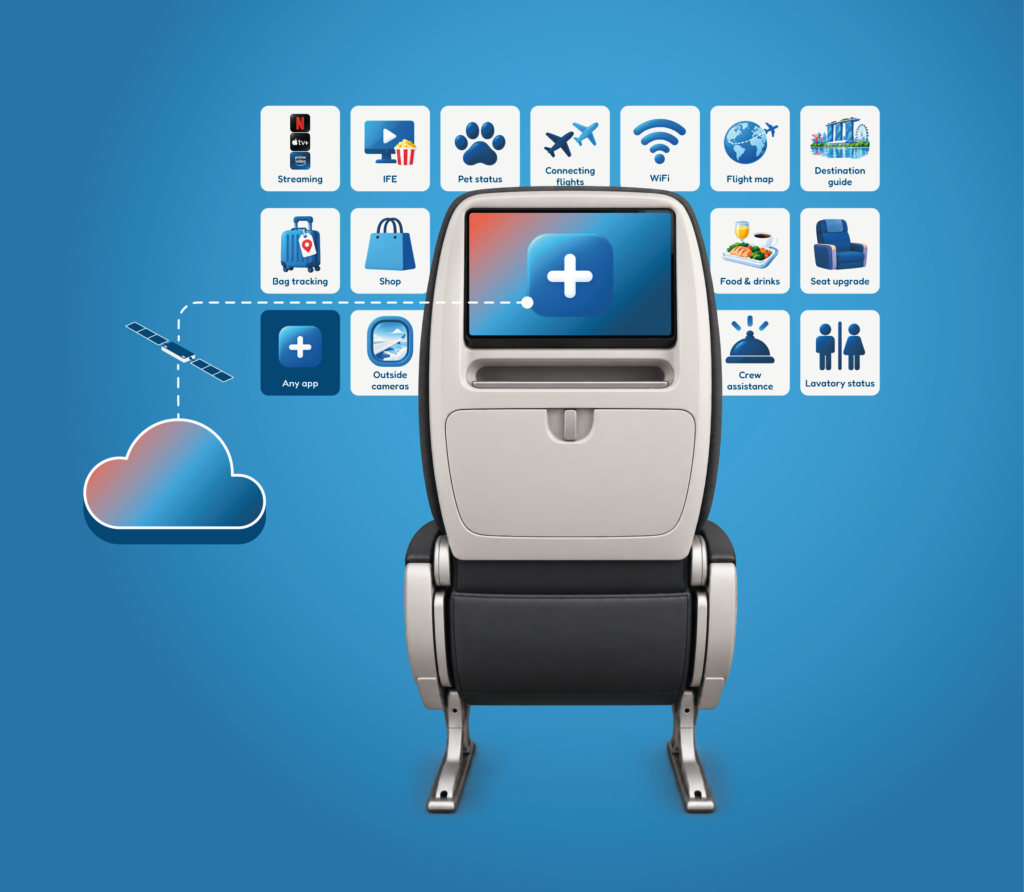
Once the passenger pairs their own device over the cloud with the seat, the screen loads their profile — including loyalty tier, preferences, watch history, past purchases and the context of the flight they are on — from the cloud over its own connection.
Importantly, the system can support virtually any use case and application the airline chooses — as defined by the partnerships and licensing agreements forged.
The app selection is really only limited by one’s imagination; think about everything from streaming, gaming, destination guides, and shopping to bag tracking, seat upgrades, and pet status updates. And, as the airline seeks to further hone the experience, the seatback evolves at their pace and according to their vision, delivering all the key data to their systems.
The airline is also then free to decide how it offers connectivity to passengers’ own devices, whether as a complementary service, a loyalty amenity or via paid or sponsored tiers.
Axinom and Rosen Aviation anticipate that the Connected Seatback Platform will resonate most with airlines that consider software to be the key differentiator for the passenger experience of the future. And they reckon they can crack into the major operators, as well as airlines that are brand new to seatback IFE.
Opportunities in the market
“For operators that have never offered a seatback screen, the platform lowers the barrier. The screens are wireless and need no IFE head-end server and no data wiring to the seat, and content and applications arrive over the air. That makes a seatback realistic for fleets where it never added up before,” Schuster says.
“For the majors, the case is a different one. Many of them already run a large set of cloud services on the ground, from loyalty and payments to retail, and LEO connectivity now brings those services to the seat. With the Connected Seatback Platform, the airline owns the screen and decides what runs on it, instead of depending on one vendor’s closed system.”
Sim testing and HIC
Ahead of the Aircraft Interiors Expo 2027 in Hamburg, Rosen as the display provider is preparing U.S. Federal Aviation Administration simulation testing, followed by head impact criterion (HIC) testing.
“Our product teams are also designing the infrastructure for power to the seat right now. Because the screens are wireless, no data wiring to the screen is needed,” notes Rosen Aviation senior VP strategy, Lee Clark. And because Rosen can essentially customize the entire solution to meet a diverse array of customer requirements, he says it’s relatively easy to scale from one end of the aircraft to the other.
“Our current opportunities are mainly focused in economy seating, so that’s where our development efforts are currently focused,” reveals Clark, noting that talks are underway with major seatmakers.
“Beyond economy, we fully expect to bring the same passenger benefits offered by the Connected Seatback Platform to premium and first-class seats, as well. Which is not to mention the host of other new features and improvements we’re working closely with Axinom to develop, which can ultimately be introduced for the front of the aircraft in the next two to three years.”

Since introducing the Connected Seatback Platform concept to the market, Axinom and Rosen have fielded a “very encouraging” response, according to Schuster.
“We cannot share names at this stage, but our dialog with airlines is very fruitful. We are talking with product and technical teams that are ready to discuss how our solution enables their specific use cases. We look forward to continuing these conversations in Singapore and to starting new ones,” she says.
“Our message for APEX FTE EXPO is that we come to listen as much as to show. The Connected Seatback Platform is a seatback the airline owns and controls, so what it becomes is largely up to the airline. That is why we want to hear from airlines early: what they expect from the seatback once their aircraft are connected over LEO, which services they want to bring to it beyond entertainment, and what they would do with a platform that is entirely theirs and powered by their own cloud ecosystem. Those conversations shape how we take the platform forward on the way to its public showcase at Aircraft Interiors Expo 2027 in Hamburg.”
Related Articles:
- Fast-growing Astronics identifies memory board crunch
- Gogo Galileo enjoys rapid growth in business aviation
- Digital & Connectivity underpin Airbus Global Services Forecast
- Airbus, Boeing flag aircraft seat supply and certification constraints
- Air Astana equipping A321LRs with SES multi-orbit IFC
- Frontier starts fitting A320s with Geven Comoda First Class
- China coverage gap of note as Korean Air and Asiana offer Starlink
- Q&A: Axinom and Rosen Aviation talk Connected Seatback Platform
- How United is leveraging Starlink and the cloud to enhance IFE