


Expanding at an exponential rate, Digital & Connectivity services for commercial aircraft continue to represent the fastest-growing services market, according to Airbus. The European airframer expects demand in this segment to triple over the next two decades to $27 billion, representing a compound annual growth rate (CAGR) of 5.3% — as the world fleet swells to more than 45,500 aircraft by 2045.
While Digital & Connectivity is firstly a market in and of itself, “it’s also the oil that flows within the whole services market,” Airbus head of services marketing Arnaud Demeusois said during a media briefing to discuss the OEM’s annual Global Services Forecast (GSF), which also covers the mammoth Off-Wing Maintenance segment, a new cluster called Maintenance Operations Support, On-Wing Maintenance, Modifications & Upgrades, and Training.
Valued at $10 billion today, Digital & Connectivity will enjoy the highest CAGR amongst the six clusters over the next 20 years. It will serve as the foundation for transforming the whole services ecosystem, playing a crucial and evolving role in the growth of the overall market, which is expanding at a 3.8% CAGR despite fuel price hikes, geopolitical headwinds, and supply chain challenges, head of aftermarket strategy Amaya Rodriguez Gonzalez noted.
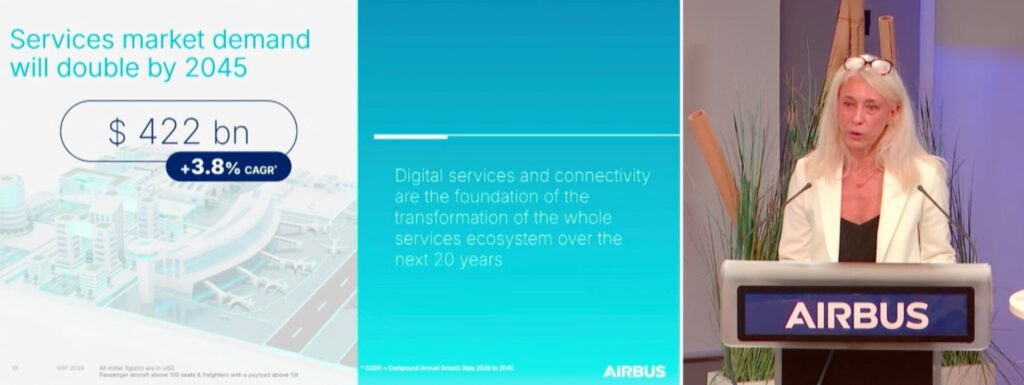
Airbus expects total demand for aviation services will double from 2026, reaching an estimated value of $422 billion by 2045.
The digitalization that Airbus is seeing and supporting across each market segment covered by the Global Services Forecast is, in fact, the rationale behind its creation of a new digital services subsidiary, Skywise.
Skywise: a subsidiary and a data platform
Formed in April, the unit merges Airbus’ Skywise-branded digital solutions — including Skywise Fleet Performance+ (S.FP+) for advanced predictive maintenance and fleet health monitoring; and Skywise Core, the ‘big data’ analytics platform developed in partnership with Palantir Technologies — with flight operations and air traffic management software from the airframer’s former subsidiary, Navblue.
“Skywise,” Demeusois explained, “is all about accompanying the customers with digital solutions across operations” — not just maintenance or flight operations in isolation. “We’re talking about what we call end-to-end solutions for the customers.”
Integrating inflight aircraft data in real time with maintenance systems on the ground requires onboard connectivity. Real-time messages from the aircraft can be ferried via ACARS, while real-time health monitoring data is transmitted via SATCOM, Airbus confirmed to Runway Girl Network. The inflight data is then combined with engineering and operational data in the analytics-rich environment that is Skywise Core, ensuring that operators can address challenges and save time.
What Airbus is accomplishing in the field of predictive maintenance, alone, is nothing short of “remarkable” compared to what was achieved just a few years ago, Demeusois said of the fundamental shift from reactive repairs to a proactive ecosystem. The airframer is developing algorithms to anticipate failures.
He revealed:
We’re getting close, actually, to the time where we can get the part even before a failure happens, even before the need… we’re getting close to this now.
Airlines are on board: over 100 operators and some 12,000 aircraft are now connected to the Skywise platform. That includes Airbus A220 operators, which can log into the same Skywise dashboard as operators of other Airbus types, as management confirmed during a media event at the A220 final assembly line in Mirabel this summer, some eight years after Airbus took over the program.
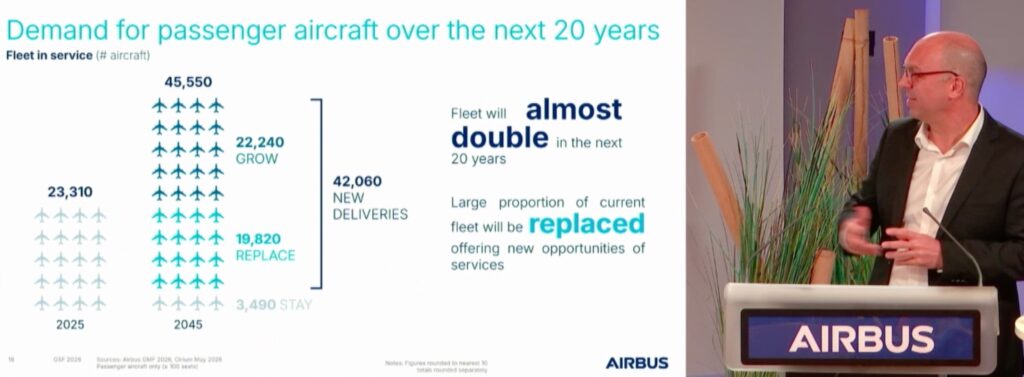
With demand for passenger aircraft set to almost double in the next 20 years, the number of aircraft connected to the Skywise platform will balloon.
Airbus Digital Alliance
Airbus is also working with key partners under the umbrella of an Airbus Digital Alliance, which includes Collins Aerospace, Delta TechOps, GE Aerospace and Liebherr. By joining forces, and building the alliance around Skywise, members can harness their expertise in airframes, aircraft systems, and data and analytics to optimize aircraft operations.
Collins, for example, is connecting with the Skywise S. Fleet Performance+ platform to help airlines better predict and manage maintenance needs.
“As an aircraft OEM, we are the integrator. So, we bring together different actors that know their components and their systems very well. We put together the engineering, the knowledge of the systems, and we develop algorithms, and we end up with more than 100 algorithms that perform very well. And it’s also experienced by our customers. And we — every week, every month — avoid cancellations now thanks to predictive maintenance performance,” Demeusois said.
From IFEC to flight ops
The Digital & Connectivity segment encompasses the work Airbus is doing to ensure that jetliners offer high-speed inflight connectivity and become a true node on the airline’s network, which improves the passenger experience (PaxEx) and drives operational benefits.
On the PaxEx front, Low Earth Orbit (LEO) satellite-powered connectivity is certainly proving a disruptive force in aviation, with SpaceX’s Starlink securing a large market share since its 2022 debut.
“Here, there is a big market shift, a big disruption,” Demeusois said of airlines’ pivot towards low-latency LEO — nearly two decades after geostationary (GEO) satellite-based IFC started gaining meaningful traction.
In the short-term, Airbus sees LEO and GEO as complementary, in terms of their different strengths. That’s why its linefit, supplier-furnished HBCplus IFC solution is based on ThinKom Solutions’ multi-orbit Ka2517 VICTS antenna hardware, which can, for instance, talk to GEO satellites, SES’s O3b mPOWER Medium Earth Orbit (MEO) satellites and Telesat’s forthcoming Lightspeed LEO network.
It’s also why Airbus will install SES’s electronically steerable antenna (ESA)-based multi-orbit IFC offering as buyer-furnished equipment; the solution uses Gilat Satellite Networks’ Stellar Blu Sidewinder ESA and routes data via both Eutelsat’s OneWeb LEO satellite network and SES’s GEO satellites.

At the same time, Airbus is also preparing for another wave of industry disruption, as Lightspeed and other new LEO operators, namely Amazon Leo and China’s Spacesail, arrive on the scene. To that end, the airframer is bolstering its HBCplus catalog with a modular architecture that will accommodate multi-orbit, multi-beam, multi-network, and multi-band IFC from 2028. This will also ensure it is prepped to support SES’s planned 2030 debut of a next-gen MEO-based meoSphere network, which will be paired with another SATCOM service and utilize a multi-beam ESA in aero.
While the first use case for high-speed IFC is Wi-Fi in the cabin to keep passengers connected and entertained, Airbus executives noted that there are “many more,” including around flight ops optimization.
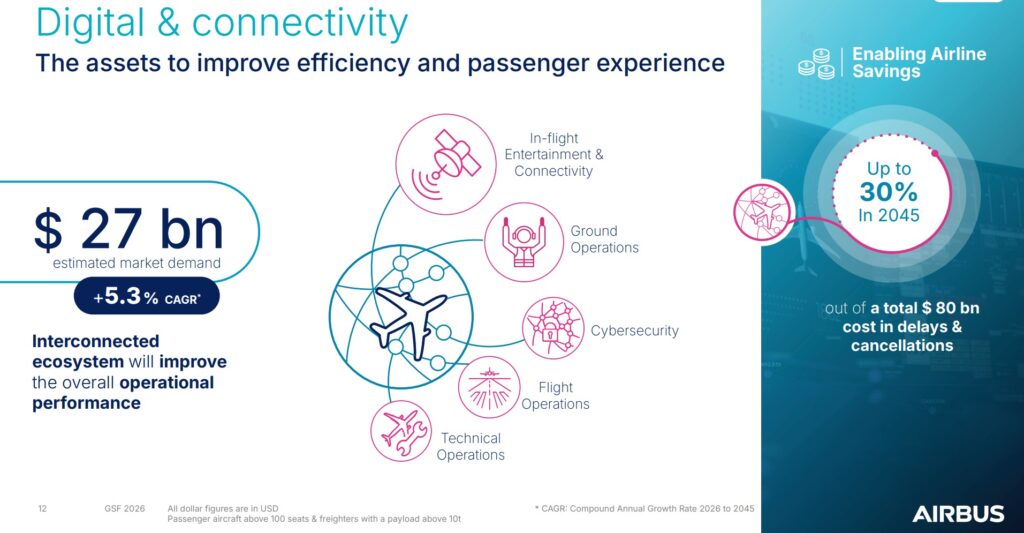
In 2025, the total cost of aircraft disruptions accounted for roughly $43 billion, a figure that’s expected to nearly double to $80 billion by 2045, Rodriguez Gonzalez said. The use of Digital & Connectivity tools across all services segments “can actually lower and enable savings of up to 30% on the cost of delays and cancellations.”
“Digital and connectivity is about data,” she continued. “It’s about what do we do with the amounts of data that today and tomorrow we will have access to. How is this data being used, and how is it connecting all the ecosystem around the aircraft? How is it connecting the pilots, the crew? How is it connecting the maintenance, the technicians? How is it connecting the passengers? How is it connecting the air traffic controllers?
“So, it’s really about creating an integrated system that allows for a more predictive way to operate aircraft, a more reliable aircraft, and a best-in-class passenger experience in the future.”
Near-term crises, long-term resilience
Even in the face of several near-term challenges and headwinds, including the closure of airspace during armed conflicts, high fuel prices, and supply chain bottlenecks, the aviation industry continues to be extremely resilient, as evidenced by Airbus’ wider Global Services Forecast.
The largest sector, Off-Wing Maintenance, is expected to reach $217 billion by 2045, representing a 3.7% CAGR, as aircraft shop visits increase due to an aging and growing global fleet.
The new cluster, Maintenance Operations Support, is focused on spare parts and inventory, and will be valued at $104 billion by 2045, representing an impressive 4.3% CAGR. As new-technology aircraft are delivered, airlines will need to build up new inventories, ensuring that they can support their new-generation planes alongside their prior-gen birds. This segment is expected to be “absolutely transformed by the usage of Digital & Connectivity” solutions, especially as digital twins and ultra-connected aircraft play a transformative role in aircraft maintenance, management said.
In two decades, On-Wing Maintenance will be valued at $36 billion, which is a 2.8% CAGR; Modifications & Upgrades at $21 billion, a 2.6% CAGR; and Training at $17 billion.
“We see that the trajectory is positive, and the demand for services continue growing, and this is extremely exciting,” declared Cristina Aguilar Grieder, SVP Customer Services Commercial Aircraft at Airbus.
“As the global fleet doubles to more than 45,550 aircraft by 2045, we need to get ready,” she said. “Airbus is expanding its role as an integral services partner to support our customers across the entire aircraft lifecycle. By integrating predictive operations, fleet modernization, and advanced digital solutions, we are helping airlines ensure fleet availability, reliability, safety and long-term operational excellence.”
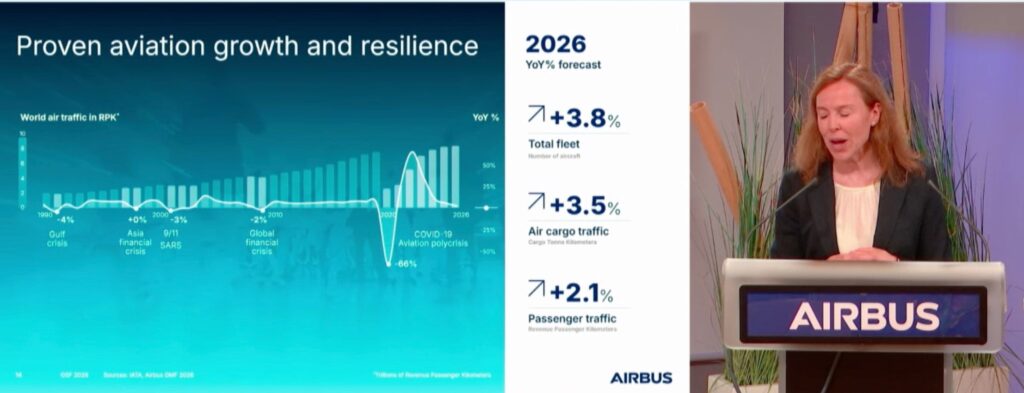
The COVID pandemic and subsequent supply chain crunch took a bit longer to recover from than prior crises, but aviation is resilient, said Aguilar Grieder. All infographics are credited to Airbus