


Inflight connectivity standards group Seamless Air Alliance this year made the case for why it believes SpaceX’s Starlink Low Earth Orbit (LEO) satellite-supported IFC solution hasn’t permanently won the aviation market.
Counting Airbus and Delta among its founding members, the group’s thought leader Peter Lemme suggested at SATShow in Washington D.C. that Starlink will enjoy market dominance in the near term, but predicted that a second wave of disruption will transpire when new LEO networks enter the picture, including Amazon Leo and Telesat Lightspeed. This, in turn, could usher in a third wave of disruption, he said: a paradigm wherein multiple providers serve an aircraft, enabling airlines to take advantage of least-cost routing, which has already been adopted in maritime.
Best known for powering inflight connectivity with high-capacity geostationary (GEO) satellite service — including, lately via its new three-satellite ViaSat-3 network — Viasat is among a cluster of IFC providers which have seen some high profile airline customers defect to Starlink’s low-latency LEO service. While Viasat is not a member of Seamless, the satellite operator and aero ISP is a key partner to Delta, and has outlined a wider technology roadmap that will see it offer an Amara-branded multi-orbit GEO/LEO solution that ingests Telesat Lightspeed capacity, when the Ka-band LEO network comes on line.
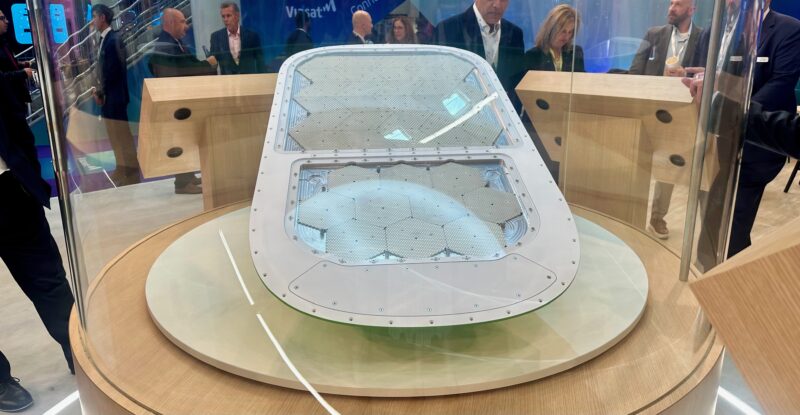
Viasat’s traditional gimbaled antenna will initially support Amara, but the Carlsbad, California-based company is developing a new multi-beam electronically steerable antenna called AERA that will be optimized for Amara, and is in the technical evaluation process to receive Boeing linefit offerability. And so, we put the question to Viasat: do you agree with Seamless’ prediction (for the three waves of IFC disruption)?
Capacity access, application experience, and winning economics
“I don’t agree with the premise of the question that implies the disruption is coming from operators in a specific orbit,” Don Buchman, president of Viasat Aviation, replied.
“What Viasat has always said, and is being reinforced with the resoundingly positive feedback on ViaSat-3, is the single biggest failure mechanism in IFC is running out of capacity. What we have seen is an operator enter the market with excess bandwidth, so the disruption was not Ka vs Ku or LEO vs GEO, it was delivering on demanded capacity.”
He continued:
In the end, the market boils down to basic elements: can the IFC provider deliver on all demanded bandwidth and at what price economics. You can see this play out in the ground fixed markets — new market entrants are constantly closing a market due to lack of capacity, or raising pricing to get the right economics. It is no different in the inflight connectivity market. A multi-orbit system is more about resiliency in both capacity access and application experience while delivering the winning economics.
It is notable that Novaspace has observed a convergence of pricing across GEO and non-geostationary (NGSO) satellite networks, including LEO, as new capacity, intensifying competition, and evolving business models reshape the satcom market.
In a new report, the respected global space consultancy and market intelligence firm noted: “After years of aggressive discounting to gain market share, NGSO operators are beginning to adopt more sustainable pricing strategies. At the same time, improving satellite economics and greater capacity availability continue to enable GEO operators to compete on price.”
Demand fundamentals remain strong
For its part, Viasat remains personally convinced that it has “the best strategic approach” to a multi-orbit IFC system — a flexible, multi-orbit architecture, backed by high-capacity satellites like ViaSat-3 that “lets us put capacity where it’s needed based on demand,” Buchman said. “With beam-forming technology, we can send dedicated capacity to individual aircraft as demand shifts, whether that’s someone streaming 4K video over the ocean, scrolling a social feed with a lot of short form video, or a crew pulling real-time data. And the approach will enable us to focus even more on the hot spot geographical areas that have highly concentrated demand via augmented coverage and capacity.
“We are especially excited about our simultaneous multi-orbit terminal Viasat AERA, which you were able to see in person in Hamburg last spring [at Aircraft Interiors Expo]. Viasat AERA… integrates the high capacity and low unit cost of GEO with experience benefits of LEO latency, all managed by our proprietary, intelligent MultiLink orchestration layer.”
For the three months ended September 30, 2026, Viasat’s aviation revenue grew 8%, ending with about 4,490 commercial aircraft in service, which represented a slight decline sequentially.
“On a year-over-year basis, aircraft in service increased 6%, with average revenue per aircraft up 3%. Our inflight connectivity backlog at quarter end was about 660 commercial aircraft, and includes aircraft awarded in the quarter, offset by installations and removals from backlog based on recent customer announcements,” Viasat CFO Gary Chase said on the firm’s fiscal Q2 2027 earnings conference call.
“We continue to focus on what matters most: the quality of our airline relationships, the growth of our installed base, and the long-term service revenue opportunity those aircraft represent. Long-term demand fundamentals remain strong, and in the second half [of the year], we expect continued new installations and awards.”
Indeed, for Viasat, there is still meaningful business to be won in aviation, with Buchman describing the IFC market to RGN as “a large, growing market with a big portion open to competition now and in the future.”

Viasat counts American Airlines and Southwest Airlines as customers. Hard on the heels of American’s announcement that it will bring Starlink to its entire mainline fleet, and Southwest’s revelation that it will pivot to Starlink fleet-wide, Buchman reiterated Viasat’s position that it fully expects to reengage with Starlink adopters in the future.
“Yes, I still see an opening, and I still consider these our customers, and our team works tirelessly every day to earn the business of our customers,” he told RGN. “Airlines often tell us they want options and control over what their passengers see and experience. Viasat Amara is built for that approach. It works across orbits, and the airline shapes the experience. We are well positioned for the future.”
The firm expects to release more details about the Viasat AERA multi-beam ESA hardware “soon,” he said.
Viasat’s new ultra-high-capacity ViaSat-3 F3 GEO satellite for Asia-Pacific entered service on August 31, 2026, followed by the September 17 service-entry of ViaSat-3 F2 GEO for the Americas. Since then, Viasat has made some interesting observations about passenger behavior.
“[W]hat we measure, flight by flight, and the trend on VS3 F2/F3-connected aircraft is really painting an overwhelmingly positive experience,” Buchman enthused. For example, passengers on flights employing VS3 F3 capacity “use about twice the data per session, supporting higher quality video streaming, much more responsive internet browsing such as on popular social feeds, and an overall better passenger experience.”
Related Articles:
- LATAM to connect Panasonic IFE with SES multi-orbit on A321XLRs
- Viasat says Lightspeed coverage delay doesn’t change plan
- Beyond Starlink: what comes next for inflight connectivity?
- ThinKom eyes Airbus HBCplus modular for Nexus aero antenna
- Southwest aims to be first U.S. major with Starlink fleet-wide
- American, KLM and RAM ink Starlink deals; Amtrak beings trial