

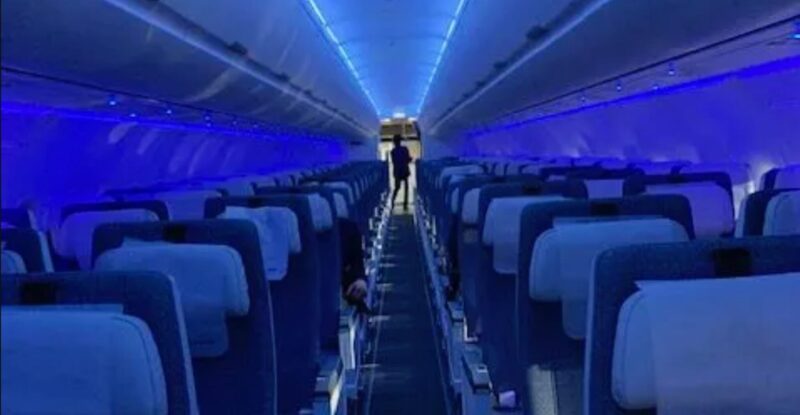

Air Astana has been operating in stealth mode to bring SES’s multi-orbit, electronically steerable antenna (ESA)-based inflight connectivity solution to its Airbus A321LR twinjets. Now, the carrier’s first fitted aircraft is offering high-speed Internet to passengers on an introductory complimentary basis.
The connected A321LR (EI-KGB) took to the skies on October 29 for its first revenue flight with Internet access on the Almaty-Tashkent route.
Counting 13 A321LRs in its fleet, Air Astana will roll out the new IFC hardware “in phases” throughout 2027. The airline utilized its own MRO facility for the first install, which in turn further enhanced its in-house engineering expertise, Air Astana CEO Ibrahim Canliel says.
SES’s ESA-based multi-orbit IFC offering uses Gilat’s Stellar Blu ESA to talk to Eutelsat’s OneWeb Ku-band Low Earth Orbit (LEO) satellite network and SES’s geostationary (GEO) satellites. OneWeb has received clearance to operate in Kazakhstan.
Zhaslan Madiyev, who serves as Deputy Prime Minister and Minister of Artificial Intelligence and Digital Development for the Republic of Kazakhstan, notes that his agency “removed barriers and adapted legislation for non-geostationary satellite systems” to support the launch of LEO/GEO connectivity on Air Astana.
“This has paved the way for the practical implementation of the technology.”

As part of an introductory period, Air Astana is providing complimentary Wi-Fi access to all passengers aboard fitted A321LR aircraft through January 31 2027. From February 1, free Wi-Fi will be available to Business Class passengers and Nomad Club loyalty members with Gold and Diamond status, while paid packages will be available to other passengers.
Nomad Club members of all tiers will also be able to avail of free messaging, the airline says.
This is not Air Astrana’s first experience with inflight connectivity. Its three Boeing 767s are fitted with Inmarsat-now-Viasat’s Global Xpress hardware, though Air Astana’s inflight Wi-Fi landing page is now focused on touting Wi-Fi for A321LR passengers.
According to Blane Boynton, SES’s senior vice president, aviation, the multi-orbit IFC solution on the A321LRs “will enable Air Astana to offer a consistent, high-quality online experience across its network and bring a new era of inflight connectivity to passengers throughout Central Asia and beyond.”
The Air Astana IFC project is part of a broader digitalization project in Kazakhstan. “Internet access already covers trains and is now reaching air routes. The goal is connectivity wherever people live, work and travel,” the Ministry of Artificial Intelligence and Digital Development says in a statement published on LinkedIn.
Uzbekistan Airways, in the neighboring Central Asian nation, is bringing SES’s multi-orbit Ka-band Open Orbits IFC solution to its A321neos, as announced last year.
Related Articles:
- Embraer moves with speed to factory-fit multi-orbit IFC to E2
- VietJet adopts Starlink despite coverage gaps in China and India
- Eutelsat inks key agreements for OneWeb replenishment, IRIS² buildout
- Why Air Astana is right to tout the PaxEx aboard its A321LR
Featured image credited to Neelam Mathews