


Gogo estimates that its Eutelsat OneWeb satellite-powered Galileo inflight connectivity product has achieved a remarkable 35% to 40% share of the Low Earth Orbit (LEO) satcom market in business aviation.
As of November 6, 2026, “cumulative shipments have surpassed 760 units, which we believe gives us between 35% to 40% market share of the LEO business aviation connectivity less than 12 months after introduction — making Galileo the most successful LEO product launch in business aviation,” CEO Chris Moore revealed during Gogo’s third quarter earnings conference call. Gogo achieved 690 Galileo shipments by the end of Q3.
That’s no small feat, given that the Broomfield, Colorado-based firm is competing on the LEO front with SpaceX’s popular Starlink IFC service.
An electronically steerable antenna-based IFC system, Galileo is based on Hughes Network Systems’ ESA technology, and offered in two flavors: a half-duplex (HDX) solution for smaller aircraft, which currently provides download speeds of 60 Mbps and upload speeds of 10 Mbps; and a full-duplex (FDX) configuration, supporting speeds of 195 Mbps down and 32 Mbps up.
Shipments of Galileo are pacing “well above our expectations,” Moore noted, with the company achieving “a record quarter of shipments for Galileo of 172 units” for the three months ended September 30, 2026, representing a 59% increase from the second quarter and a 95% increase year over year.
Gogo ended the third quarter with 297 Galileo aircraft online, up 61% from the prior quarter, demonstrating its ability “to convert shipments into aircraft online quickly,” Moore said. Each aircraft that activates “represents a seven to 10-year recurring revenue relationship,” he added.
With Eutelsat in the process of replenishing its OneWeb LEO network with higher-capacity satellites, Gogo recently outlined a long-term Galileo technology roadmap that calls for performance enhancements to be implemented roughly every 24 months over six years.
The company’s continued investment in hardware and satcom will see Galileo HDX pivot to a 300 Mbps down/100 Mbps up service by 2032, while FDX is earmarked for 1.5 gig down and 350 Mbps up over the same period, Gogo said.
Eager to protect customers’ existing investments, Gogo is designing the HDX and FDX upgrade path to preserve as much of the existing installation infrastructure as possible.
It remains to be seen if Gogo will ultimately tap into Europe’s future IRIS² multi-orbit network, but the company appears well positioned to avail of opportunities given that Eutelsat OneWeb is the LEO lead on the project.

Gogo has a strong pipeline of Galileo business, especially for its lightweight HDX kit — with several notable new contracts secured in the third quarter alone.
Private aviation and fractional aircraft ownership company PlaneSense selected HDX for its entire fleet of 71 Pilatus PC-12 turboprops and PC-24 jets, as well as for future aircraft deliveries, while Textron Aviation announced it will be the first OEM to include HDX as a standard fit for its Cessna Citation Longitude, Citation Latitude and Citation Ascend business jets.
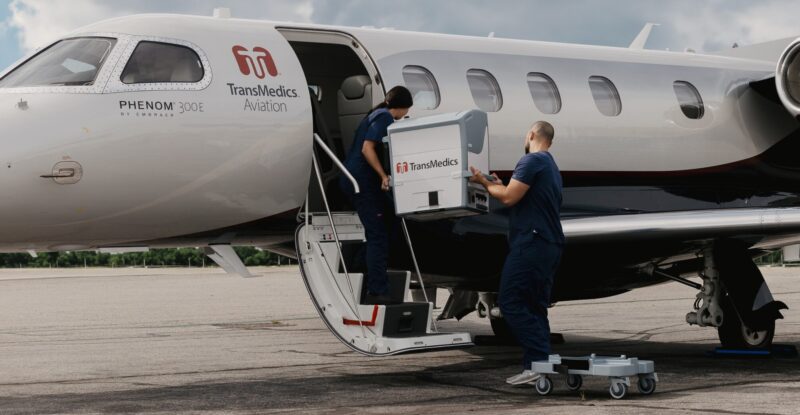
Additionally, Galileo reseller Duncan Aviation purchased 40 HDX systems, representing Gogo’s largest single MRO order of the year, and medical technology and logistics company TransMedics contracted with Gogo to equip its fleet of 22 Embraer Phenom 300E aircraft with HDX to support time-critical organ transport missions across the United States.
The TransMedics announcement “is another strong example of growing adoption of our LEO connectivity services across the aviation sector, as operators look for reliable, high-speed communications to support increasingly demanding operations,” Eutelsat enthused in a statement on LinkedIn. “In this case, donor organs are continuously monitored during transport, making resilient, low-latency connectivity an essential part of the mission.”
Also during Q3, Bombardier ordered 10 FDX and 15 HDX units “to support their demonstration fleet, aftermarket installations, and OEM deliveries,” Moore said on the earnings call.
At the end of last month, in what is Gogo’s fourth quarter, U.S.-based charter operator Jet Excellence announced it will equip its entire fleet of Cessna Citation X aircraft with HDX.
Gogo is still perhaps best known for providing air-to-ground inflight connectivity in North America. But after acquiring Satcom Direct in December 2024, it has been in the process of transforming from a domestic ATG company into a global provider of high-speed broadband for the business and military/government aviation market.
With its Galileo LEO messaging clearly resonating, and management observing overall momentum behind its next-gen satcom portfolio, Gogo reckons that its strong Galileo installation rate could eventually offset legacy ATG IFC declines. The firm is even eyeing possibly monetizing its ATG spectrum.
“These developments are encouraging, although ATG erosion continued to weigh on profitability, with adjusted EBITDA declining 27% year-over-year despite growing Galileo adoption,” William Blair said in its latest report on Gogo, which posted a $3.2 million net loss for Q3.
“In our view, Galileo’s momentum and potential spectrum monetization provide reasons for optimism, but the pace of the earnings recovery and competition from Starlink remain key considerations…”
Related Articles:
- Eutelsat inks key agreements for OneWeb replenishment, IRIS² buildout
- Hughes stays flexible with ESA, double-ESA and hybrid ESA-VICTS IFC
- Op-Ed: The value of a network agnostic IFC terminal
- Press Release: FlightPath3D and Gogo accelerate partnership
Featured image credited to TransMedics