
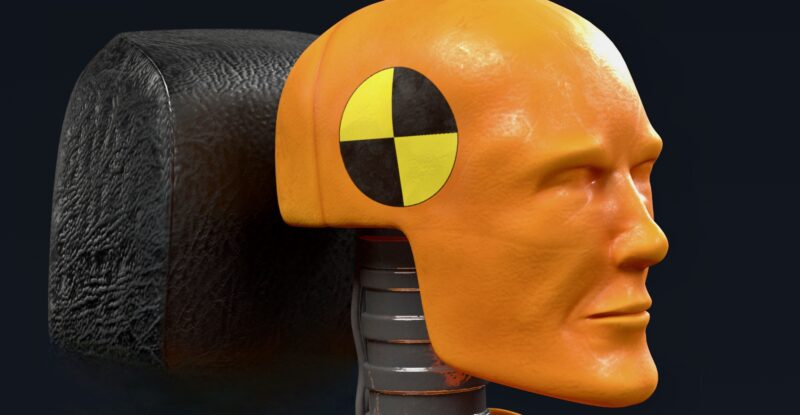

Obtaining certification for premium aircraft seats has never been easy. But in recent years, aviation safety regulators have started paying much closer attention to how the shoulder belt of non-forward-facing seats at oblique angles interact with the necks of crash test dummies used in sled testing.
This additional scrutiny has, in turn, created certification challenges, and is among the reasons why a premium seat certification bottleneck is presently affecting airlines and seatmakers, and consequently passengers around the globe.
Though oblique seats first emerged in industry over two decades ago, modern seats bring fresh considerations.
For starters, airlines have optimized the layouts of their business class cabins by adopting more angled seats — in some instances, positioned past the usual 45-degree angle away from the aircraft centerline — and more seat variations, including mini-suites with doors and plenty of electronics.
Three-point harnesses with a lap belt and an upper torso restraint help premium aircraft seatmakers meet stringent and necessary head impact criterion (HIC) regulations, limiting a passenger’s flail in the event of an emergency. They also address some of the newer neck injury criterion (Nij) benchmarks.
However, the shoulder belt is sometimes observed “riding towards the neck” of the anthropomorphic test device (ATD) used in the sled testing required for certification, a major seatmaker explained to your author at the Aircraft Interiors Expo in Hamburg.
“As you turn the ATD away from the belt and you do a forward test, the seat belt does begin to graze towards the neck,” the company noted.
“We’ve done a lot of research; and the automotive companies have done a lot of research that shows it’s not necessarily a big issue.”
Safety standards specified by standards body SAE International and adopted by airworthiness authorities dictate that straps must not bear on the neck or side of the head during testing.
If grazing of any sort is being observed, should the seat pass or fail? Should other evaluation criteria be considered? Should industry be permitted to deviate from current rules, as informed by exhaustive automotive industry data?
These questions around Nij are being considered by the European Aviation Safety Agency (EASA), which has been in deep consultation with suppliers since raising the red flag via the certification process some time ago.
Proposing changes to the evaluation criteria that aim to provide an equivalent level of safety, industry has requested a deviation to the current design standards for Rotorcraft, Transport Aeroplane, and Small Aeroplane Seating Systems (the European technical standard order known as ETSO-C127c).
For example, it proposes making a cut-out in the torso jacket of the FAA Hybrid III ATD used for testing to expose the belt guide and enhance its visibility, EASA explains.

Rayk Hey, the chairperson of SAE International’s Aircraft Seat Committee last month published photos on LinkedIn showing the cut-out of the ATD jacket “to facilitate the industry ad hoc group technical proposal on shoulder belt interaction.”
It is a sign of our modern times — and the premium push transpiring in commercial aviation — that regulators, including the UK’s CAA, are honing in on language for neck injury testing, and addressing ambiguities. The U.S. Federal Aviation Administration, too, is seeing seats and suites that don’t pass its human factors tests, Bloomberg reported in May.
In the meantime, some seatmakers will simply opt to make all their seats compliant to the most stringent interpretations of the current rules.
Related Articles:
- FAA proposes AD to address incorrect seat installs on 737 MAXs
- Fast-growing RAVE Aerospace identifies industry choke points
- Middle East conflict is wild card for aerospace supply chain: report
- How the AirPRO lap belt airbag from SCHROTH eases certification
- Op-Ed: Seating architecture must evolve to accommodate power, IFEC
- Airbus enters preliminary work to offer lie-flats on the A220
- Lufthansa starts selling most Allegris business class seats on 787-9
- In-seat monitors, USB ports bring Nij to the fore
Featured image credited to istock.com/3drenderings