

Enjoying robust demand for its RAVE series of embedded inflight entertainment systems, RAVE Aerospace has identified widespread memory chip shortages and safety regulators’ more stringent head injury criterion (HIC) certification requirements as among the challenges presently facing aircraft interiors stakeholders and their airline customers.
A competitor to IFE industry stalwarts Panasonic Avionics and Thales, RAVE Aerospace is the brand that emerged after private equity firm Kingswood Capital Management completed its acquisition of Safran Passenger Innovations (SPI) in early February.
“The amount of activity last year was staggering, and it’s good for everyone; everyone’s winning a fair share. It’s not like any one player is scooping up a lot of the market. We’re all doing well in our own markets with our customer bases,” RAVE Aerospace vice president, products and strategy Ben Asmar told Runway Girl Network during a sit-down interview at APEX TECH in Los Angeles, just days before the Kingswood acquisition was completed.
“Last year — I can’t mention any names — I think we won seven new customers to the RAVE family, which is great. That means we’re growing. Our product is resonating, and I think we’ve proven ourselves to be a very viable competitor against the other two. And I think in a market that’s small, having three strong, viable competitors can only be good for the customers out there.”
AI is eating up memory chips
That’s not to say there aren’t continued headwinds in industry.
The supply chain bottlenecks created by the COVID pandemic have largely been ironed out at RAVE Aerospace, with Asmar noting: “we’re back up into the 90 percentile for on-time delivery to seat suppliers, to Airbus, Boeing, our customers. So, I think we’ve managed to really wrestle the supply chain challenges and get things flowing again.” But memory chip manufacturers are now prioritizing chips for AI.
Consequently, the chip crunch is very real in aviation and other industries.
“The high-tech market is still limited in terms of what it’s producing, and the biggest challenge is pricing and costs right now. There’s a lot of memory being directed to the AI market; they’re kind of sucking up all the storage and raising the prices significantly, so that’s putting pressure on us and all the other suppliers to keep our costs down,” Asmar explained.

“Memory over the next probably two, three years is going to be very challenging, which will put pressure on anyone who’s delivering electronic components in any market, but when you’re in a market that’s small, like aviation, it puts even more pressure on it,” he continued.
“So, we’re doing our best now to try and kind of soften the blow, if you like, by making sure we’ve got good supply. We’ve got good stocks of the parts we need that are going to be scarce, so we continue to deliver on time, because we don’t want to get back into that situation where we have supply chain challenges, which then puts pressure right down the whole ecosystem.”
Airframers’ need for advanced IFE/seat integration work
Even when it was known as SPI and owned by french aerospace giant Safran, RAVE Aerospace remained “agnostic” when it came to its relationships with seatmakers. “Whether it’s a Safran seat, a Collins seat, a Recaro seat or any other one, we do treat them all equally and make sure that our product can be represented as best as possible,” Asmar said.
That approach is especially important now that major airframers want to see IFE/seat integration projects in advanced stages before they agree to factory-fit the content to their aircraft.
Grappling with production delays and supply chain constraints since the COVID era, Airbus and Boeing are “really looking at ‘how do we keep our production system going?’ And they really want to see, ‘this seat and that IFE pairing is already done. Clean sailing.’ If it’s not, it’s actually quite difficult to get everyone aligned to say, ‘okay, yes, you can put this new IFE system in this existing seat or this new seat and take it forward,” Asmar said.
“So, that for us means we need to be closely partnered with all the seat supplies to make sure we can continue to get our product into the market.”
(Incidentally, RAVE Aerospace’s agnostic partnership approach now extends to the inflight connectivity service realm. As the firm readies to support the connected seatback revolution, it says it is committed to working with “all connectivity service providers, LEO, MEO, GEO and hybrid, so airlines never get locked into a single stack. The role of RAVE Aerospace is to integrate cleanly with whichever partner our customers choose.”)
High HIC certification thresholds
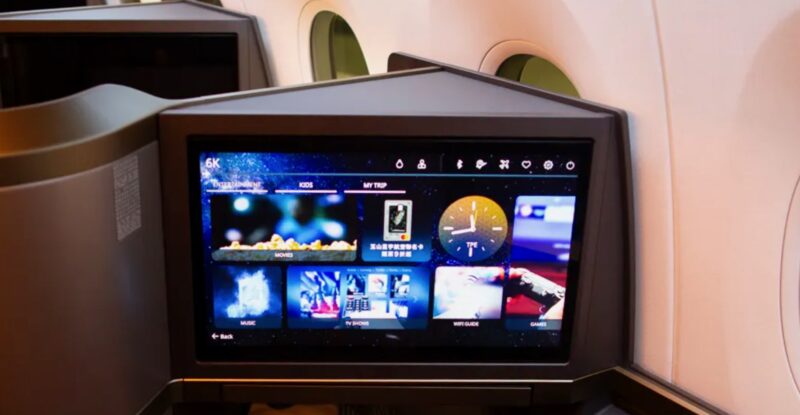
Boasting dockable displays, RAVE Aerospace’s RAVE-branded IFE systems are known for their modularity and flexibility, and airline customers have long been able to swap out the peripheral bar for upgraded kit.
In recent years, however, aviation safety regulators have strengthened HIC certification testing requirements, especially for new business class suites, which in turn has created acute challenges across industry.
“There are still significant challenges with certification. I don’t see them going away anytime soon. In fact, I think they’re getting worse,” Asmar confided. “So, any change in the HIC zone, the regulators are really saying, ‘actually there, we want to make sure that whatever is going in there is retested,’ which is creating challenges for airlines to do things like upgrades. I mean, we’ve [long] had the philosophy of dockable displays. You can take a display out and put a new display in, which is great from a technological perspective and a speed-to-market perspective, but as soon as you change whatever is there and it’s a HIC impact, then you’re going to have to do some retesting.
“We’re on a couple of industry groups. We’re trying to look at other ways that we could achieve the same result through analysis, but we’re not there yet. There’s some time to go.”
Addressing obsolescence
Naturally, airlines want to acquire products with a long lifespan. So, from a technology perspective, any product built by RAVE Aerospace must be valid “for the next ten to 15 years,” Asmar said. That’s why the company tries to develop products that will last and work well for about a 20-year period which can be challenging given the rapid advancements in consumer technology and the long lead times in commercial aviation.
“We — and I think our competitors probably do the same — try and put as much as possible in any new display or server or infrastructure or component that’s going to go on the aircraft because it does need to last a long time,” Asmar said. Airlines, too, have been extending the window between major IFE retrofits, “probably because some of the supply chain issues that have been in the market” and the fact that there’s not enough aircraft coming off the line. So, we’ve seen those windows start to extend. It’ll be interesting over the next couple of years to see if they shrink.”
“But from our perspective,” continued the RAVE Aerospace executive, “we still think it’s the best practice to make sure the components we put on have the longest lifecycle. So, our airlines have the flexibility to decide, ‘actually, you know what, I don’t need to change the IFE… because it’s still functioning. Well, I can just do a cabin refresh, maybe change some of the more comfort factors like the seat cushions, curtains, the things that make it look nice, as opposed to doing a complete rip and refit.”
Related Articles:
- Connected seatback at the fore as RAVE Aerospace enters new era
- Op-Ed: The legacy IFE debate: remove, replace or reinvent?
- RAVE Aerospace nixes proprietary antenna work as LEO shapes IFEC
- Panasonic enjoys rapid IFE growth as connected seatback takes wing
- United, Delta tout NPS and wellbeing benefits of seatback IFE
- Thales talks event-based 360Stream and near-live highlights
Featured image credited to Jeremy Dwyer-Lindgren