


As airlines seek to bring the latest and greatest inflight entertainment systems and seating platforms to their fleets, multiple factors are conspiring to slow their rollouts.
Seat supply chain bottlenecks, tighter airframer requirements for IFE/seat integrations, and seat certification challenges — involving head impact and neck injury criterion testing — have created turbulence for operators, adding to the already lengthy lead times associated with bringing new seats onboard.
The problem is so acute that “the typical lead time on new seat programs has lengthened dramatically from 12 to 18 months, up to 24 to 36 months,” Panasonic Avionics CEO Ken Sain said during the Aircraft Interiors Expo (AIX) in Hamburg. And some prominent seatmakers are actually declining new business as they “ration available engineering and production capacity.”
Consequently, even as Panasonic Avionics’ new OLED-based Astrova inflight entertainment system breaks cover on aircraft around the world — roughly 300 jets are expected to be flying with the system by April 2027 — legacy seats and seatback monitors are staying on aircraft for longer periods while the industry works through the chokepoints.
This, in turn, stymies the ability for airlines to provide a consistent digital passenger experience “on every aircraft for every flight,” said Sain, who also heads up Panasonic Connect as CEO.
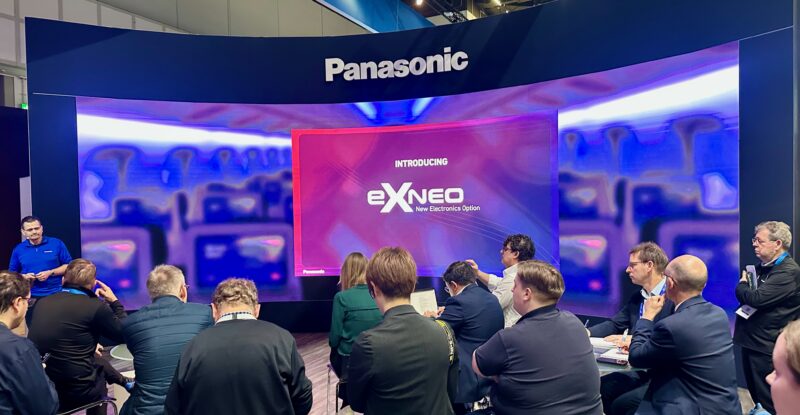
That’s why, after building Astrova — a modular next-gen solution described by Panasonic as “the first forward-fit upgradable IFE system” — the IFE giant used the occasion of AIX to unveil eXNeo, a retrofit-only drop-in replacement option for its legacy X Series monitors that offers the same form-fit-function and power consumption.
Panasonic’s prior-gen X Series Eco- and Elite-branded monitors utilize capacitive touch technology and LED backlighting. With eXNeo, the display module and passenger-facing surface remain unchanged. And the geometry, local stiffness, weight, mounting interfaces, and other passenger-accessible characteristics are maintained. This is crucial to ensuring that the seat does not need to undergo head impact criterion (HIC) certification testing again.
“And that’s important,” noted Panasonic Avionics senior vice president of product and strategy Andrew Masson, because as Sain mentioned, “the seating suppliers are constrained right now.” The drop-in approach is “deliberate”, he emphasized, as Panasonic needed to have “something that fits directly in those seats.”
Leveraging the latest generation CPU and GPU technologies available today, and providing up to an eight-fold boost in storage and RAM compared to older X Series monitors, plus advanced Bluetooth audio capability, eXNeo is specifically designed to complement, not replace. Indeed, maintaining the same physical configuration is fundamental to the no-reHIC certification strategy and supports rapid overnight installation.
“Panasonic will go on board your airplane, and they will replace every single monitor overnight, all 200 or 300 of them,” Masson shared. “So there’s no appreciable downtime for the airline. We’ll go on board. We’ll take every monitor off, put every new monitor on. It’s done,” Masson said.
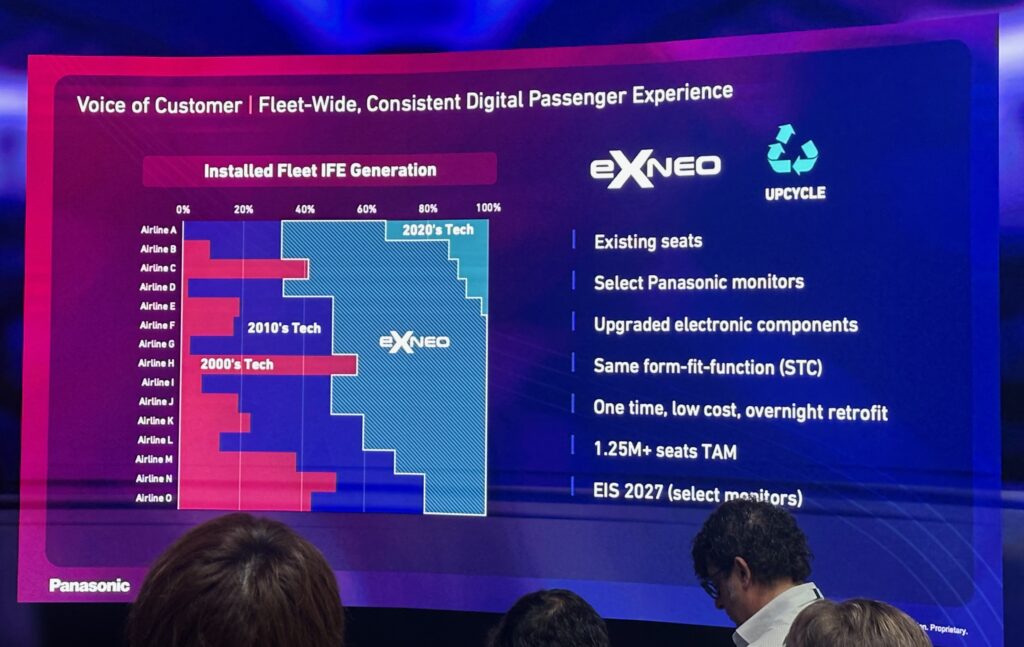
Panasonic listened closely to its customers to develop eXNeo. It has identified a total addressable market of 1.25M-plus seats with X Series monitors.
Impressed by Masson’s claim at AIX, we asked: can eXNeo really be able to fly in revenue service the next day without any further testing?
“Yes, that is the objective of the retrofit solution,” Panasonic told RGN in a follow-up exchange.
Pre-modified eXNeo units, incorporating the updated processor, motherboard, storage, and Bluetooth capability, will be provided as replacement units. During the retrofit, the existing X Series monitors are removed and replaced with the eXNeo monitors, software is loaded, and the aircraft can be returned to service with minimal downtime.
Panasonic’s eXNeo is a service offering. The drop-in replacement work can be performed by Panasonic Technical Services (PTS), the largest MRO network dedicated to IFE and onboard connectivity services with over 45 line maintenance stations, eight regional repair stations, and 15 base maintenance and OEM locations.
Importantly, eXNeo is compatible with Panasonic’s new open and neutral application hosting platform, Converix, as well as its Astrova IFE system, which enables airlines to standardize the digital passenger experience across their fleet.
“We have introduced the latest CPU and GPU microprocessors, similar to the ones we have in Astrova, to provide the same digital experience,” Masson said, noting that the tech can enable airlines to add advanced games and hyper-personalized connected seatback activity.
Moreover, eXNeo will operate “the very latest version of Android, and it will have access to all the features that the latest Android version will have as well, which is extremely important for our airline customers,” many of whom have two or three generations of IFE in their fleet. Panasonic is in fact still delivering new X Series screens to airlines — even though the system’s architecture is a decade old.
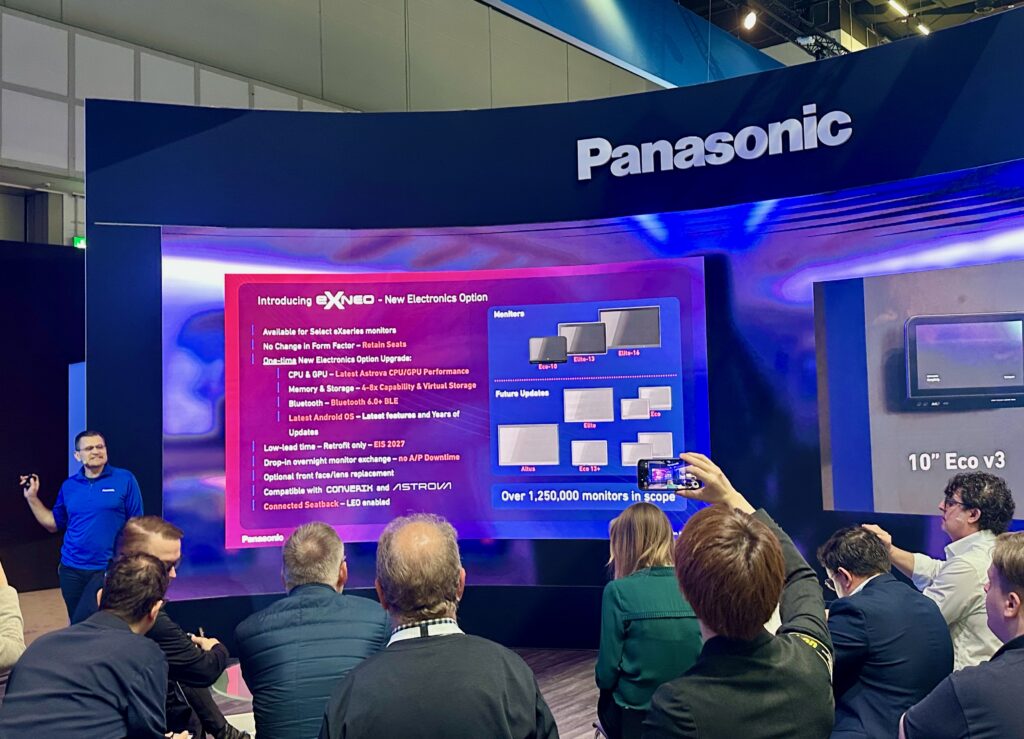
Panasonic is planning an eXNeo entry-into-service in 2027.
Panasonic’s eXNeo package of upgraded electronic components can clearly help industry address the present seat supply crunch by enabling airlines to keep flying their current seats with X Series monitors whilst bringing key digital enhancements to customers, in line with their broader connected seatback ambitions.
The solution “is really focused on airplanes that are towards the end of life, so they have only 10 years left,” Masson said, or even for aircraft delivered to airlines today with X Series “and they want to keep going until that first retrofit, or around about 10 years.”
“We will not be making this a linefit option,” he stressed. “We are making this a retrofit option only, and it will only be available to those airlines that already have existing X Series systems, because we don’t want to go through the really lengthy additional certification process. We have Astrova out there for those new programs.”

This is not the first time that Panasonic Avionics has offered its massive installed base of IFE customers a cost-effective opportunity to obtain next-gen functionality without needing to replace the entire IFE system. Cast your minds back to 2011 and the firm’s eXK proposition, which provided a simple upgrade path for its legacy K Series platforms, as your author reported for Flightglobal at the time.
Nor indeed is it the only way for Panasonic customers to bring performance improvements to IFE at a fraction of full-replacement costs.
But by ensuring commonality between Astrova — the fastest-adopted IFE system in Panasonic’s history — and existing X Series platforms, and by effectively acting as a bridge product until an airline is ready to buy new, Panasonic eXNeo is also a positive sustainability story.
Little wonder, then, why the firm has already seen “a lot of demand” and indeed why an Upcycle logo accompanied an eXNeo slide shown on Panasonic’s stand at AIX.
“Astrova solved forward-fit upgradeability; eXNeo solves retrofit upgradeability for over a million seats. And while eXNeo isn’t groundbreaking in its technology, it has the potential to be every bit as consequential as Astrova,” Sain declared.
Related Articles:
- Aircraft seat certification delays spur testing tweak request
- Op-Ed: The legacy IFE debate — remove, replace or reinvent?
- Panasonic Avionics sees Astrova Curve debuting in first class
- Fast-growing RAVE Aerospace identifies industry choke points
- Stelia Aerospace to double premium seat production capacity
- How United is leveraging Starlink and the cloud to enhance IFE
- Airbus enters development phase for ultra-luxe First Class Experience
- Qatar Airways to realize AI vision on 777X with Panasonic Converix
- Middle East conflict is wild card for aerospace supply chain: report
- How the AirPRO lap belt airbag from SCHROTH eases certification
- Op-Ed: Seating architecture must evolve to accommodate power, IFEC
- Press Release: Panasonic’s Astrova IFE is first to achieve Eyesafe 3.0