


For a company that only launched in January, Kirkland, Washington-based Skyband Systems is enjoying a remarkable trajectory in aviation.
Its M100 avionics unit, which keeps aircraft navigating when GPS and global navigation satellite system (GNSS) signals are disrupted or in question, has already entered into production, and management is targeting U.S. FAA supplemental type certification (STC) on the prototype aircraft — an Embraer Praetor 600 — by as early as November.
A line replaceable unit, the M100 fuses independent onboard inertial sensing with Iridium’s positioning, navigation and timing (PNT) ASIC chip, which receives a cryptographically protected signal from Iridium’s 66-satellite Low Earth Orbit (LEO constellation.
Connecting to the aircraft’s existing Iridium antenna, the system delivers its output to the flight deck through an electronic flight bag (EFB) application and cockpit annunciator. This provides pilots with real-time GPS alerts and supplementary situational awareness.
“As GPS interference has grown into a daily concern for flight crews, Iridium PNT offers a signal that is resilient against jamming and spoofing. Skyband’s M100 brings that capability into the cockpit, and we are excited to see it reach production,” says Iridium CEO Matt Desch.
Bringing a brand new system to civil aviation at this pace is no small thing. But Skyband, whose leadership team comprises former Starlink Aviation engineers and executives, already knows the market. It’s also working with a highly respected FAA ODA, AeroMech, based in nearby Mukilteo.
“Certifying new avionics requires a level of rigor and transparency that not every new entrant is prepared for,” says AeroMech COO Anthony Wiederkehr. “Skyband has approached the STC process with a clear commitment to safety and has worked openly with our engineering and ODA teams at every step. The Praetor 600 installation is on a solid path, and we look forward to bringing the M100 to additional aircraft types.”
For Skyband co-founder and CEO Will Seidel, “Finishing our first STC this fall is the milestone that turns the M100 from a flight-test program into a product operators can install on their aircraft.”
As certified out of the gate, M100 will be receive-only, read-only from the aircraft. But, together with Skyband’s software, it can offer expanded functionality, should a prospective avionics partner be interested in certifying it as a nav source.
And so, RGN put the question to Skyband co-founder and president Robert Wiggenhorn: if the likes of Honeywell or Collins reached out to you guys and said, “We’d just like to snatch you up right now,” are you open to those types of conversations?
“Right now the team is laser-focused on getting the M100 in pilot’s hands as quickly as we can to make an immediate improvement to aviation safety. With that being said, we’re definitely open to integration, partnership, and other types of discussions with avionics leaders such as Garmin, Honeywell, or Collins,” Wiggenhorn replied.
“In under a year we will have gone from clean sheet design to FAA-certified hardware. That type of engineering velocity is much easier to achieve with a small cross-disciplinary engineering team. However, working with existing avionics manufacturers will definitely help us deliver more customer value by integrating further into the cockpit and scaling customer installs with global distribution and go-to-market. We’re constantly thinking about how to balance speed with scale. So now or down the line, we’re definitely open to discussions if that would help accelerate getting this technology incorporated into flight decks.”

The timing of M100’s market entry is right. IATA’s Incident Data eXchange indicates that reported jamming events in 2025 increased by 67% compared to 2023 while reported GPS spoofing incidents rose by 193%. Acknowledging the spike, both the European Union Aviation Safety Agency (EASA) and the FAA have updated their guidance to stakeholders.
“GPS interference has become a routine operational problem rather than a rare event,” Skyband says of the persistent and vexing problem which is particularly acute around conflict zones, including the Middle East, the Baltics and much of Eastern Europe.
Notably, the M100 is in no way dependent on GPS/GNSS even for clock timing. It addresses interference by providing position and time independent of local GPS and GNSS constellation availability. “The M100 brings something new to the cockpit: a global navigation source resilient to GPS jamming and spoofing,” Seidel notes.
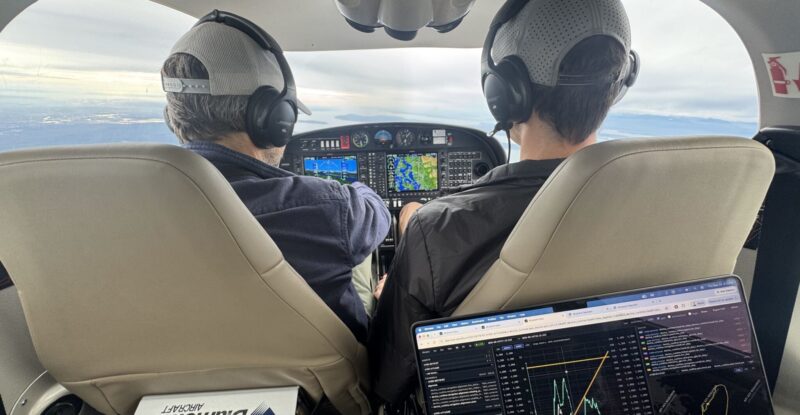
End-to-end system performance has been validated across 17 test flights, and qualification testing is taking place this month.
Skyband Systems is exhibiting at NBAA-BACE in Las Vegas this week. Attendees can see the production M100 and a live demonstration of the firm’s GPS Threat Map and EFB application.
- Skyband develops LEO-powered PNT unit to validate GPS on aircraft
- EASA updates GNSS jamming and spoofing guidance, citing spike
- Digital & Connectivity underpin Airbus Global Services Forecast
- Rocket Lab CEO vows commitment to aero as firm buys Iridium
- Tiny Iridium PNT ASIC could arrive in aero as carry-on equipment