

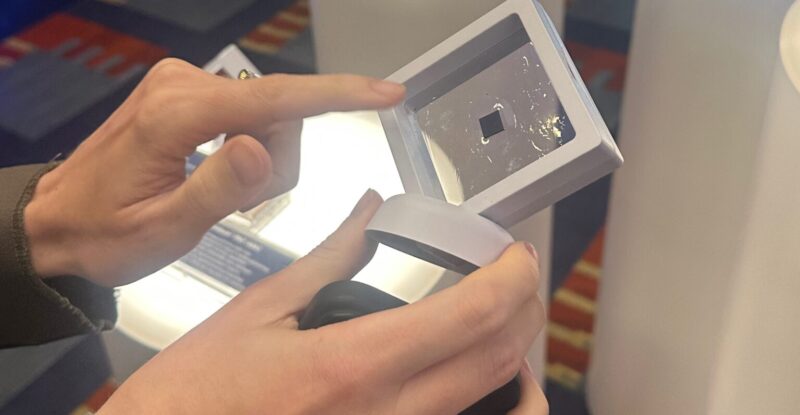

Against a geopolitical backdrop that has seen an exponential increase in the number of jamming and spoofing incidents involving global navigation satellite systems, there is demand, especially in business aviation, for authenticated, pole-to-pole positioning, navigation, and timing (PNT) data.
That’s why Iridium Communications expects its miniature new PNT ASIC will arrive on flight decks initially as carry-on equipment as part of the pilot’s electronic flight bag (EFB) before being ultimately integrated with aircraft avionics.
When embedded into a device, such as a tablet-based pilot EFB, the Iridium PNT ASIC receives a cryptographically secure time and location data signal from Iridium’s 66 cross-linked L-band Low Earth Orbit (LEO) satellite network that’s 1,000 times more powerful than GPS and capable of working inside buildings — or indeed through an aircraft’s aluminum or composite fuselage.
The chip is expected to hit the commercial market very shortly, in mid-2026.
“If you want to put something on a multi-function display in an avionics system, you have to have a TSO (Technical Standard Order). If you have carry-on equipment that gives you reference information, that’s something totally different on your EFB. And so now what we’re trying to do is we are working to get the TSO so that it can be integrated with the avionics and be part of the avionics solution on an aircraft. That’s what we’re after,” John Peterson, Iridium’s executive director aviation line of business said of the resilient alternative to GPS/GNSS.
“In the meantime, especially in the business jet community, there is a desire to have something that works more like carry-on equipment, kind of like ForeFlight on your EFB, that’s good enough.”
Consequently, the McLean, Virginia-based satellite operator is working two tracks.
“We are, short term, working on the carry-on equipment aspect of it, but scalability is going to come from being integrated into the avionics system, and that’s long term what we’re working. So, we’re working both simultaneously,” Peterson explained.
“We have the new ASIC coming out, the new ASIC permits. And the nice part about PNT is it’ll work through the aluminum because the signal is so much stronger.”

As to which avionics will ultimately be integrated with the PNT ASIC, Peterson said it’s an open question: “Is it integrated into the GPS? The IRS (Inertial Reference System)? Is it another box in the aircraft, what have you. Is it integrated into operators’ Iridium Certus [satcom] system, and we throw an extra antenna up there? Many are interested in that,” he revealed.
And because the chip is so tiny, there is no real space constraint. “There’s plenty of room for it,” Peterson noted. “It’s never about the hardware and the software. It’s all about the certification.” As RGN readers are well aware, the process of certifying any hardware or content on aircraft is lengthy indeed, and backlog constraints are acute.
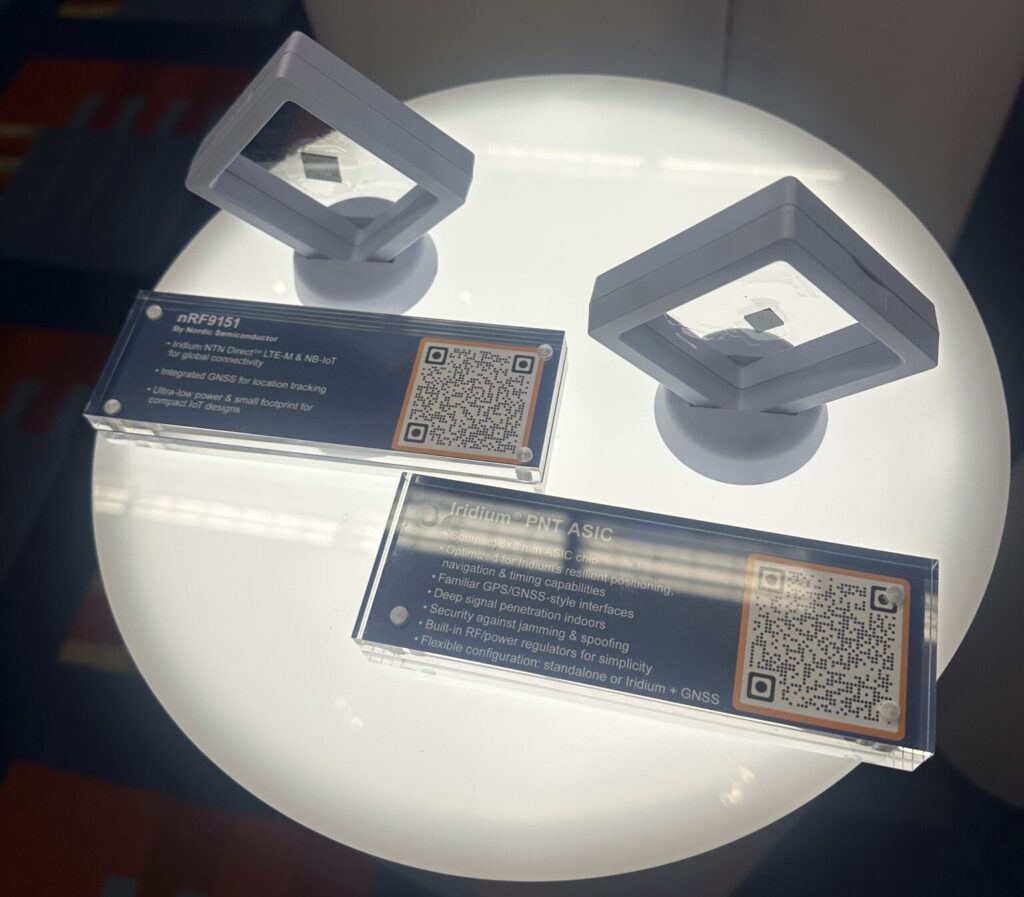
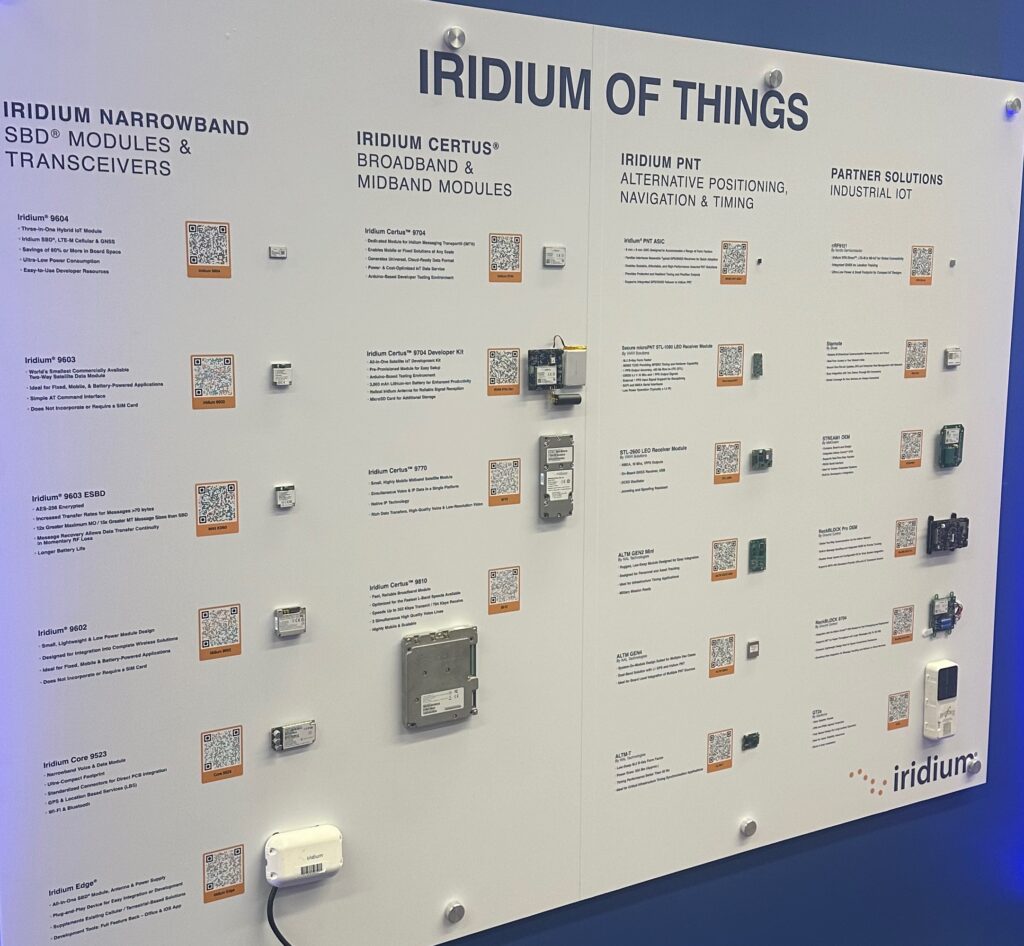
Iridium this spring showcased the PNT ASIC in its dedicated meeting rooms at the big SATShow conference and exhibition in Washington D.C, including as part of a wider display of its hardware. Compare the size of the PNT ASIC to even the petite Iridium Certus communication modules on display.
Related Articles:
- Iridium to acquire Aireon, mulls independent payloads for VHS, PNT
- Iridium prepares to unleash Certus 100 Safety for civil aviation
- Flightradar24, Aireon partnership sees ADS-B data streams combined
- Iridium VAMs explore integrating PNT service with avionics
All images credited to the author, Mary Kirby