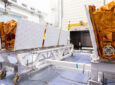



Part of the SpaceRISE consortium responsible for designing, building and operating the European Union’s forthcoming IRIS² multi-orbit satellite constellation, Paris-based Eutelsat will play a key role in providing secure and resilient communications for government and defense users via the 264-satellite Low Earth Orbit (LEO) satcom portion it will operate.
The primary driver for IRIS² is that it meets the EU’s sovereign broadband interests, which is especially important given persistent geopolitical volatility. SpaceRISE partners SES and Hipasat will respectively operate the 18 Medium Earth Orbit (MEO) satellites and the small ‘Low LEO’ sub layer that, together with the LEO network will comprise the multi-orbit IRIS² constellation.
However, the satellites will be dual-use and able to facilitate commercial applications, including inflight connectivity in civil aviation in the post-2030 era.
Optical inter-satellite links (OISLs) will feature in the European Commission-led scheme. But Eutelsat’s current 654-satellite OneWeb LEO network relies on a gateway ground segment as opposed to OISLs, and ergo faces capacity constraints.
And so, we wondered, what will laser links mean for the passenger experience when IRIS² is online?
We put the question to Eva Birgitte Bisgaard, the president of Eutelsat’s Connectivity Business Unit, who is a major proponent of the resilience provided by multi-network and multi-orbit connectivity for military, government and indeed civil aviation.
“It’s going to be more about the capacity and the speed that is going to be available,” Bisgaard said of the benefit of OISLs to the passenger experience. “And so, if you have more speed and capacity available to actually serve a single airplane, then that might be something, but it is not even necessarily the truth. Because, as long as you’re combining different technologies today, or the multi-orbit, it is not necessarily something a passenger will experience.”
To her point, Eutelsat’s OneWeb LEO service is presently helping to support IFC on several hundred aircraft in the world fleet as integrators SES and Panasonic Avionics use it to power the LEO portion of their multi-orbit LEO/GEO IFC solutions. And passengers seem delighted with the performance. It certainly impressed your author on a recent Air Canada roundtrip between Washington Dulles and Montréal-Trudeau to visit Airbus’ A220 final assembly line in Mirabel. I was aboard an E175 fitted with SES’s multi-orbit IFC service inclusive of OneWeb LEO service, and the free Wi-Fi experience was virtually flawless.
In the future, when the MEO portion of the multi-orbit IRIS2 network is in play, the MEO satellites, with their wide coverage footprint and longer dwell times, will do some clutch work in reducing the number of handovers, and step in to cover service interruptions in certain parts of the world.
The OISLs, meanwhile, “make sure that the connectivity holds on a greater space because you don’t need to land the traffic. It will be able to potentially also reduce, to some extent, the latency. But already now we’re so far down the line [in delivering low latency via existing OneWeb LEO] so it might be in some use cases, but not others,” Bisgaard noted in reference to the passenger experience.
In short, passengers probably won’t notice when the laser links are in play, but they’ll do important behind-the-scenes work just the same.
Laying the foundation for IRIS² and bridging the gaps
To date, Eutelsat has ordered 440 replenishment satellites from Airbus Defence and Space to ensure operational compatibility and continuity of its current OneWeb Ku-band LEO constellation. Part of a ‘stepwise approach‘ to a Gen 2 network, the new satellites will replace early OneWeb satellites when they reach the end of their operational life and are expected to be aligned with the ultra-secure architecture required for IRIS².
In a bridging measure, during the ramp up of the IRIS² program, Eutelsat will provide OneWeb LEO satellite capacity across multiple areas of strategic interest to the French Armed Forces, under a new agreement between the two.

Several other important steps have been taken — and decisions made — around the IRIS² multi-orbit network, even as the SpaceRISE consortium players hone their plans.
In January, SpaceRISE announced that Ka mil capability had been brought into use via a dedicated LEO satellite operated by Eutelsat. “By leveraging Ka mil, a part of the Ka frequency range harmonised for military and governmental use, SpaceRISE thereby secures its filings of Europe’s Ka spectrum on the IRIS² orbit,” the consortium said.
“Facing pressure from European governments to limit its schedule delays,” IRIS² will also see the addition of 66 smaller satellites for the LEO component to “assure launches starting in 2029, with the full-capacity 264-satellite system to be launched around 2032,” Space Intel Report revealed in a 15 June post.
Given IRIS²’s multi-band, multi-orbit capabilities, it’s easy to why Eutelsat’s Bisgaard is also keenly watching the evolution of antennas, including in the aero market.
“I think anything that we can do to combine multi-band and multi-orbit is going to be better,” she said, adding that it’s “going to be an absolute upside for aviation in general, because you will simply have more options. And if you have more options in there, you’re going to have a greater resiliency within the setup.”
Related Articles:
- Now critical IFC needs resiliency, security: Eutelsat’s Bisgaard
- Advancing multi-band ESA development Kymeta eyes aero
- SES advances work on multi-band ESA for meoSphere + LEO IFC
- Viasat sees runway for EAN in EC’s 2 GHz MSS decision
- Hughes stays flexible with ESA, double-ESA and hybrid ESA-VICTS IFC
- SES meoSphere will be core to new MEO/LEO inflight connectivity
- Eutelsat reports ‘strong progress’ in IFC as LEO revenues take off
- Immfly targets budget airlines with OneWeb LEO IFC, Gogo antenna
- Eutelsat OneWeb takes stepwise approach to Gen 2 LEO network
- GEO satellite outage speaks to the value of Iridium LEO mesh. network
Featured image credited to SES