

Over a dozen years ago, Lufthansa started offering digitized newspapers and magazines to its guests, making them available for download before, during and even after their flights. After expanding the service in 2016, the German flag carrier’s siblings in the Lufthansa Group progressively followed suit.
Now, passengers across Lufthansa, Austrian Airlines, Brussels Airlines, SWISS, Edelweiss, Eurowings, Discover, Lufthansa City Airlines, and Air Dolomiti have access to complimentary ‘eJournals’, with the number of personal free downloads decided based on travel class and frequent flyer status.
But as the Lufthansa Group starts rolling out SpaceX’s Starklink Low Earth Orbit (LEO) satellite-powered inflight connectivity across its fleet — the solution debuted on August 19 on a Lufthansa A320neo — and more broadly, as airlines around the globe bring snappy non-geostationary satellite and multi-orbit IFC to their aircraft, where do digital magazines and newspapers sit in the discussion?
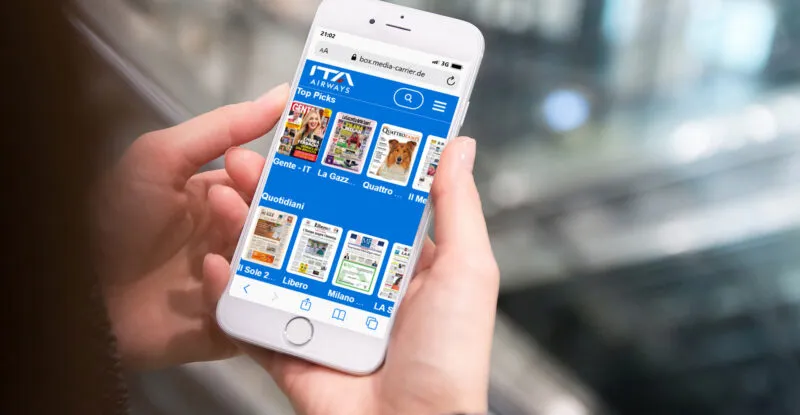
We put the question to Lufthansa Group’s longtime partner Media Carrier Solutions GmbH, whose Media Box digital library ensures that Group carriers and other airlines including American, EVA Air, ITA and LOT can provide their passengers with access to 1,600 editions of newspapers and magazines, podcasts and travel guides in over 40 languages. The titles can be made available as a pre-flight download, over the airline’s app, and/or via wireless IFE, embedded IFE, or indeed the inflight Wi-Fi portal.
“I’m not afraid of it,” Media Carrier Solutions managing director Sandra Bardewyck said of LEO connectivity during the Aircraft Interiors Expo in Hamburg. After all, she said, passengers continue to face paywalls for newspapers and magazines, whether they’re accessing them on the ground at their gate or in flight over the onboard connectivity pipe. “And I assume that not everyone has such a big variety of newspapers and magazines on their own phone. So there is still a lot of value in newspapers and magazines. That’s how I see it.”
Moreover, she told RGN, airlines are starting to realize the value of offering passengers a personalized experience, including tailored content, even as they simultaneously provide unfettered access to a streaming class of Internet service. “If I know that you are into cycling. I present you with a cycling magazine, and then probably put some advertisement in to gain additional revenues.”
Digital newspapers and magazines enable carriers to have a “containment” strategy for passenger eyeballs, agreed company business development director Patrick King, who reckons that Media Carrier can offer “the perfect personalization content type as we have something for everyone.” Crucially, this personalization can be more fully integrated into an airline’s app and e-commerce environment.
If you’re flying to Ibiza, for example, said King, then you might be presented with travel guides, but also perhaps you’ll see the latest breezy fashions and accessories being worn in this ‘nightlife capital,’ and be given the opportunity to buy them through the airline, “which is then available for you to collect when you land.” Content can also be paired with the airline’s pre-order menu or food and beverage program.
“Obviously, there are data security issues, GDPR, and so on, which is why the airlines will require and request you to have a membership with one of their loyalty programs, Miles & More or whatever it might be, to enable not just the containment of the eyeballs, but also to enhance your experience.”

Today, on short-haul flights, passengers remain keenly interested in newspapers and in skimming titles. “It’s a shorter dip-in,” Patrick said. On long-haul flights, there’s obviously “more relaxed and indulgent time,” and passengers can enjoy “a little bit of me-time” after clearing through their emails.
As a Gen Xer and a journalist, I fully appreciate the benefit of having access to the world’s best magazines and newspapers — without a paywall — at my fingertips when traveling. And I’m not surprised to learn that whenever this sort of content is offered via IFE, it ranks “within the top three sectors,” as King explained.
But younger demographics, including Gen Z and Gen Alpha, are relying on social media for news and entertainment. How can Media Carrier ensure containment of avid TikTok and Instagram users for airlines?
“Some of the legacy brands, obviously, are continuing to have a presence in social media, but as you say, their stickiness with the young people isn’t the same,” King replied. “So we’re doing simple things like creating a synopsis for a title because there could be a newspaper or a fashion magazine that’s been around, like maybe Harpers and Queens or Tatler, that doesn’t resonate so much with the younger audience, but the fact that they can deliver fashion and lifestyle that maybe you’ve never experienced before, if you present the right synopsis to a person that’s never seen the brand before, you then bring them in.”
In short, text or RRS (really simple syndication) feeds for certain content can entice audiences.
Media Carrier works closely with publishers to make sure it is developing and delivering content in the most user-friendly fashion across passenger devices, IFE systems and even the AI-powered smart glasses which are gaining traction in homes, at work, and in non-aviation modes of transport like trains and cruise ships.
“So we’ll just be working with those publishers to make sure that that kind of content is displayed in the same passionate, fantastically modern way as trends change,” King said.
Meanwhile, to ensure relevant personalization and meaningful recommendations around lifestyle and retail — in addition to content — on board aircraft, Media Carrier has products “ready to go” for airlines, he revealed.
Related Articles:
- Lufthansa installs Starlink on A320neo for August 19 debut
- Bluebox ‘unboxes the blue’ to drive ROI for connected jets
- American talks RFP as it readies to bring screens to narrowbody fleet
- American pivots to Starlink for 500-plus Airbus narrowbodies
- How Anuvu is using AI to make the world’s content fly
- RAVE supercharges IFE development with new OS and App Marketplace
- Do fast Wi-Fi and the shift in media consumption portend BYOL IFE?
Featured image of ITA Airways’ implementation of the Media Box is credited to Media Carrier