
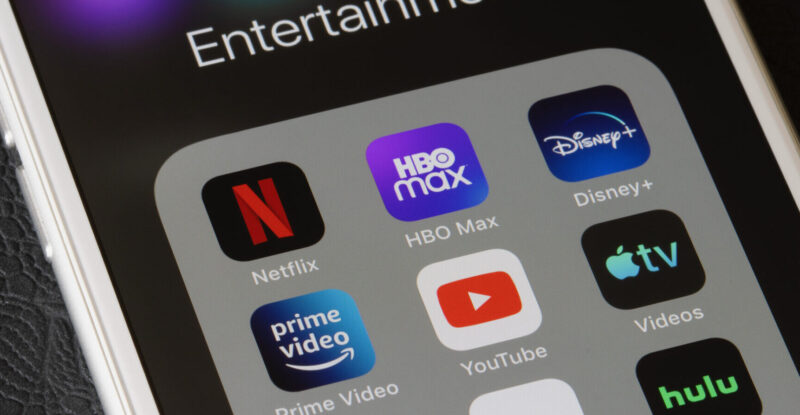

If a major streaming platform ever owned a major Hollywood studio, would it change the trajectory of inflight streaming and by extension, the trajectory of the inflight entertainment and connectivity market?
With the world’s top two streaming platforms, Netflix and Amazon Prime, firmly in mind, and against a backdrop that sees a meaningful portion of the world fleet being fitted with fast, streaming-capable non-geostationary satellite orbit (NGSO) and multi-orbit satcom, that’s the question I posed in late January during the APEX TECH conference in Los Angeles.
After all, Netflix — with over 325 million global paid subscribers — was then still favored to acquire Warner Bros. Discovery (WBD) and with it WBD’s vast library of content including more than 7,000 movies and 30,000-plus series, as well as its top-notch HBO/HBO Max content. What would have stopped Netflix, which boasts its own impressive Netflix Originals programming, from extending terrestrial streaming rights to the inflight realm expressly for its own content — if it saw fit to do so?
Had the proposed transaction been consummated, Netflix would surely have dictated where and when its own amazing content could be legally viewed, including deciding on whether or not the content could be streamed over broadband inflight connectivity pipes to passengers’ own devices. Cast your minds back to 2015 for a moment, when Netflix’s then-chief product officer Neil Hunt told Digital Spy that the firm had designs on dominating IFE, by either slapping a ‘box‘ (server) on board aircraft or ferrying it via next-gen inflight Wi-Fi.
(For the uninitiated, as a quick spool up: even though free, streaming-capable broadband inflight Wi-Fi has technically been available since JetBlue set the original standard with the launch of Viasat’s high-capacity Ka-band satcom service in 2013, the lion’s share of movies and TV series consumed in flight are stored in onboard servers, and supported by a licensing model. This model sees the airline first license the content from the studio, usually by working with a trusted content service provider. The content is then encoded, encrypted, and often edited or censored before being uploaded to onboard servers and broadcast to passengers via studio-approved IFE systems — either wired systems such as seatback screens or wireless via a portal. In short, the aircraft is legally considered a broadcast venue and the airline pays for the privilege to broadcast content to passengers.)
But while my question at APEX TECH was relevant just two-and-a-half months ago, it is moot, at least for now, as Paramount on 27 February entered into a definitive agreement to acquire WBD. The move will obviously create another global streaming competitor in the market, giving Netflix and Amazon Prime a run for their money, not to mention Disney+.
Yet, the marriage has other implications.
Once the deal is done, subject to customary closing conditions, Paramount has signaled its intent to retain a more traditional ‘windows of release’ model, wherein the theatrical feature films it commits to deliver every year from each of the two studios “will receive a full theatrical release, with a minimum 45-day window globally before becoming available on paid video-on-demand (VOD), with the intention of 60-90 days or more to maximize the audience for our most successful releases.”
Ostensibly, Paramount’s decision will help to preserve the early, albeit-shrinking ‘nontheatrical window’ that airlines, cruise lines, schools and other venues continue to enjoy after a movie’s theater run (these days, a lot of new films arrive on board — prepped for the inflight market — just before or roughly in parallel with when they hit the VOD market).
Legal uncertainty and renewed caution
The revenue generated by licensing to the nontheatrical market is nothing to sniff at, mind. Indeed, it is still quite valuable to movie studios. And so, there’s a lot at stake.
Flanked by executives from Paramount, Disney, BBC Studios and Sony, Airline Passenger Experience Association (APEX) CEO Dr. Joe Leader last fall warned airlines at the APEX Global EXPO in Long Beach that there is legal uncertainty around whether the terrestrial rights covered in passengers’ streaming subscriptions extend to the onboard environment — most especially when traveling abroad and overseas where geo-restrictions are imposed. Paramount Pictures vice president non-theatrical sales Vince Cruz said at the time that it is simply “incorrect” for airlines to assume they can circumvent licensing in favor of streaming, and that airlines should make customers aware.
Since that seminal conference session last fall, a few rather meaningful things have happened in industry.
For starters, APEX has committed to deliver the first tail number-specific, globally auditable reporting structure for licensed inflight content usage under its so-called FlightTrack initiative. FlightTrack complements the association’s APEX STREAM (Standardized Technical Rights Enforcement for Airline Media) framework, which is designed to gather feedback from airlines, studios, content service providers and IFC companies with a view on clarifying the licensing landscape as it pertains to inflight streaming.
Spearheading both FlightTrack and STREAM as director is Thales executive and long-time industry veteran Jon Norris, who said at APEX TECH in January that FlightTrack is an information-sharing exercise.
What we’re doing is providing a service, which is just an auditable database of the flights that took place, and then we’re providing that data to the studios and distributors, and they can do what they choose to do with that information.
Moreover, since this activity began, RGN has observed that many (though not all) airlines and certainly most of the world’s top-tier inflight entertainment and connectivity stakeholders are exercising caution when touting streaming-capable connectivity on board aircraft.
Even some newbies to the IFC space are being careful with their words.
Will we arrive at a Bring Your Own License (BYOL) model for IFE?
I know what you might be thinking: in a world where ubiquitous connectivity is a thing, and we are accustomed to streaming content over-the-top to our hearts’ delight on the ground, the idea that airline passengers must wait until their airline-of-choice licenses a movie and physically stores it in a traditional onboard server before it’s either technically available or explicitly legal to view in flight seems a little…archaic.
Personally, I have two minds on the matter. As a content creator, I understand that, when it comes to their own copyrighted material, studios absolutely get to say — to quote Vivian in the movie Pretty Woman — “I decide; I say who, I say when.” As Norris stressed during his FlightTrack update, U.S. copyright law, which was established in 1976 and updated for the Internet age in 1998, dictates that any performance or display outside of a private dwelling, including aircraft cabins “is considered public and generally requires a license. So it’s about location, and it’s not about how the content is consumed.”
On the other hand, this warning from APEX and studios comes at a time when the mix of content we consume has changed, and doomscrolling is a pastime! Sure, some of us jump from Instagram to a streaming platform to consume a particular movie after the algorithm serves up a teaser and a reminder about our favorite type of content (that’s why I ended up watching The Help for the fourth time last week). But if there is legal ambiguity around whether airline passengers are permitted to access OTT subscriptions in flight, or if actual roadblocks are put in place to prevent streaming and preserve the traditional inflight licensing regime, won’t passengers simply say, “okay, I’ll just check out Instagram or TikTok or YouTube” using the high-speed Internet connection on board?
In short, won’t more eyeballs be lost to the socials? And so the question becomes, does it make sense to hold back the tide on the Bring Your Own License (BYOL) model in flight?
It’s true that some airlines, working with their content service providers and select streaming platform sponsors, already offer cleverly-curated and cached content IFE channels that deliver movies and TV series created for the direct-to-consumer market but which are not explicitly delivered over a live inflight connectivity pipe. This exposes the streaming platform’s brand to passengers, who might not even realize that they’re viewing content stored on board.
But passengers also want to be able to pull up their streaming subscription on the seatback and avail of the latest blockbuster, or continue the movie they were just watching in the lounge or at home. And importantly, with the introduction of fast inflight connectivity and edge caching technology, which enables individual streams to be temporarily stored on board for replay to other passengers, in turn preserving bandwidth, the technical barriers (which were flagged by industry just three years ago as the main inhibitors to this model) have been removed.
And so, from this vantage point, despite all the hand-wringing, it feels like the momentum is behind a BYOL model for IFE, especially as seatbacks get connected. But what do some of the world’s top IFE and connectivity companies think?
Panasonic Avionics
I posed the question to Panasonic Avionics vice president of product & portfolio management Andrew Masson during APEX TECH.
Said Masson:
The market is both smart and knows what it wants. Eventually someone’s going to realize that they can make money out of streaming, and it’s going to happen. I think it’s up to us to empower it.
When airlines get together, they’re collectively able to make shifts like streaming happen pretty quickly. If it were me, I just go and set myself up at one of the major sponsored movie events, like the Oscars or the Golden Globes, and say, ‘We’re representing these airlines, and we’d like to get your content on board. And, by-the-way, we serve over 4 billion people a year.’ Someone’s going to think ‘4 billion people, charge ‘x’ cents per person. Yeah, no problem.’
The way we all consume media has changed in the last few years, the pax experience is ready for some disruption. It can save airlines money, and gather rich content, and negate the need for a once-a-month media load for each airplane.
So, I’d say it’s simply a matter of time until it changes. It’s more a matter of when, and who’s going to lead that change?
Perhaps, then, it’s just a matter of getting the appropriate agreements in place with studios, and the financials correct, to ensure that airlines, their IFC service providers and indeed any of us passengers who pay attention to potential liability, can breathe easy.
Media is changing, Masson noted to RGN, citing for example that Prime spent over $700M to make the first season of The Lord of the Rings: The Rings of Power, which was “a lot of money, for 10 hours of content.” And yet, today, he said, “YouTube dropped 100 million hours of content and didn’t spend a dime, and some of it is really good. I’d certainly watch it over some of the ‘professionally produced’ shows that have been released recently.
“There’s some tremendous, rich and amazing home-produced content out there. Your 4K cell phone enables you to create cinema-grade content, yourself, in your house, and highly creative people are making the most amazing things.”
Satellite operator and aero ISP Viasat
In addition to powering IFC with a high-capacity Ka-band solution, Viasat is preparing to offer an Amara-branded multi-orbit IFC offering inclusive of Telesat’s Lightspeed Low Earth Orbit (LEO) service.
“Streaming onboard has been possible for quite some time — we were delivering it to passenger devices as far back as 2013,” noted Don Buchman, president, Viasat Aviation. “The limiting factor hasn’t been physics or network capability, it’s how content licensing adapts to a world where passengers are traveling globally, but still want access to familiar sports and programming from home.
“As those licensing models evolve, the inflight experience will increasingly reflect the connected expectations people have wherever they travel.”
Satellite operator and aero ISP SES
SES currently enables geostationary (GEO), multi-orbit LEO/GEO and MEO/GEO inflight connectivity solutions in aviation, and is developing a next-gen MEO/LEO offering for 2030 and beyond. It is also exploring cross-unit content bundles between its media and aero or cruise businesses, as the passenger experience evolves.
Company senior product executive Blane Boynton said he is personally “inclined to believe that the seatback experience is going to mature and is going to fall along the lines of some of these platforms that we all use every day. And I think whichever team can enable that first will actually have an advantage.”
Thales
Will the BYOL model emerge, including for the seatback screen as fast connectivity becomes ubiquitous in the world fleet (and edge caching also becomes the norm), we asked Thales?
“Ultimately it is going to be very difficult to fully control,” said Kurt Weidemeyer, who serves as vice-president, product management for Inflyt Experience at Thales.
“People will bring what they want on the aircraft and we are enabling the technology with the screen. We will follow whatever guidelines are accepted by the industry in the future.”

However the landscape shifts out, the major embedded IFE companies are clearly preparing for any eventuality with their connected seatback IFE work.
Panasonic’s connectivity-native, next-gen Astrova embedded IFE system can easily facilitate integrations with passengers’ personal subscription services. One of its big customers, United Airlines, already has an agreement in place with Spotify which will enable passengers to use their personal devices to log in to the Spotify app on the IFE screen, and then enjoy their favorite personalized content on the seatback. So they’ll be able to pick up their favorite podcasts, music, and audiobooks from right where they left off.
For its part, Thales has already won Qatar Airways and Delta as launch customers for its Crystal Cabin Award-winning FlytEDGE system, which features the industry’s first blade architecture and 96TB of storage to enable onboard edge caching.
RAVE on bringing short-form content to the seatback
Meanwhile, RAVE Aerospace, formerly known as SPI, is putting the wheels in motion to accommodate the new media mix via the seatback.
Having showcased passenger PED mirroring and casting functionality on its RAVE Ultra IFE system at last year’s Aircraft Interiors Expo in Hamburg, RAVE Aerospace vice president, products and strategy Ben Asmar later told RGN at APEX TECH that the company is “looking at non-traditional media or non-traditional content owners and saying, okay, maybe we can approach those guys and say, ‘hey, there’s a huge demand for short-form content, for social content. Maybe we can start by bringing some of that to the casting capability [for in-seat IFE].
“First, start getting some excitement in the industry, start getting people seeing, ‘okay, this is possible.’ And maybe that brings some of the other guys on board…”
Related Articles:
- Panasonic enjoys rapid IFE growth as connected seatback takes wing
- Studios warn airlines: don’t bypass content rights in flight
- Warner Bros. Discover reveals the value of time-tested favorites
- How United is leveraging Starlink and the cloud to enhance IFE
- Connected seatback at the fore as RAVE Aerospace enters new era
- Delta seeks to gain edge with Thales FlytEDGE
Featured image credited to istock.com/hapabapa