

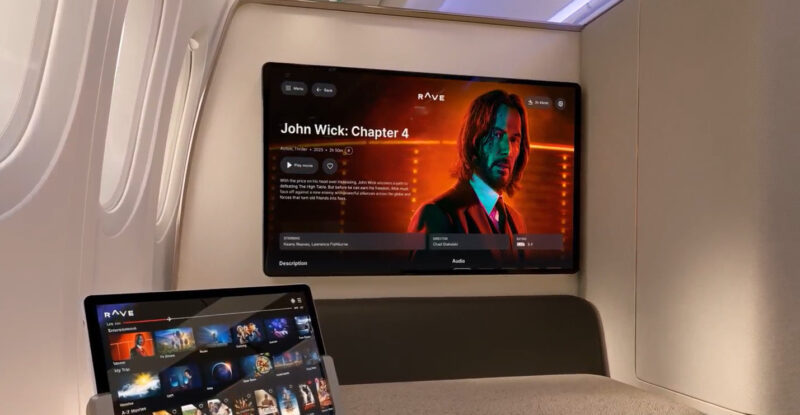

Seeking to accelerate development cycles in inflight entertainment and bring dramatic enhancements to the passenger experience — including via artificial intelligence — RAVE Aerospace has invited third-party app developers to build on RAVE OS 2, the new open platform for its RAVE IFE systems.
The move is part of a fundamental shift in how the Brea, California-based firm is addressing the IFE market. Moving away from closed, hardware-defined systems, RAVE Aerospace is embracing an open approach that will evolve over time by utilizing some of the best and brightest apps in the industry whilst stimulating more app development in the space.
“With RAVE OS 2, we’re introducing two new digital products” to support this shift, RAVE Aerospace vice president, products and strategy Ben Asmar explained to Runway Girl Network at the Aircraft Interiors Expo in Hamburg.
“One is called the Developer Suite,” which provides a comprehensive software development kit with APIs, allowing developers to build applications for RAVE IFE systems, he said.
“So, RAVE Aerospace doesn’t have to go and build all the applications. We can start using a community of developers to go make features.”
We’re also going to deploy something called the App Marketplace.
So, if a developer makes a great app, we can put it in the App Marketplace. We can pre-test it, we can make sure the application works with our system, and then we can make it available to airlines to download and deploy to their fleet.
In this way, RAVE Aerospace hopes to see IFE development cycles start to move as quickly as other industries. And, as developers bring AI advancements to mobile applications on the ground, they can do so for the inflight audience.
“We think the sum of the parts of different people can make much more meaningful experiences,” Asmar said. “We can go and get an expert in maybe shopping apps, put that shopping app in the app marketplace, and all of a sudden, we can bring that expertise in. We provide a set of tools for them to make their application available, and then it’s available for the wide variety of airlines to purchase, so they get some value from that, and the airlines get some fantastic apps.”
In tandem with this more open approach, and now paired with RAVE OS 2 is the introduction of Harmony, RAVE Aerospace’s new standard graphical user interface (GUI).
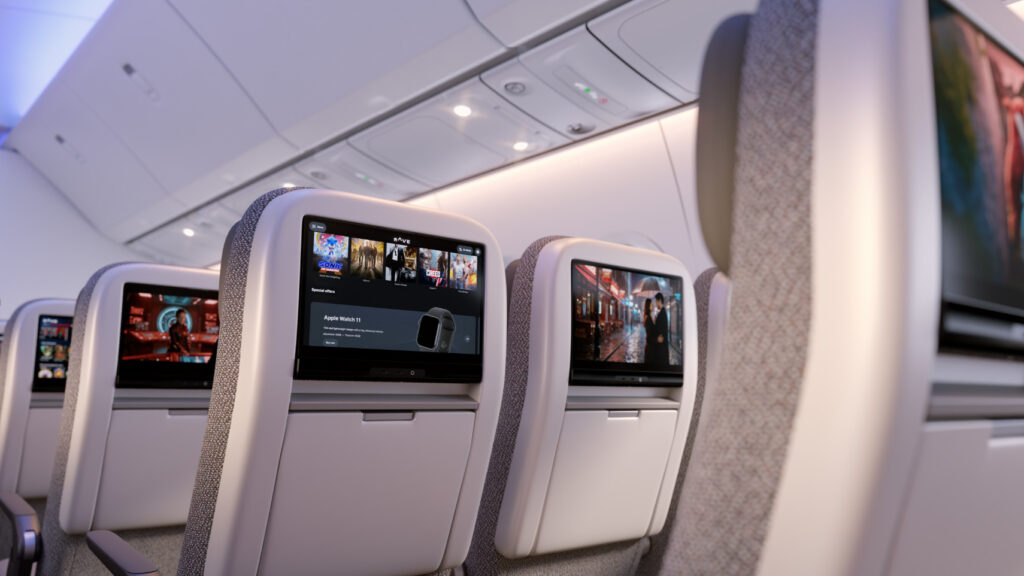
Developed in collaboration with technology consultancy and digital agency Reaktor, Harmony makes the IFE system easier to navigate and feels more natural than prior-gen GUIs. That’s because RAVE Aerospace has adopted features that will already be familiar to passengers, like the ability to scroll up and down, which is new for the RAVE line, as well as scroll across just like on popular over-the-top (OTT) streaming platforms.
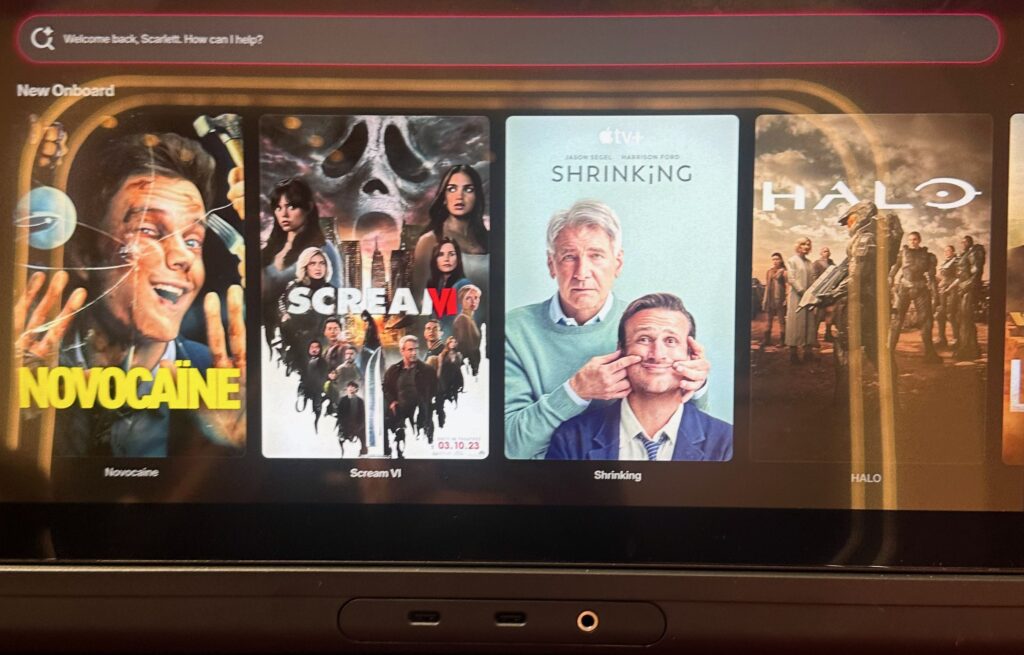
“Getting on an aircraft is challenging because you’ve got a very short amount of time to understand how to use all the technology. So, we can make it feel familiar to someone,” Asmar explained.
Hero widgets, the sort of premium banner spaces seen on OTT platforms, are present in Harmony, providing rich information including ratings, descriptions and subtitle info, as well as suggestions for similar movies.
With Harmony, RAVE Aerospace has also introduced the concept of live widgets, with Asmar showing us how FlightPath3D’s hugely popular moving map can live in a live widget on the screen and then, if the passenger opts to more fully jump into the map, they will be taken there instantly with no load time whatsoever.
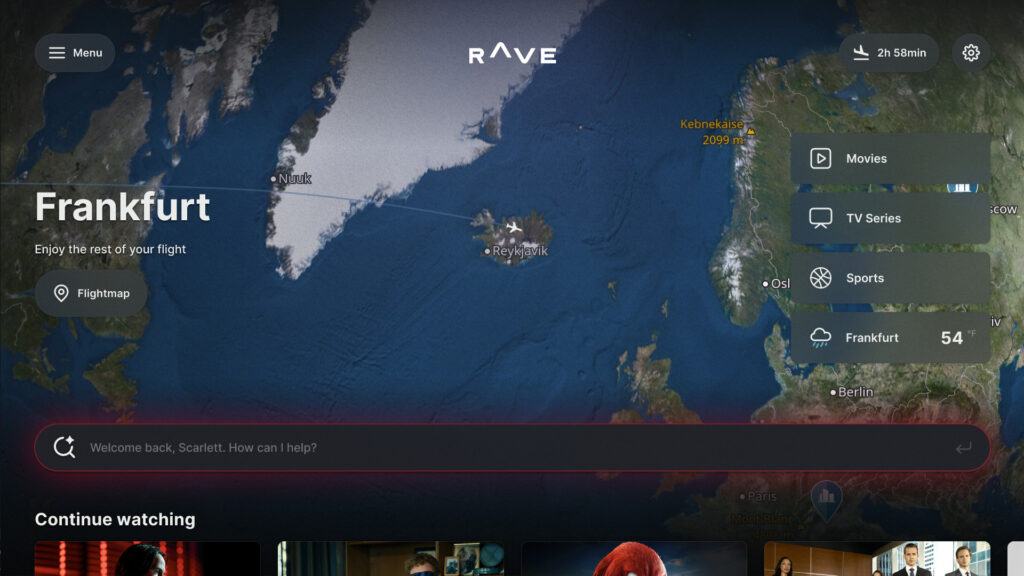
In keeping with its strategy of having an open platform for apps, RAVE Aerospace does not intend to produce its own in-house moving map application. Rather, it partners with FlightPath3D.
“Without any doubt, they have the best map,” Asmar said. “It’s so responsive, and it looks beautiful.”

Asmar demonstrated Harmony to your author at AIX 2026, including the FlightPath3D live widget. Image: Mary Kirby
Notably, AI in the form of an agent has been directly introduced to the Harmony interface, giving passengers another way to navigate the system. The chatbot can also effectively serve as a copilot, diving into the large (and ever-growing) language model on board to offer suggestions and options.
Information, such as the airline’s onboard menu, can also be ingested to offer compelling content and meal pairing suggestions, and create ‘surprise and delight’ moments for passengers.
Thinking about watching a James Bond movie?
Perhaps a vodka cocktail would hit the spot, the IFE bot suggests. Shaken, not stirred… naturally.
“We think this is really the future interface of IFE. It just takes you there right away,” Asmar noted.

RAVE Aerospace is clearly building on the solid foundation it created when it developed RAVE 5, the forthcoming fifth generation of its RAVE IFE system, which boasts a Snapdragon dragonwing processor with a dedicated AI neural processing unit in it. “That allows us to actually do some pretty cool things” even in a disconnected environment, Asmar said.
Eventually, passengers connected via Bluetooth headsets to the IFE screen will be able to speak to the IFE system, and have a natural conversation with it just as they would any other chatbot.
Adding broadband connectivity to the equation to support a truly connected seatback experience will also bring new opportunities.
Harmony will launch on RAVE 5 in either late 2027 or early 2028, but it also works on the RAVE Ultra Plus, RAVE Ultra “and even right back to RAVE generation 2” displays, Asmar said of the scaled back version available for even legacy kit.
“So that allows airlines who have multiple generations of RAVE equipment to harmonize their experience across their entire fleet.”
Related Articles:
- Fast-growing RAVE Aerospace identifies choke points
- Connected seatback at the fore as RAVE Aerospace enters new era
- Thales’ new Tandem OLED-based FlytEDGE Aura IFE shines bright
- RAVE Aerospace nixes proprietary antenna work as LEO shapes IFEC
- Panasonic Avionics sees Astrova Curve debuting in first class
Featured image credited to RAVE Aerospace