

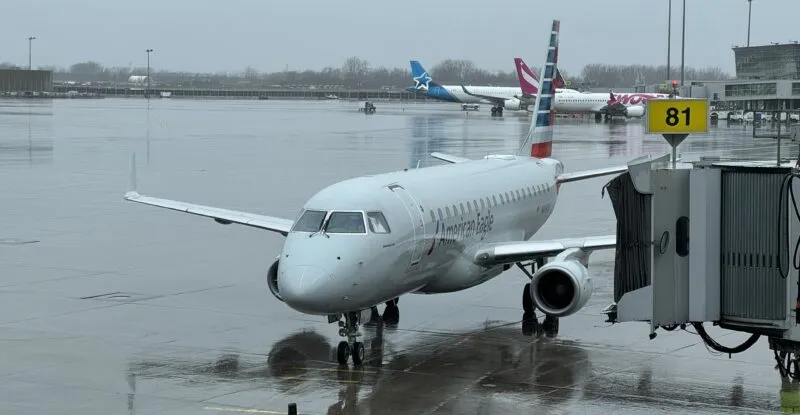

SES expects to have completed more than 700 installations of its multi-orbit electronically steerable antenna (ESA)-based inflight connectivity solution by year-end, and has slashed the amount of time it takes to retrofit the system to aircraft.
As of early November, the satellite operator and aero ISP had activated service on some 230 ESA-equipped aircraft year-to-date, bringing its total installed base to roughly 650 aircraft, including 538 regional jets at American Airlines.
“By the end of the year, SES will have completed over 700 installations across a range of aircraft types from RJs to widebodies,” SES said of the IFC system, which utilizes Gilat’s Stellar Blu Sidewinder ESA and ferries data via Eutelsat OneWeb’s low-latency Low Earth Orbit (LEO) satellite network and SES’s geostationary (GEO) satellites.
The timeline for reaching this point has, however, taken longer than expected — and there have been some learnings along the way.
After American Airlines subsidiary PSA replaced legacy air-to-ground IFC hardware with the SES ESA solution on its CRJs, president and CEO Dion Flannery shared color about the process.
“What began in 2025 with initial installation evolved into a program spanning multiple locations and vendors,” Flannery said. “Installation teams completed six-day modifications removing interiors, installing structurally mounted electronically steered antennas and integrating advanced systems that dramatically improve performance.”
Since then, SES reports that it has significantly reduced equipage time.
“We’re continually applying the learnings from these installations to refine the service, streamline installation processes, and reduce installation times, which is now down to less than 36 hours per plane,” the Luxembourg-based company said.

As Starlink and other non-geostationary satellite-powered IFC systems gain traction in aviation — including SES’s own cadre of multi-orbit products — the firm has also seen some decommissions of its GEO-focused IFC at airlines. There has been an upside, however. During the first quarter and third quarter, management achieved what it calls “favorable restructurings” of aviation contracts, freeing up satellite capacity for new customers.
Moreover, for the nine months ended September 30, SES saw growth momentum in mobility, as driven by aviation, including due to the positive contract restructurings “as well as higher service revenue from existing customers, partially offset by lower ESA shipments and the decommissioning of certain customers,” CFO Lisa Pataki said on SES’s Q3 earnings conference call. Looking ahead, she said, SES expects service revenue to continue to increase.
Having recently won Finnair and Air Astana as new customers, and after bolstering deals with LATAM, American Airlines and Avianca, SES has secured more than 1,330 aircraft commitments for the ESA-based solution. It believes its offering, which is seeing “over 99% availability” on fitted aircraft, is competitive with Starlink.
“We’re also seeing customers in aviation begin to tell us that they want options. They are not looking for just one solution, and that plays well into the capabilities that we have,” SES CEO Adel Al-Saleh said on the Q3 earnings call.
Related Articles:
- LATAM to connect Panasonic IFE with SES multi-orbit on A321XLRs
- Embraer moves with speed to factory-fit multi-orbit IFC to E2
- ThinKom eyes Airbus HBCplus modular for Nexus aero antenna
- Air Astana equipping A321LRs with SES multi-orbit IFC
Featured image credited to Jason Rabinowitz