


Keen to maximize inflight connectivity optionality for airlines, ThinKom Solutions has designed its new Ka-band multi-orbit ThinAir Nexus aero antenna to be small enough to fit into the form factor of Airbus’ linefit, supplier-furnished HBCplus modular architecture — and has even left enough room for the kit to be paired with a LEO-only electronically steerable antenna (ESA).
ThinKom is waiting to get some feedback from Airbus and HBCplus managed service provider SES about the exact sizing required to slot into HBCplus modular, which can connect to multiple satellite systems and is slated to debut in 2028. But the information shared thus far indicates that “Nexus is small enough that we could fit in the Airbus form factor and leave adequate room for an ESA,” ThinKom chairman and CTO Bill Milroy revealed to Runway Girl Network.
A modular, low-power terminal that can work gate-to-gate, Nexus is compatible with SES’s current Ka-band multi-orbit MEO/GEO Open Orbits network, which is presently supported by ThinKom’s popular ThinAir Ka2517 VICTS mechanically-steered phased array antenna.
Far smaller than Ka2517, and smaller even than the Ka1717 for regional jets, Nexus is also expected to be compatible with SES’s future Ka-band meoSphere MEO network, Milroy said.
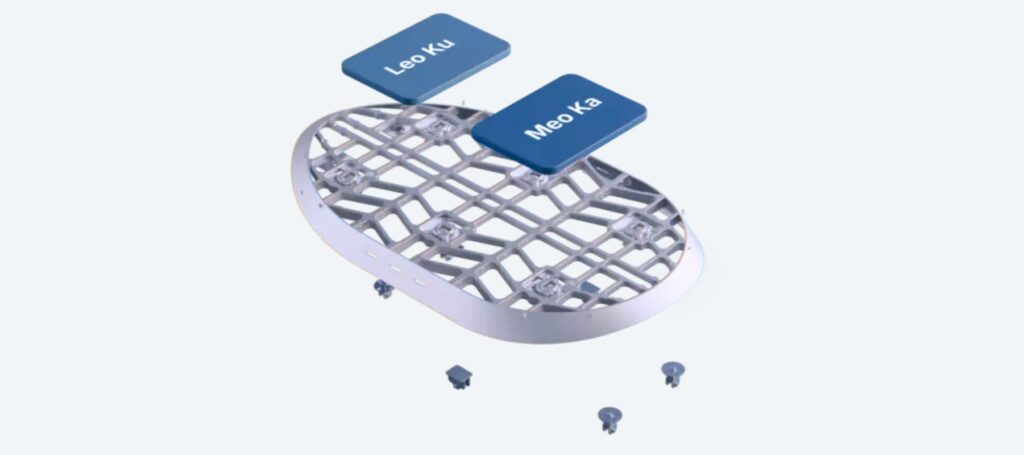
Shown in renderings, Airbus’ HBCplus modular architecture can accommodate multi-orbit, multi-band, multi-network configurations. Image: Airbus
In keeping with ThinKom’s agnostic approach to hardware, and indeed in line with Airbus’ own HBCplus remit to uncouple hardware from the service, Nexus is envisaged to also work on Hughes Network Systems’ high-capacity GEO services, and on Telesat’s forthcoming Lightspeed LEO network, which Hughes intends to support as part of its portfolio of multi-orbit IFC services and as an HBCplus MSP.
As such, should Nexus clear the necessary hurdles at Airbus to be deemed a supplier-furnished option under HBCplus modular — and if other LEO satellite networks on the program remain open to such pairings — airlines would have a variety of compelling multi-network options, including the ability to augment GEO/LEO (Hughes GEO + Lightspeed LEO) with a second LEO pipe, purely for example.
Moreover, the technological stage would be set to support a multi-vendor environment, or as Milroy calls it, “multiple operators” to enhance resiliency, maximize commercial optionality including with a possible ‘least cost routing’ approach, and address the growing need for sovereign optionality. This in turn would ensure that airlines are not “locked in” to any single provider.
There are some unknowns, however, including whether HBCplus MSP Amazon Leo would ultimately be willing to pair a smaller ESA, akin to its consumer-facing Nano, with other aero terminal hardware.

ThinKom has also designed Nexus to be maximally flexible for Boeing operators and in the aftermarket. “It’s compatible with Boeing’s Aerodynamic Shroud,” Milroy revealed. And while it can follow the ARINC 792 standard and utilize an adapter plate, it doesn’t have to follow a standard.
Given that Nexus features a power in, Ethernet out approach, ThinKom can also “put the modems on the outside, which is what a lot of the airlines are asking us to do,” he said.
ThinKom is focused on offering Nexus in the Ka-band first, but it may develop a Ku-band version if there is demand. And Milroy thinks there might be an opportunity to reengage with OneWeb via parent Eutelsat down the road on the issue of potential compatibility. Close observers of the inflight connectivity industry understand what an optionality boon this would be for airlines.
Part of a terminal integration package provided to Airbus by RAVE Aerospace, ThinKom’s Ka2517 kit is offered in the here-and-now under the airframer’s linefit, supplier-furnished HBCplus flex program. The hardware is also in line to be fitted to some Delta aircraft alongside a OneWeb LEO-only ESA as part of Hughes Network Systems’ Hughes Fusion product.
Airbus indicated recently that it’s also fielding interest from airlines for multi-orbit IFC via the HBCplus flex Ka2517 kit to support Lightspeed LEO and GEO services.
Related Articles:
- Beyond Starlink: What comes next for inflight connectivity?
- Airbus fields interest in HBCplus to support LEO + GEO IFC
- Digital & Connectivity underpin Airbus Global Services Forecast
- SES meoSphere will be core to new MEO/LEO inflight connectivity
- Amazon Leo ESA, ThinKom Nexus and new Starlink kit break cover
- How Quvia helps airlines throw out the IFC playbook and take control
- Airbus open to IFC orchestration should multi-vendor take off
- Rise in sovereign satcom presents GEO-capable hardware opportunity