

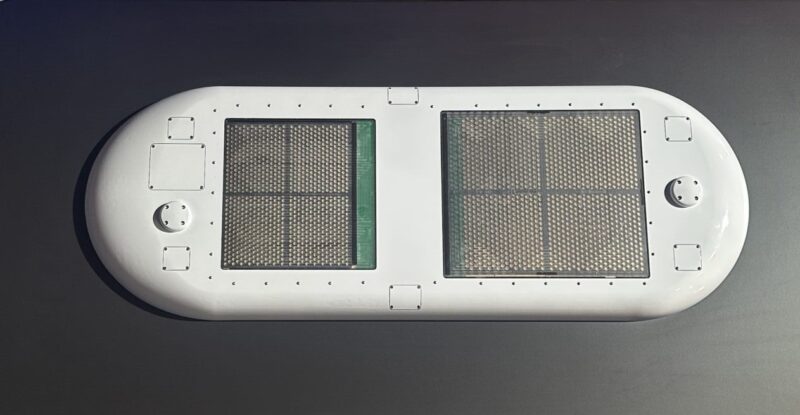

Panasonic Avionics in 2027 plans to offer a “truly global” multi-network Low Earth Orbit satellite-powered inflight connectivity solution — including across G7 and BRICS (Brazil, Russia, India, China, South Africa) countries — by pairing two LEO-only electronically steerable antennas (ESAs) atop aircraft fuselages to support service from Eutelsat OneWeb and China’s Spacesail.
Already an aero distribution partner for Eutelsat OneWeb’s Ku-band LEO service, Panasonic Avionics lately has been working under an MOU with Spacesail to leverage the Chinese satellite operator’s forthcoming Ku-band LEO network.
“We see the ability to have two terminals on board the top of the airplane — one from OneWeb and one from Spacesail — which will allow us to offer resiliency and redundancy,” Panasonic Avionics VP of connectivity John Wade told Runway Girl Network just before the Aircraft Interiors Expo opened its doors in Hamburg, and where company CEO Ken Sain announced plans to launch the global multi-network LEO IFC solution in 2027.
Panasonic will be responsible for blending and managing the hybrid OneWeb/Spacesail service for airlines. “We will be able to offer a combined network; we can do network bonding,” Wade explained. “So, we’d be able to bring the total speed of both networks at the same time, where we can operate them simultaneously. And we think it’s going to be a very compelling product for the future.”
With Spacesail targeting 500 megabits per second as an initial release, and OneWeb going up to 600 megs, “by bonding those two terminals you get a gig,” he noted.
Wade has for some time held the view that commercial airlines are going to migrate to LEO connectivity, and indeed that a double-LEO, double-ESA paradigm will emerge. “There are other LEO providers that tell you they’ve got approval to operate over certain areas, like China, where they don’t. And so, by adding a combination of OneWeb and Spacesail, we are going to be able to offer a totally global service,” he said.
Passenger behavior changes
Many airlines are still flying with Panasonic’s legacy Ku-band GEO-specific IFC solution, which is based on a gimbaled antenna architecture. And the firm recently launched multi-orbit, LEO/GEO IFC using Gilat’s popular Stellar Blu ESA (Air Arabia is a launch customer for the service.) As such, Panasonic is sitting on some interesting data. And, according to Sain, passengers are showing a clear preference for LEO-based IFC.
He explained at AIX:
We’re now seeing passenger behavior changes in both data use as well as type. On our LEO network, we’re seeing two-and-a-half times more data consumption versus GEO and the passenger behaviors — and what they’re doing on board — are actually changing.
On GEO, passengers browse the web, followed by the airline portal, which most airlines view as an engagement touchpoint for them. On LEO, passengers also browse the web, but the airline portal is being crowded out by video streaming as well as social media, and so the implication for airlines with LEO services is they must find ways to keep their passengers engaged in their digital engagement ecosystem.
And while LEO and GEO are great complements to each other, they are not perfect complements. GEO is a backstop for LEO coverage gaps and results in seven times higher latency, which is very noticeable to passengers. So the perfect solution is actually a global LEO network, but that solution appears geopolitically blocked and unlikely to change. Today’s LEO networks are aligned with G7 countries, or China and Russia, but not both. And so, even though they’re capable of operating all around the world, they aren’t authorized to work all around the world.
So, the best workable solution is a multi-network LEO solution, two geopolitically complementary LEO networks. And Panasonic is the first provider to announce a truly global LEO solution across both G7 as well as the BRICS countries. And our agreement to incorporate Spacesail, the number one China LEO provider, will do just that, offering more capacity, resiliency and flexibility in 2027.

RGN asked Wade if a 2027 go-live date is a little ambitious given that Spacesail is still very much in the build-out mode for its LEO constellation?
Color around the timeline
“Spacesail has got a couple of hundred satellites flying already. And they’ve got an aggressive launch schedule this year to put more capacity into space,” he replied.
“It won’t be truly global by 2027,” he said of the Spacesail portion. “It’s more like 2028, but the initial areas they’re lighting up are very complementary to OneWeb. So therefore, when we’re talking about this, the truly global LEO network, it deals with what Ken was talking about concerning the geopolitical issues that not every network will be able to work in every location. But if you put the two together that are complementary, you get truly global connectivity.”
In short, Panasonic can light up this global multi-network LEO IFC solution once key regions like China are covered with Spacesail capacity in 2027, as OneWeb is already technically global, even if it doesn’t have landing rights in certain countries.
Hardware-wise, Panasonic has already selected a LEO-only ESA from Intellian, which was on display both at the Intellian stand at the recent SATShow in Washington D.C., and later in a private room on Panasonic’s stand at AIX.
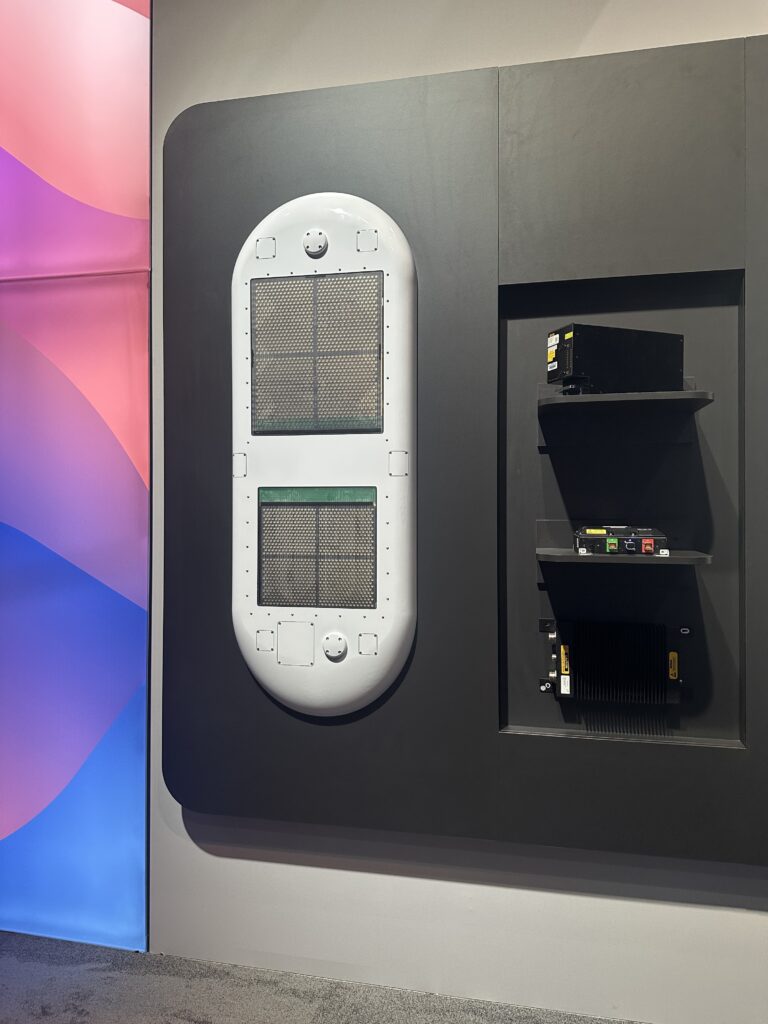
Panasonic’s LEO-only ESA, made by Intellian, is expected to enter into service in 4Q 2026, likely in support of a OneWeb-specific supported offering. The ESA, which can also serve as an augment to Panasonic’s GEO gimbaled antenna, was on display on Panasonic’s stand at AIX. Image: Mary Kirby
Spacesail has also selected its chosen ESA hardware to power IFC. Wade was not at liberty to disclose details about the kit, citing confidentiality, but said, “they have close-to-production hardware, and we are going to be doing something very similar that we did with Intellian, which is to take essentially equipment for another market and then ruggedize it for aviation. So that’s how we propose to get a terminal to market for Spacesail very quickly.”

A longtime supporter of GEO-based IFC for the Chinese market, Panasonic has strong partnerships in the region. But whilst the firm appears well positioned to secure international Chinese airline customers for its multi-network LEO IFC solution, it is going to offer it “to anybody who wants it,” Wade confirmed.
Today, a number of Panasonic’s airline customers fly into China and use the APSTAR-6D Ku-band GEO satellite over China. And so, the sensitivities around using a Chinese LEO network “might not be quite as significant as they could be, so we’ll wait and see,” he noted.
There are, of course, network resiliency and redundancy arguments for having two disparate networks on board aircraft. “You can actually ensure that you get some level of service if…you can’t operate on a single network because of geopolitical issues, a network outage or something else,” said the Panasonic executive. “We think it actually gives us a stronger solution in terms of the airlines wanting to have guaranteed uptime.”
These considerations are also part of the unique value proposition of another double-NGSO network strategy coming to market, albeit a MEO/LEO IFC offering, as outlined by SES when it revealed details about its forthcoming next-gen meoSphere MEO network at SATShow.
Related Articles:
- SES meoSphere will be core to new MEO/LEO inflight connectivity
- Intellian advances ESA for Panasonic, reveals further aero aspirations
- Do fast Wi-Fi and the shift in media consumption portend BYOL IFE?
- Air Arabia debuts Panasonic Avionics multi-orbit IFC
- Panasonic enjoys rapid IFE growth as connected seatback takes wing
- Eutelsat reports “strong progress” in IFC as LEO revenues take off