

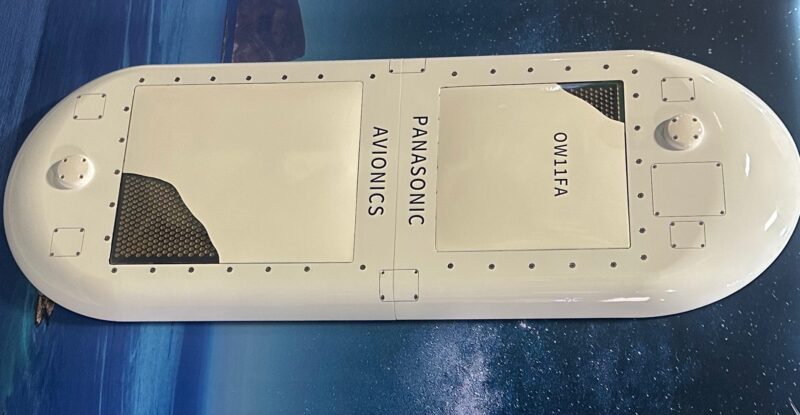

Having made a name for itself in the maritime industry as a leading provider of flat panel antennas, including in support of Eutelsat OneWeb Low Earth Orbit (LEO) satellite-powered connectivity, Intellian recently burst onto the aviation scene when it was selected by Panasonic Avionics to produce a Ku-band LEO-only electronically steerable antenna (ESA) for the IFEC giant’s airline customers.
The ESA, which will talk to OneWeb, is being positioned as capable of supporting standalone LEO inflight connectivity or serving as an augment to Panasonic’s Ku-band geostationary (GEO) satcom system. And, if Panasonic Avionics VP John Wade’s prediction proves out that a double-LEO, double-ESA paradigm will emerge in aviation, the Intellian hardware might even find itself sitting alongside another provider’s ESA atop aircraft fuselages in the future.
Intellian used the occasion of the massive SATShow conference and exhibition in Washington D.C. to showcase a mockup of the LEO-only aero ESA for the very first time. The mockup was prominently displayed as part of a dedicated ‘aviation’ wall on the Intellian stand (beside two other intriguing antennas: a half-duplex system and a small L-band antenna).
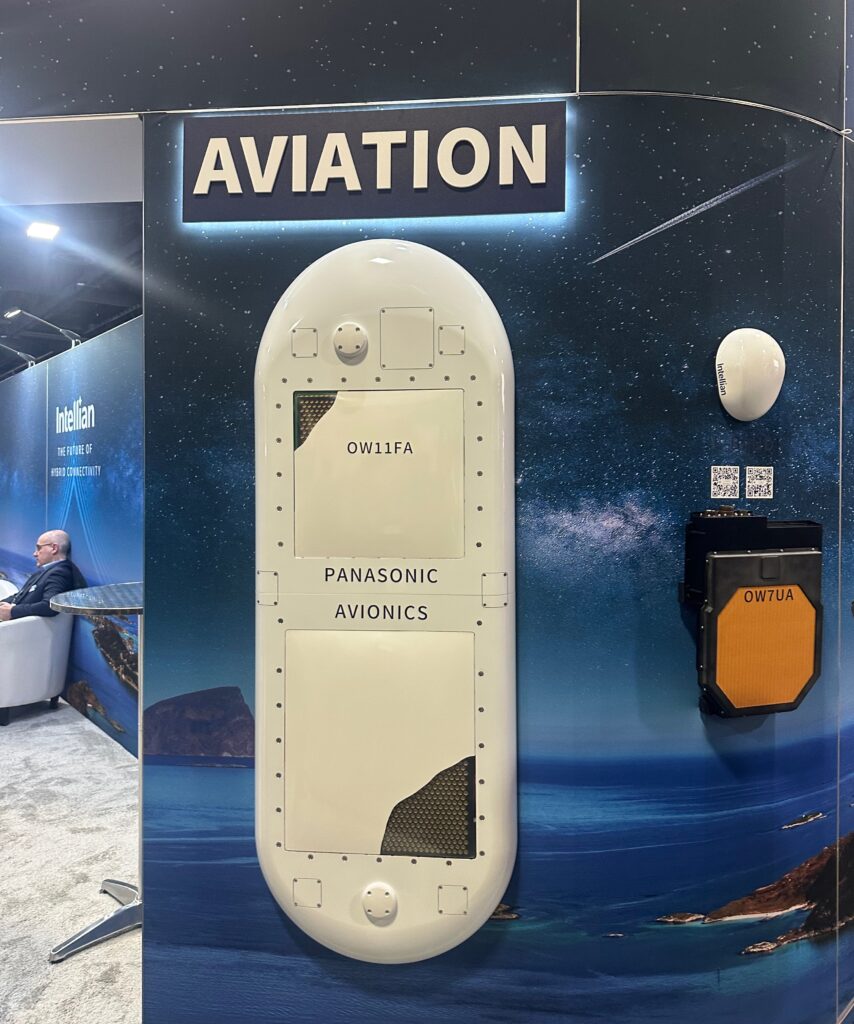
The mockup was shipped in two sections so the seam you see between the words “Panasonic” and “Avionics” is not part of the design.
By nature of the fact that the terminal for Panasonic is LEO-specific, it does not follow ARINC 791 or 792 standards (akin to how Starlink and others are eschewing these standards.)
Moreover, the terminal itself “is built on its own mechanics, and is sealed, radomed, assembled, tested and delivered in one piece,” Intellian avionics development director George Nicola explained to RGN at the show. “The white fairing that you see on the outside can be remanufactured to whatever the installation house decides they need to do without impacting the user terminal itself.”
When Panasonic was mulling its options for a LEO ESA provider, cost was a big factor. Given that aviation antennas have always been historically very expensive, Panasonic looked for a LEO-only terminal that was “very mature” and “very affordable” and found the sweet spot with Intellian, according to Wade. It also extensively tested the South Korean company’s full-production maritime terminals.
“There’s no real proof of concept here for aviation, because all the bits and pieces are done,” Wade, who serves as Panasonic’s VP, connectivity business unit told RGN last fall in an in-depth interview, just as the Irvine, California-based company was nailing down the final design specs for the aero ESA hardware.
A flight-test program is expected to kick off soon, with Black Label equipment available in the second half of this year.
During SATShow, Nicola explained that Intellian boasts a number of differentiators, including by offering global support, distribution, and technical support.
“We can support our customers everywhere. We can deliver hardware from all our various locations. We have a factory which is second to none in terms of we have our own SMT (surface mount technology) line. We can build all of our own components. We have all of our own ability to environmentally test all those components and screen them before production. We’ve got a full production capability just made; we’ve just gone from ISO9001 to AS9100. We’re about to start Part 21 approval as well, so we can manufacture and certify our own product,” he said, adding:
So really, if I was going to summarize how we set ourselves apart it’s that we are an end-to-end provider of hardware. We’re not an array manufacturer who is dependent on somebody else to do the rest of it.
So that’s one thing, and then the other element, I would say, as a differentiator for us is we have leverage across multiple verticals, where we take the same technology and reuse that technology, we’re sinking our costs across a far bigger population of terminals than just aviation, and that allows us some flexibility in bringing our price points down for everybody, not just aviation… That leverage of scale is, as far as I’m aware, not available anywhere else.
The Intellian executive reckons the Ku-band aero ESA developed for Panasonic will debut as a LEO-specific inflight connectivity offering, as opposed to an augment to Panasonic’s traditional GEO gimbaled antenna (the latter configuration in support of multi-orbit LEO/GEO IFC), but he says, “they may well augment their existing solution if they feel like it’s necessary.” Intellian hasn’t yet done a separation analysis of where the ESA would sit relative to the gimbaled antenna.

As it prepares to make its foray into aviation with a Ku-band LEO terminal, Intellian is also advancing its flat panel Ka-band terminals for a variety of markets. Earlier this year, it was selected by Telesat to build a Lightspeed LEO terminal for fixed enterprise applications, wireless backhaul, government, land mobility and maritime connectivity.
Nicola revealed that the firm is now talking to multiple satellite operators about whether they want Intellian to build a Ka-band aero terminal for them. “The mantra of reuse is still very much kind of in the bones of what we’re doing.”
He also divulged that Intellian is exploring developing a Ka-band multi-orbit ESA for aero.
Related Articles:
- SES meoSphere will be core to new MEO/LEO inflight connectivity
- Air Arabia debuts Panasonic Avionics multi-orbit IFC
- Panasonic enjoys rapid IFE growth as connected seatback takes wing
- Eutelsat reports “strong progress” in IFC as LEO revenues take off
- Telesat further optimizes Lightspeed for defense, sees schedule slip
- Panasonic adds LEO-only IFC antenna including for GEO augment
- RGN Premium: Panasonic’s John Wade talks value of Intellian ESA
All images credited to Mary Kirby, as snapped at Intellian’s stand at SATShow