
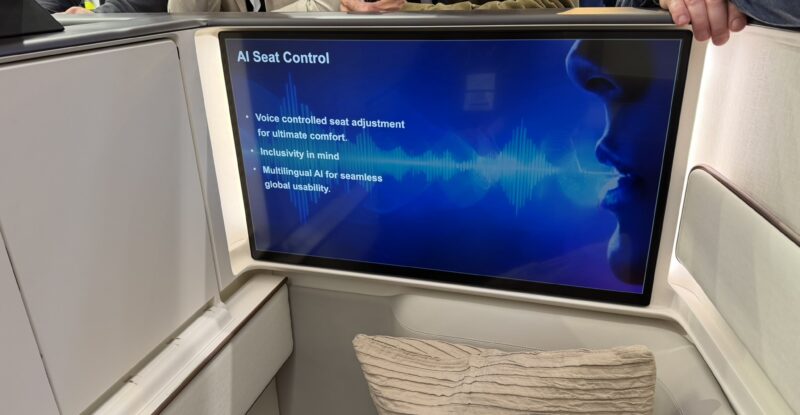

HAMBURG — When RECARO Aircraft Seating sent out a press release touting its R7 Horizon technology demonstrator in advance of the Aircraft Interiors Expo (AIX), and said it would feature “AI-powered seat control by voice,” many members of the #PaxEx media began to ridicule it.
In candor, your author was one of those people.
After all, there’s nothing more 2026 than cramming AI into an existing product for no other reason than to signal to investors that you’re doing something with AI. And a growing number of folks are getting sick and tired of AI being forced into everyday life.
But when RECARO actually demonstrated the AI seat control application for its R7 premium lie-flat seat on the show floor of AIX, I found myself pleasantly surprised at just how much sense it makes.
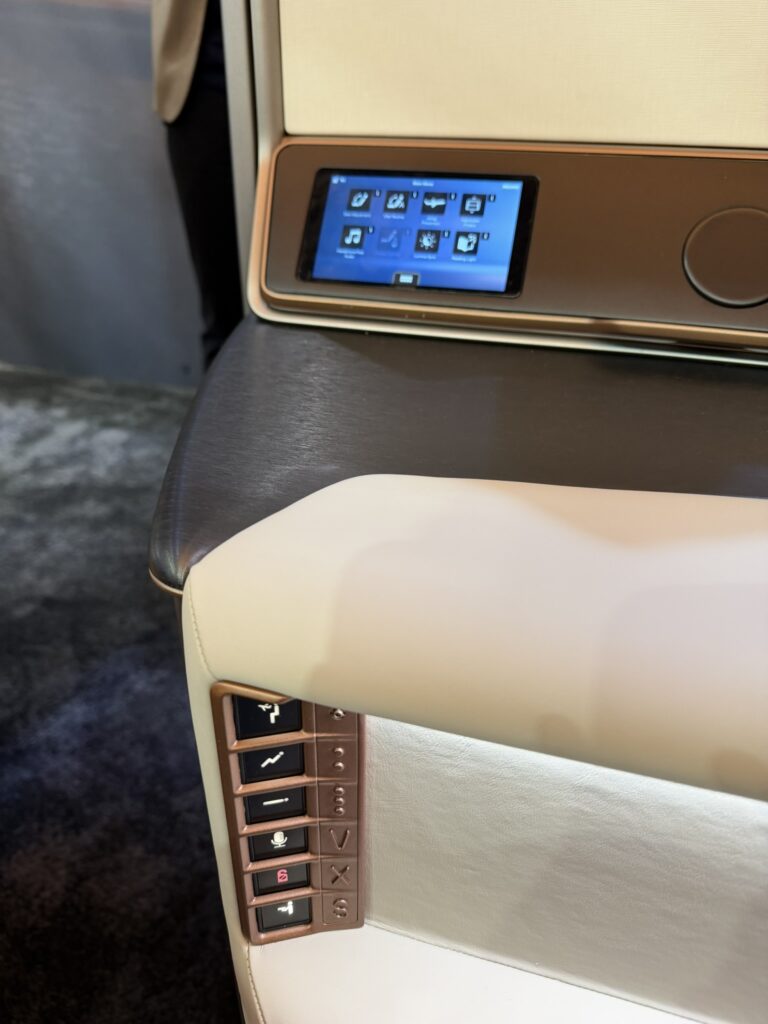
As premium seats have gotten more and more complex, so too have the controls. Different seats have different bits and pieces that can be adjusted in many different ways. To make matters worse, the way passengers interact with these controls is all over the map. Some seats use physical buttons that the user can touch and feel, others use capacitive buttons that provide no physical feedback at all, while many use touchscreen controls which are difficult to navigate.
Airlines and their seat manufacturers have in some instances created a usability and accessibility dilemma. If the most seasoned of #PaxEx product reviewers struggle to adjust a seat, how can someone with low or no vision?
When RECARO began demonstrating its ‘AI-powered seat control by voice’ feature at the Aircraft Interiors Expo, accessibility didn’t seem to be the seatmaker’s main pitch to the media. But it quickly became apparent to myself and others that this was the correct play.
RECARO was confident enough to let journalists sit in the R7 Horizon demonstrator and simply give it a go. The seatmaker has baked the interface directly into the seat control panel, providing a dedicated button that the passenger presses and holds while they talk to the seat. A microphone in that same control panel did an admirable job of picking up the correct voice over the background noise on the stand.
Once the user presses the button, the seat accent lighting turns blue to indicate that the system is listening. After a command, the passenger lets the button go and the seat parses the common words and moves the seat.
A more production-ready version of this system would need an expanded interface to confirm the request — potentially through the IFE system or voice feedback — but as a demonstration this was good enough. In this iteration, the passenger just kind of has to trust that the seat understands the request correctly.
I was seriously impressed with just how well RECARO’s system understood what I was asking it to do. It was able to process natural language requests and translate them into seat movement. For instance, when I said, “I need to go to the bathroom,” the seat moved to its upright position. When I said, “I wanna watch a movie now,” the seat moved to a relaxed position in between upright and fully reclined.
Impressively, the seat understood all the wackier commands I threw at it as well. RECARO claims it is able to accomplish this in 90+ languages, though it seemed to have less than amazing success understanding the multitude of different languages that fellow #PaxEx scribe, and The Up Front editor John Walton was throwing at it.

RECARO was not the only company at AIX pitching an AI voice-controlled seat, however. Over at the Unum booth, inclusive technology specialist Access-IQ had integrated its own system into Unum’s premium seat, though it took a much different approach.
Rather than adding controls into the seat itself, Access-IQ offloaded the interaction between the passenger and seat to the passenger’s own device, giving the passenger control of seat movements from their phone or even a connected watch. This system didn’t seem quite as accurate in understanding my requests, as natural language commands had to be manually mapped to seat positions, whereas RECARO’s system figured that out on its own.
But as an early-stage accessibility enhancement, both of these systems are exciting. Jokes aside about an aircraft cabin full of passengers shouting at their seats to recline, there may be a real place for voice-controlled seat offerings in the near future.
 Related Articles:
- Boeing and Airbus develop tactile placard standard for aircraft
- British Airways offers Hearlo app to remove communication barriers
- Testing Safran’s headrest-free sound for premium seats
- Recaro adds front row, quality-of-life features and A330 version of R7
- Press Release: RECARO showcases innovative aircraft seating at AIX
All images credited to the author, Jason Rabinowitz