

As one of most watched channels on seatback IFE screens in the world fleet, the inflight moving map has steadily grown in popularity over the years. In fact, the number one piece of content accessed by Delta Air Lines’ passengers — ahead of even early run movies — is the map, with 45% of customers engaging with it at some point during their flights, the US major revealed in 2024. Amazingly, some 20% of its passengers only watch the map.
While a handful of stakeholders have made important inroads in the 3D interactive moving map market, including Panasonic Avionics with its Arc solution and Earth visualization technology specialist GeoFusion’s work for Thales, the dominant provider in the space continues to be FlightPath3D, which counts a raft of carriers as customers and works with major embedded IFE firms, including RAVE Aerospace, to support the packaging of its map with their hardware.
This dearth of suppliers in industry can create opportunity in the space, however. Enter IdeaNova Technologies, which has quietly developed a map solution called InPlay Navigator that can easily, quickly and inexpensively integrate with modern and, notably, legacy IFE systems, either as a standalone product or alongside the software firm’s other solutions — such as its new offline AI engine for IFE.
“We think that there is only one player really in this industry, FlightPath3D,” IdeaNova CEO Juraj Siska told RGN at the Aircraft Interiors Expo (AIX) in Hamburg. But while FlightPath3D’s map presently has a lot more features, IdeaNova “noticed that, especially on legacy platforms, it takes a while to launch.”
So, IdeaNova set about to develop an in-house product from scratch. “It’s not a big heavy lift,” said Siska of Inplay Navigator. “It’s just really a software layer that we deploy in terms of Docker containers which is a package of software and can be deployed on any kind of hardware including stuff like Raspberry Pi.”
This flexibility “allows us to do all kinds of customization,” he said, including supporting an integration with IdeaNova’s award-winning Inplay secure streaming platform.
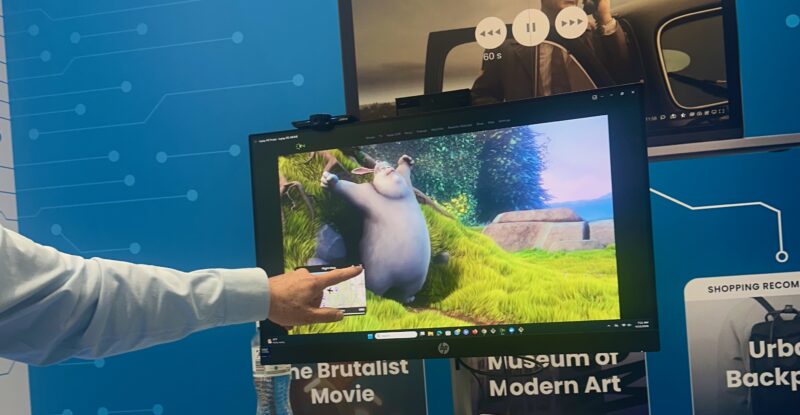
“You might have noticed,” when using inflight moving maps “that sometimes it takes a while to discover where you are or discover where the flight map or flight information is. Usually, it means that you have to leave the entertainment piece. So, with our integration, we were able to achieve a single click integration where the map shows up at the same time as the movie,” Siska said while demoing Inplay Navigator on the Inplay streaming platform.
“It stops the movie just so you can focus on the map, but you can resume that playback right away, and you can also reverse that, and you can have the map in a full screen mode and the movie in a picture-in-picture mode, so that single click operation is, I think, a very convenient way for passengers to watch the most desired pieces of content — the entertainment and the navigation.”
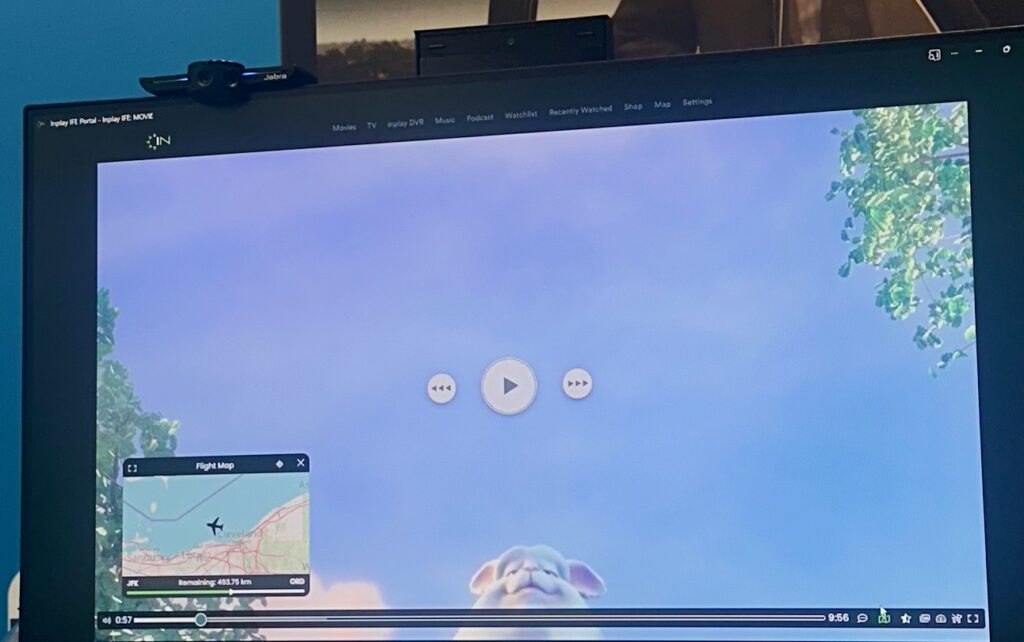
Because Inplay Navigator is dockerized, IdeaNova can support a fast deployment for operators.
“Obviously, it needs to be integrated on the hardware. We need to talk to customers to see if there is any need for customization. But the displayer is totally customizable, so if people want to have their own buttons and so on, we can do that,” Siska said. “It’s a very quick process of enabling a legacy IFE platform with a brand new offering.”
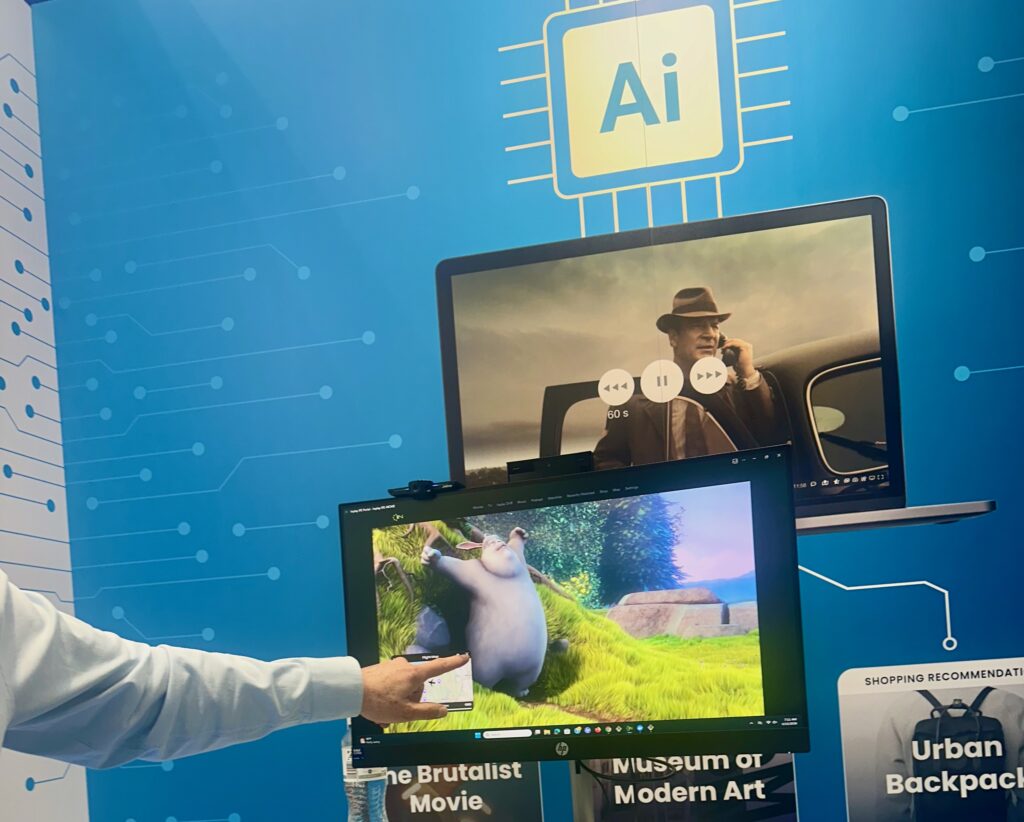
Adding other layers of functionality, like IdeaNova’s new onboard intelligence platform, Inplay AI, is also a seamless process, noted Siska, as AI is largely hardware agnostic and even legacy IFE systems will be able to accommodate it.
Billed as the world’s “first offline AI engine for IFE” and demonstrated for the first time at AIX 2026, Inplay AI runs directly on aircraft servers, tailoring content, shopping or meal recommendations, adapting user interfaces and surfacing other relevant content for each passenger in real time.
With 10,000 points of interest, Inplay AI can match the profile of any particular passenger. Siska explained:
So we want to make sure that between every city pair — the origin and the destination — we have enough points of interest that match any kind of customer profile, and those are changing periodically, right? New museums are being built. There are new parks opening, and so on.
This opens an opportunity for advertising as well, quite obviously by providing not only the destination and origin information, but also things along the way. If you have advertisers, they would like to point out information related to their new offerings within the flight path, and they can do that.
Providing onboard personalization without relying on inflight connectivity is among the value propositions for Inplay AI. That’s because no broadband cabin connectivity pipe is perfect, even those powered by low-latency non-geostationary satellites.
“I went on two Starlink flights recently, within a month. One of them had no connectivity at all because the service didn’t work, and the other one had it about 90% so I was able to watch my college basketball game, but only about 90% of the time,” Siska confided. So, one of the use cases for Inplay AI is to “cover outages” of IFC.
“Another reason,” he continued, “is that confidentiality and privacy of personal data” is important including for IdeaNova’s business aviation clients and airlines that honor data privacy and security law, including the EU General Data Protection Regulation (GDPR). Customer information is not carried anywhere else. “I mean, it can be, if you get consent, but by design it’s super secure.”
Moreover, the ability to provide an interface where the airline has skin in the game, can retain the relationship with the passenger, and improve the passenger experience, whilst having the opportunity to upsell advertising space holds appeal.

IdeaNova’s latest innovations are certainly in sync with the direction that the IFE market is headed.
For example, long-time partner RAVE Aerospace, which utilizes IdeaNova’s DRM, IPTV and casting technology, used the occasion of AIX to showcase a new Harmony graphical user interface. Developed in partnership with digital agency Reaktor, Harmony can host FlightPath3D’s moving map in a live widget on the screen, and introduces a new chatbot that dives into a large language model on board to offer suggestions and options to passengers.
But while IdeaNova is indeed “a modular company” insofar as it partners with the likes of RAVE Aerospace or major carriers such as United or Delta to provide a component of their overall IFE functionality, it can also offer an end-to-end IFE solution, especially to smaller airlines and business aviation operators — customers that “might not be desirable for Thales, for example, or Panasonic, just because that opportunity is just so small for them,” Siska said.
“From that perspective, we do have an end-to-end solution that includes the ability to process content in the cloud, the ability to distribute it to the aircraft, and obviously deliver it to passengers.”
So, if I’m an airline attending AIX and I want to just work directly with you and have an end-to-end solution, you’re open to that relationship, your author asked?
“We’d love that opportunity to talk to them, and we have very much everything on the software side,” Siska replied. “We are not a hardware company. We do have hardware partners that we work with, and we’d be happy to work with additional partners as well. But from the passenger-facing perspective, and from the content-processing perspective, we do have an end-to-end offer.”
And that offer now includes an inflight map.
Related Articles:
- RAVE supercharges IFE development with new OS and App Marketplace
- Op-Ed: The legacy IFE debate — remove, replace or reinvent?
- How United is leveraging Starlink and the cloud to enhance IFE
- Why FlightPath3D stays ahead of geopolitics for aviation map clients
- Panasonic Avionics enhances Arc 3D inflight map platform
- #PaxEx Podcast: IdeaNova and the bright ideas shaping IFEC
- Thales’ new Tandem OLED-based FlytEDGE Aura IFE shines bright
- Press Release: IdeaNova unveils Inplay AI for offline personalization