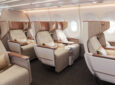


HAMBURG — Two years ago, Thales became the first amongst its peers in the embedded inflight entertainment space to publicly launch a clearly defined and explicitly detailed onboard edge caching solution for commercial aircraft.
FlytEDGE, as it’s known, leverages Thales’ Crystal Cabin Award-winning Onboard Data Center (ODC) and a partnership with Netskrt Systems to support both cloud-based content management and edge caching. It quickly attracted top-tier airlines as customers, including Qatar Airways and Delta.
In the here and now, FlytEDGE powers several different use cases, such as cloud gaming, and live and near-live event-based programming for passengers, while driving AI-powered operational benefits for airlines and giving them incredible flexibility to make rapid changes to IFE user interfaces and apps.
But its ability to store content locally on board aircraft after it has been accessed online by passengers means that FlytEDGE is also ready for the future. That’s because it lays the groundwork for airlines to ultimately enable passengers to stream movies and TV series via their own streaming subscriptions if and when the appropriate inflight content licensing arrangements have been brokered by studios and airlines, as the Bring Your Own License (BYOL) model emerges in IFE.
Importantly, FlytEDGE preserves precious and costly bandwidth whilst increasing the probability that streamed content will be delivered without pixelation or buffering — the way that content creators want it to be viewed, and indeed expect it to be shown.
Now, the French aerospace giant is using the occasion of the Aircraft Interiors Expo in Hamburg to tell the rest of the FlytEDGE story, specifically, the physical and equally “future ready” seat-end part that will be clearly visible to passengers.
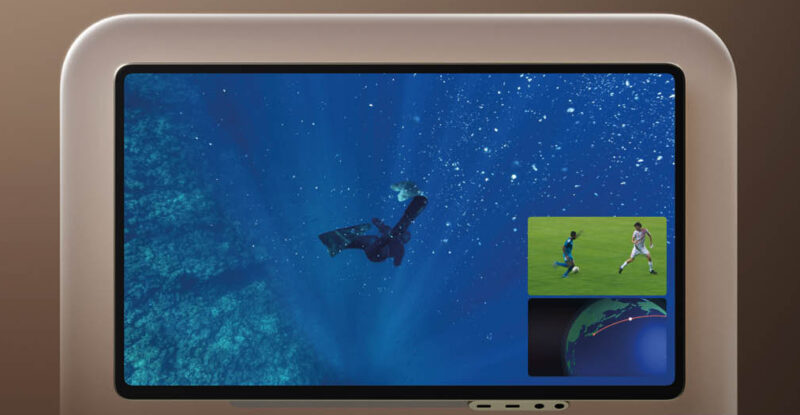
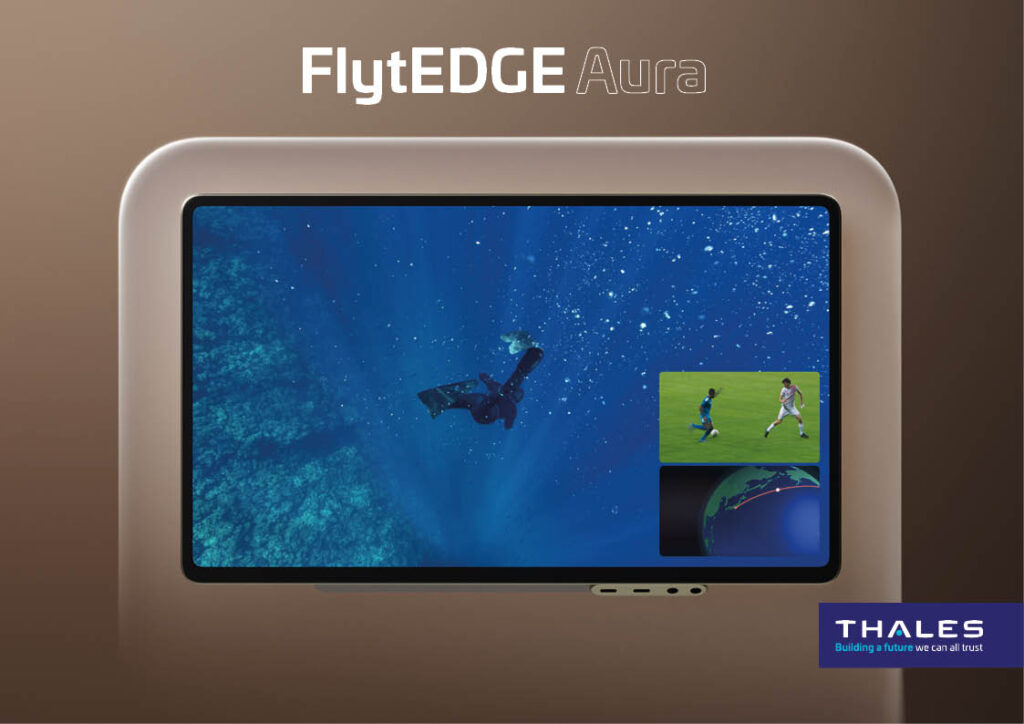
Say “hello” to FlytEDGE Aura, Thales’ next-generation inflight entertainment system and the first-ever in industry to feature 4K HDR10+ Tandem OLED displays.
30% lighter and far brighter
“So, we’re bringing new displays, new seat boxes, new wiring,” Kurt Weidemeyer, who serves as vice-president, product management for Inflyt Experience at Thales, enthused to RGN just before the firm pulled back the curtain on a brilliant 13” FlytEDGE display at its stand at AIX.
Tandem OLED, I hear you say, what’s that?
As opposed to classic OLED, which has one primary light-emitting layer, Tandem OLED stacks two organic light-emitting layers to deliver a brilliant viewing experience. Many members of the gaming community are already familiar with Tandem OLED.
Weidemeyer explained its appeal:
It delivers 4K HDR 10+, it’s a brighter solution and since you use lower power in tandem — the two OLED displays, one on top of each other — it decreases the chance of burden, it increases durability, reliability, but still delivers best-in-class contrast ratio, best-in class weight versus any type of LED-based or, like we had a QLED previously. But we believe this is the future for the next generation, and that’s why we’re going all in on Tandem OLED.
Importantly, Tandem OLED will be offered across Thales’ full product line on a go-forward basis.
Thinner bezel, replaceable port module
Does Thales reckon that Tandem OLED-based FlytEDGE Aura will give it an edge over, say, Panasonic Avionics, the dominant provider of embedded IFE in commercial aviation — and an adoptee of regular OLED for its next-gen Astrova system, RGN asked?
“We don’t think that’s the only reason,” Weidemeyer replied. “So, we went with a very timeless design esthetic as well. And so, we actually don’t have a large chin anymore. [Instead, the bezel is thinner.] We have a small module for the ports that is interchangeable over time. We tried to make this all about the visual solution. We tried to create a very elegant display that, over time, will last the test of time.”
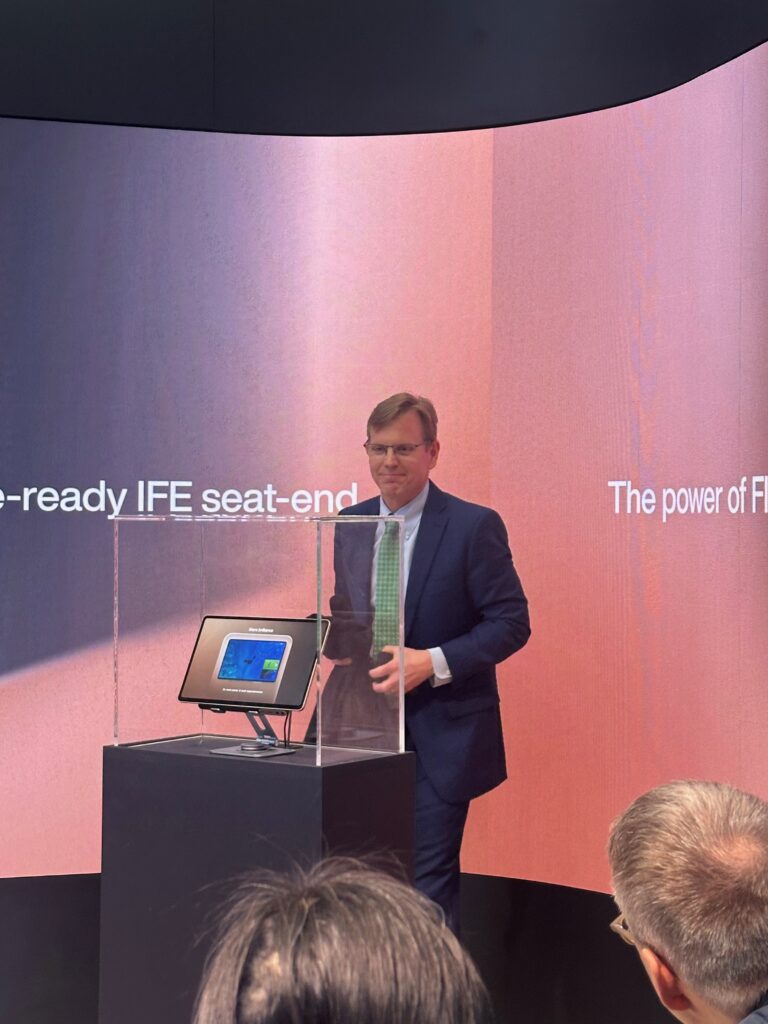 FlytEDGE Aura boasts a cutting-edge Qualcomm processor embedded in each display that’s six times more powerful than before to enable ultra-responsive navigation. But Thales has also “designed in complete modularity, so you can update the processor over time,” Weidemeyer said.
Additionally, airlines can easily update the port module.
Whereas dual in-screen USB-C ports, which collectively offer up to 120W of fast-charging power; two Bluetooth 6.0 connections for seamless device pairing and Wi-Fi 7.0 are available at this time, operators can, for instance, “move from USB-C to, let’s say, USB-D in a few years; you don’t have to replace the monitor, you just replace the port module,” he said.
“We’ve tried to make it a solution that will stay on that aircraft for the life of the aircraft and look absolutely gorgeous.”
Passengers who are accustomed to encountering aged, legacy under-seat IFE electronics boxes on aircraft in the world fleet will be over-overjoyed to learn that Thales has designed what it’s billing as “the most powerful, compact and intelligent seat box” which provides 350W of power “in a remarkably compact design.”
An upgrade path for AVANT Up customers
Thales’ prior-generation AVANT Up IFE solution only debuted a few years ago, and customers include Air India, American Airlines, Ethiopian Airlines and Emirates. “We’ve got a handful of carriers flying it, and if you ask those customers, they will tell you they’re flying the best inflight entertainment solution today, but years ago, we did foresee a digital future — always connected, where airlines wanted to have the power to control their own inflight entertainment solution platform and make changes in flight,” Weidemeyer said.
“That’s why we decided to build FlytEDGE, and that’s why we started from the ground up, and that’s where we’ve been very different than our competitors,” he continued. “It’s a completely different software solution. We say cloud-native, I mean the software that’s on the aircraft is mirrored in the cloud, and airlines really can go in, make changes in flight to the UI, to the capability, destination base, and with the press of a button, bring additional capability within their control.
“And that future is now, especially with LEO connectivity taking off and just ubiquitous connectivity, regardless of whether it’s LEO or GEO, it doesn’t matter, but that’s what we’re showcasing at the show. It’s not just FlytEDGE for the new cabin hardware, but also the different use cases for FlytEDGE because we’re even doing things operationally for airlines, even outside of inflight entertainment.
Notably, Thales has an upgrade path for all customers on AVANT Up to move to FlytEDGE Aura.
“AVANT Up is delivered with our current Optiq screens today. All of those customers can upgrade by replacing the server, the headend server, to the new FlytEDGE onboard data center, and can move up to FlytEDGE,” the Thales executive said.
Edge caching, in practice, on the horizon?
The ability to natively edge cache streaming content will become extremely important, especially if when the appropriate licensing agreements are forged between airlines and content creators. Thales is “getting into some of these conversations now,” around what that would entail, Weidemeyer revealed. “I would say that’s one of those areas that is not fully defined yet.”

Of note, Weidemeyer said he believes Thales is the only provider “with an edge caching solution that is used on the ground as a certified Content Delivery Network, which is a key piece for OTT streaming providers. They want to use an edge caching solution that they’ve worked with before, that provides this in another space today that they can trust. And so, we’ve been working with Netskrt for years to build that in.
“We built this platform because we know we are not the experts in every area, so we are bringing a ton of partners in. And we built the FlytEDGE platform to make it easy to integrate. Any type of capability that is delivered on the ground, you can easily do it now in the air because we’ve made this open FlytEDGE platform, this cloud-native platform using the same software stack that we use in data centers. So, partners when they see our software development kit, they say, ‘okay, yeah, I know how to connect to that. This is what I do today on the ground, and that’s kind of the power of FlytEDGE that we see.’”
Related Articles:
- Do fast Wi-Fi and the shift in media consumption portend BYOL IFE?
- Fast-growing RAVE Aerospace identifies industry choke points
- Panasonic enjoys rapid IFE growth as connected seatback takes wing
- Thales talks event-based 360Stream and near-live highlights
- Panasonic Avionics sees Astrova Curve debuting in first class
- RAVE Aerospace nixes proprietary antenna work as LEO shapes IFEC
- Connected seatback at the fore as RAVE Aerospace enters new era
- Does new Qatar Airways, Thales pact hint at what lies ahead?
- Delta seeks to gain edge with Thales FlytEDGE, eyes multi-network IFC
- Emirates A350-900 flies with new Thales AVANT Up features
- Diehl and Thales work to unlock the full potential of cabin data
- Thales takes IFE innovation to the edge with edge-caching and cloud
Featured image credited to Thales.