

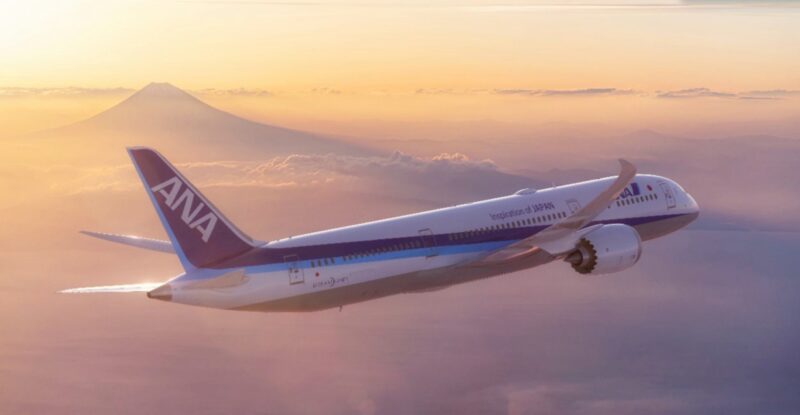

All Nippon Airways has long used various suppliers to support inflight connectivity for passengers. But as the Star Alliance member moves to both enhance the experience and offer free Wi-Fi on international flights, it has turned to edge-to-cloud network platform Quvia for deeper visibility into how the different services are performing.
Under an agreement between the two companies, Quvia will support the continued evolution of ANA’s inflight digital experience by providing the Tokyo-based airline with an “independent, real-time view” of IFC performance and passenger Quality of Experience (QoE).
Some airlines have service level agreement (SLAs) with their aero ISPs. But Quvia’s independent QoE and network insights into how connectivity is performing for passengers across flights, aircraft and routes, arms operators with the information they need to improve the experience and even make forward technology decisions.
“One of the biggest benefits of Quvia’s vendor-neutral approach is that airlines like ANA can see what’s actually happening with connectivity across their fleet, regardless of the service provider,” Quvia SVP, aviation Mike Moeller explains to RGN.
“SLAs are important, but a monthly average doesn’t always tell you what passengers experienced on a particular flight or on a route that’s important to the airline. We’ve found over the years that it’s the combination of SLAs and Quvia’s QoE data that really helps airlines understand the passenger experience and improve it. With that information, airlines can identify issues earlier, see patterns across flights and routes and work with their providers on targeted improvements, including where additional capacity could make the biggest difference.”
He continues,
We’ve seen this kind of collaboration with Air Canada and SES, as you’ve covered. When the airline and its provider are working from the same independent data, they can see where and when issues are happening, identify recurring patterns and work together to address them. That’s really the goal: giving everyone the visibility they need to make the passenger experience better.
A 2026 Crystal Cabin Award winner in the Breakthrough Startups category, Quvia is certainly no stranger to the commercial aviation market. In addition to supporting Star Alliance member Air Canada, it has publicly disclosed Delta and JetBlue as customers. In the latter instance, Quvia is providing dynamic network management of JetBlue’s Fly-Fi-branded inflight Wi-Fi, as powered by Viasat; Amazon Leo will be added to a portion of the fleet, starting next year.
Based in Miramar, Florida, Quvia’s technology portfolio includes Quvia Grid, which harnesses AI to correlate real-time data from multiple sources to make traffic routing decisions at a pace that is not humanly possible. Cruise liners, which often have a multitude of diverse connectivity links on board, have used Quvia Grid to save on bandwidth costs, as data is ferried over the most efficient pipe at any given time during the journey. Quvia sees a similar opportunity for airlines to take control of the cabin layer in a multi-link environment, should operators graduate to that model.
RGN asked Moeller if Quvia’s partnership with ANA sets the stage for potentially deeper integration (to the cabin layer) with Quvia down the road?
“There’s certainly potential to build on this over time. Right now, the focus with ANA is giving the airline an independent, real-time view of IFC performance and what passengers are experiencing across its fleet. That’s an important foundation because it gives ANA the data and visibility to make more informed decisions as its connectivity and digital needs evolve,” he replied.
“More broadly, we’re continuing to evolve our capabilities as LEO and multi-orbit grow in popularity. One example is our multi-probe solution, which lets airlines measure QoE across both LEO and GEO links and see how much time passengers are using each network. As airlines bring more connectivity options into the cabin, that kind of visibility becomes increasingly valuable.”
ANA counts Panasonic Avionics and legacy Inmarsat (now owned by Viasat) as IFC providers, and lately Viasat proper, which has won substantial new widebody IFC business with the carrier in support of its rollout of free Wi-Fi for international flights.

The ANA win is well timed for Viasat, as its ultra-high-capacity ViaSat-3 F3 Ka-band GEO satellite is now in revenue service for Asia-Pacific (plugging a key gap in coverage for other Viasat customers as well, including Delta.)
“Quvia will give us greater visibility into connectivity performance and the passenger experience as we continue to strengthen our inflight services,” ANA vice president, customer experience, Kentaro Okada says in a statement.
Financial terms of its agreement with Quvia have not been disclosed.
Related Articles:
- ANA taps Viasat to power free Wi-Fi on international flights
- Airline passengers to benefit as ViaSat-3 F3 enters service
- Air Canada delivers virtually flawless inflight Wi-Fi experience on E175
- How Quvia helps airlines throw out the IFC playbook and take control
- Airbus open to IFC orchestration should multi-vendor take off
- JetBlue partners with Quvia to advance IFC and ensure consistent PaxEx
Featured image credited to ANA