

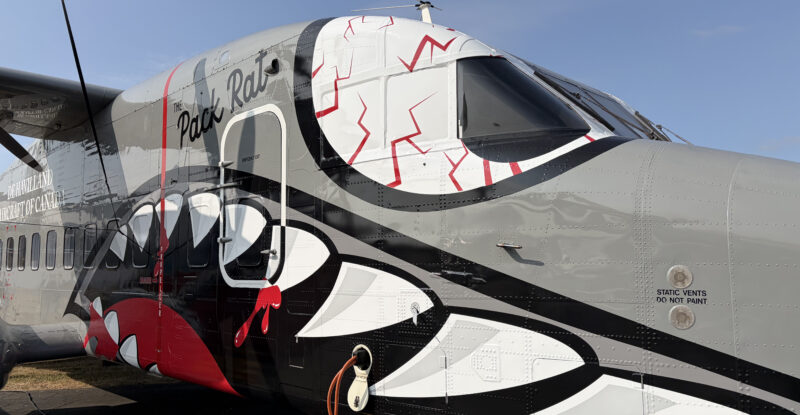

Standing with my back to BETA Technologies’ hybrid-electric MV250 cargo drone, I could just about see De Havilland Aircraft of Canada’s outrageously liveried Sherpa across Farnborough International Airshow’s static aircraft display.
Between them, the two aircraft made a striking contrast between the potential future of light airlift technology and a resurgence of its past.
De Havilland Aircraft of Canada acquired rights to the Sherpa in 2019 and is actively promoting its return to production as a rugged, short takeoff and landing (STOL) airlifter capable of performing a variety of military, government and other special mission roles.
The aircraft at Farnborough, named The Pack Rat and decorated in keeping with its name, was an upgraded former US Army C-23B+, but De Havilland is pitching an equivalent new-build aircraft to market, as the SD3-60 Sherpa.
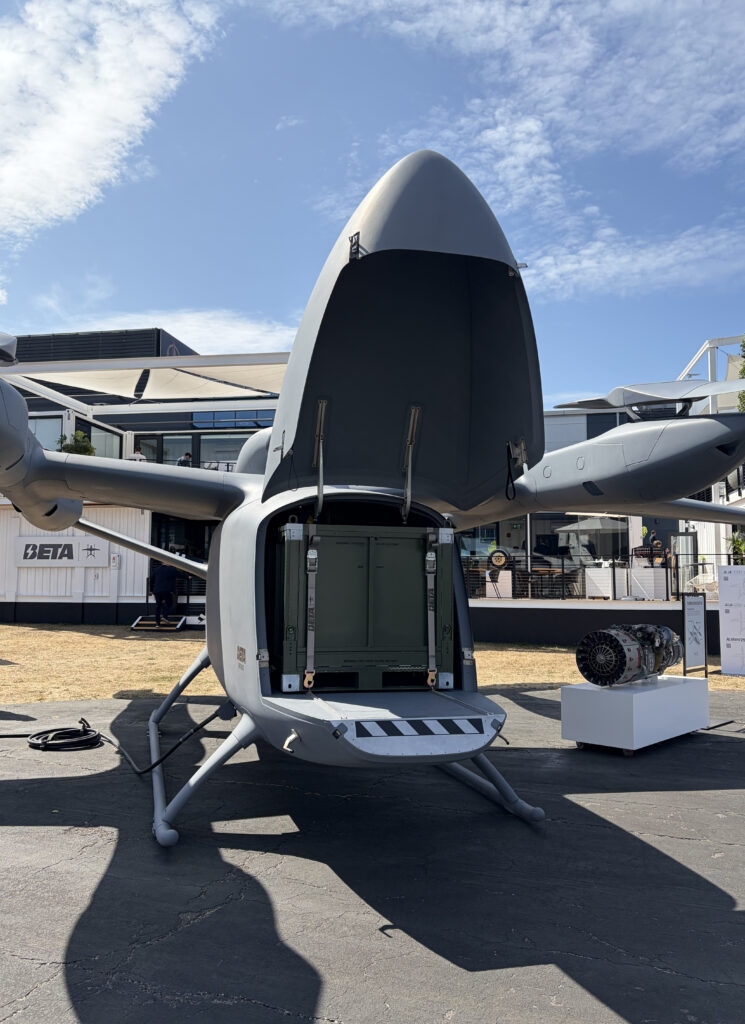
BETA Technologies’ MV250 provided an extraordinary contrast to the Sherpa in the Farnborough static, especially since the two aircraft overlap in certain mission capabilities. Image: Paul E Eden
De Havilland is taking a fresh look at what remains a useful airlifter thanks to its roomy, square-section hold, two-ton payload and air-openable rear ramp. The latter facilitates paratrooping and makes loading and unloading on the ground easy. Walking up the ramp from the ground, one is immediately struck by how useful a load space the Sherpa’s hold makes.
Even with a litter and seats installed, its width and height left plenty of room for a posse of journalists to pass one another on their way to and from the upgraded cockpit.
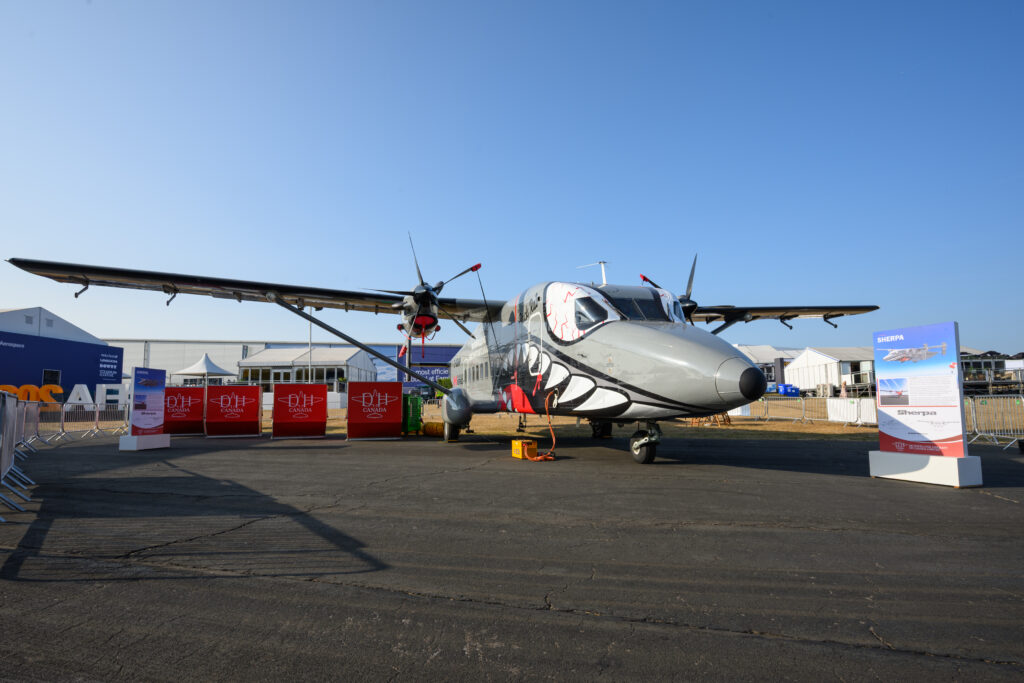
The Sherpa demonstrator flew from Canada to Farnborough in three legs. This image caught it soon after arrival, before any protective barriers had been erected. Image: De Haviland Aircraft of Canada
The Pack Rat is equipped with a Garmin G700TXi flight deck, an installation for which De Havilland holds the supplemental type certificate (STC), although any new production aircraft would be equipped to customer requirements.
The aircraft’s powerplants — two Pratt & Whitney Canada PT6A-65AR turboprop engines — each delivering a maximum 1,424 shaft horsepower (shp) on takeoff, is likely to remain unaltered, at least initially. Considering the austere environments in which the Sherpa might operate, easy access to the global PT6A support network is a bonus, while jet fuel is more readily available ‘off grid’ than avgas or electrical charging infrastructure.
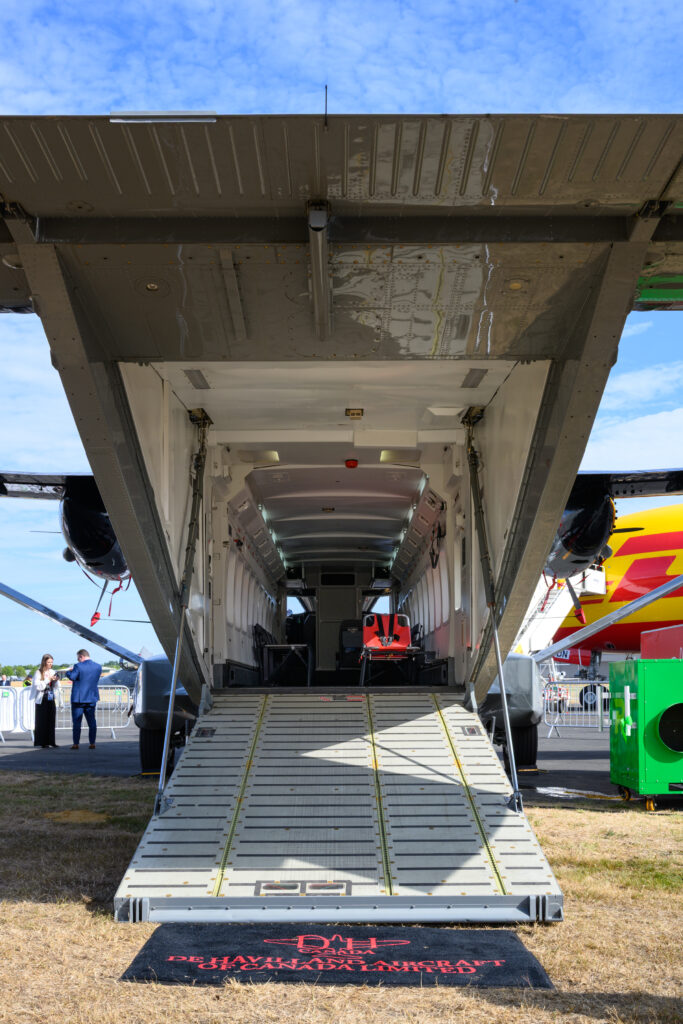
The hold is impressive for its continuous, uninterrupted cross section, maximizing available space and helping prevent ‘bulking out’, where an airlifter is effectively full before reaching its maximum payload. Image: De Haviland Aircraft of Canada
De Havilland Aircraft has created a successful business model re-imagining and supporting legacy aircraft designs. Its classic Twin Otter and Canadair CL-215 firebomber, of which the new-build, next-generation Canadair 515 is seeing a surge in demand, are among the types renewed for today’s market, while the company also supports the Dash 8 fleet globally. The slightly quirky Sherpa fits neatly into this unique portfolio.
The aircraft itself has a complex history. Belfast, Northern Ireland-based Short first flew its Short 330 (or SD3-30) regional airliner in 1974. The slightly longer, single-fin Short 360 (SD3-60) flew in 1981, by which time the twin-finned 330 was well established in airline service. Late in December 1982, Short flew the first Sherpa, a cargo version of the 330 equipped with a rear ramp to satisfy the U.S. Air Force’s European Distribution System Aircraft (EDSA) requirement.
Soon camouflaged, windowless C-23A Sherpa freighters were a common sight at European bases. The EDSA mission continued until 1990, when the Sherpa fleet was dispersed. Six aircraft passed to the U.S. Army National Guard, which added ten new-build C-23B Sherpas — with cabin windows — to its fleet.
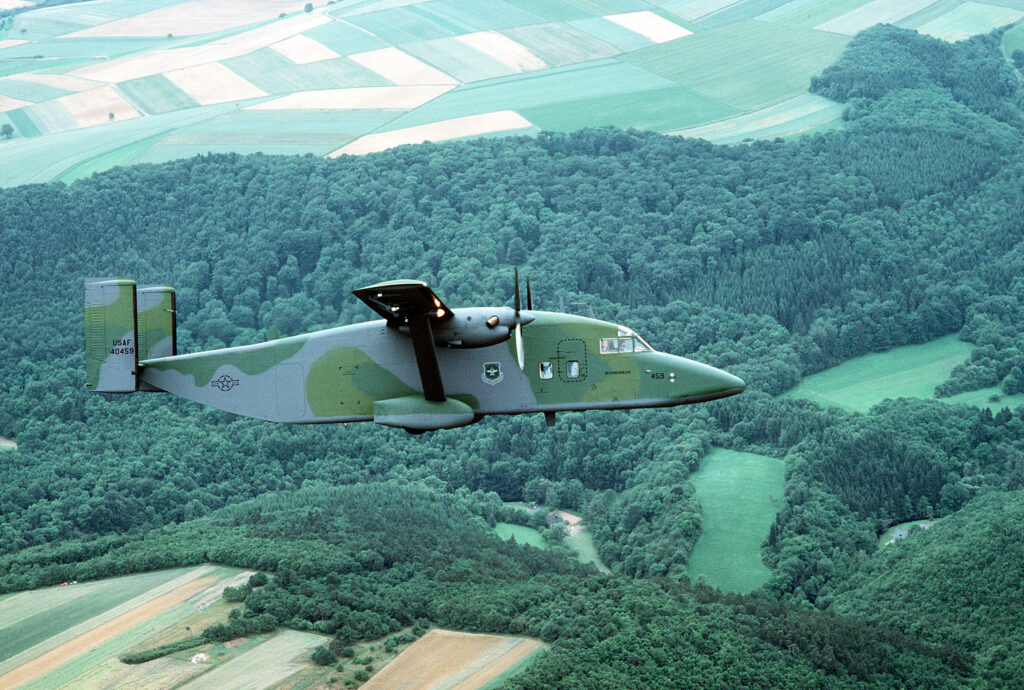
The C-23A was windowless. Flown by the 10th Military Airlift Squadron out of Zweibrücken Air Base in West Germany, the fleet’s primary task was the movement of aircraft parts and other components between the U.S. Air Force’s European maintenance and distribution centers and operating bases. Image: U.S. Air Force
Twenty additional Sherpas were then ordered. In a peculiar development, each modified an existing Short 360 airliner with the ramp and twin-fin empennage of the C-23, creating the C-23B+.
The mixed C-23 fleet served the U.S. Army into 2014, having gained a reputation for dependable versatility across a variety of missions, including overseas and on the front line.

Observers at the time considered the Sherpa’s retirement in favor of the abortive C-27J premature, pointing out its proven utility. That reputation is what De Havilland Aircraft of Canada is now relying upon.
Speaking at the Farnborough event, Neil Sweeney, the company’s VP corporate affairs noted that the surviving pool of Sherpa airframes offers limited remaining service life, hence the intention to reinstate production.
For that to happen, he said, a significant double-figures launch order is required.
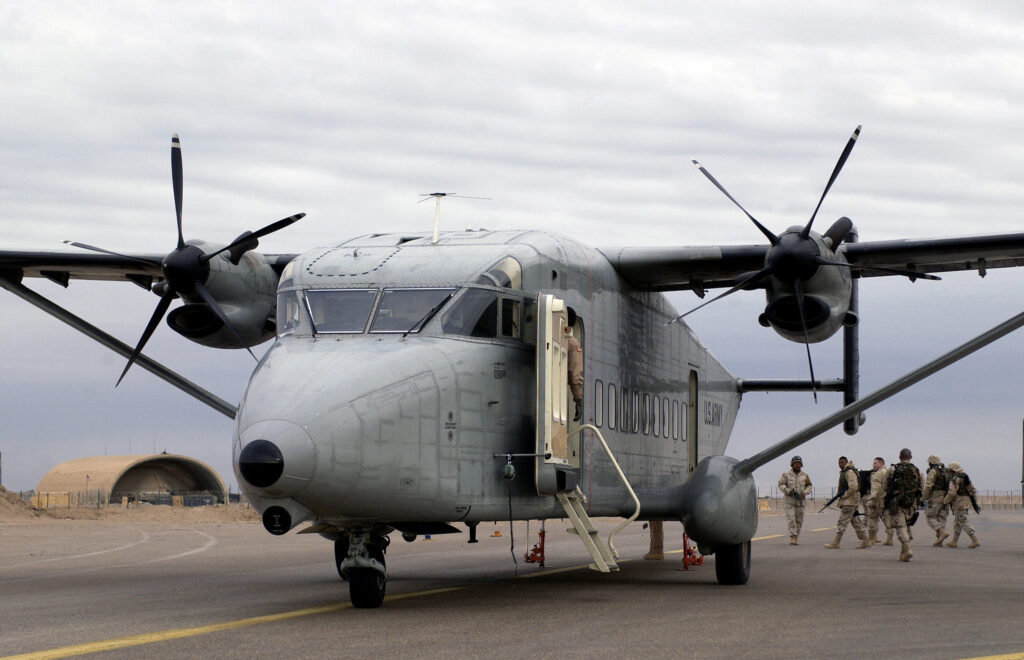
US Army National Guard C-23B Sherpas served on the frontline. This aircraft was in Iraq during 2004. Image: U.S. Air Force
Related Articles:
- Radia touts dual-use capability of giant WindRunner
- Norwegian electric flying boat developer NOEMI reveals wider scope
- Merlin Labs sees incremental path to pilot-free passenger flights
- Archers prepares for eVTOL passenger flights as war looms over UAE plan
- Press Release: GE Aerospace demos high-altitude hybrid electric flight
Featured image credited to Paul Eden