

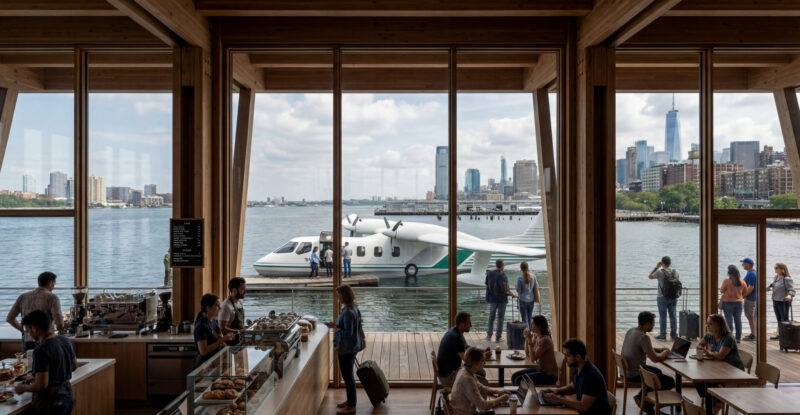

 Eric Lithun, founder and CEO of NOEMI Aerospace, has always maintained that no matter how environmentally responsible an aircraft’s design, it will fail if it does not allow profitable commercial operations. He remained true to this belief while revealing a new, wider scope for the NOEMI (meaning No Emissions) aircraft design during a 19 May media briefing.
Previously known as Elfly, the Norwegian company changed its name to NOEMI Aerospace earlier this year as a more obvious title for the international market. Now it has announced potential new roles for the machine and more fundamental possibilities, including powerplant options and a landplane version.
The core configuration will remain a battery-electric amphibious flying boat, certified to CS-23 commuter standards and expected to carry nine passengers and two crew on flights up to one hour long. In this concept, among electric aircraft developers NOEMI Aerospace is refreshingly realistic.
The aircraft’s performance aligns with missions now flown by seaplane operators using a variety of de Havilland Canada and Cessna Caravan floatplanes as well as a handful of other types. Typically sightseeing or island hotel transfer flights, these missions sit well within NOEMI’s capability.
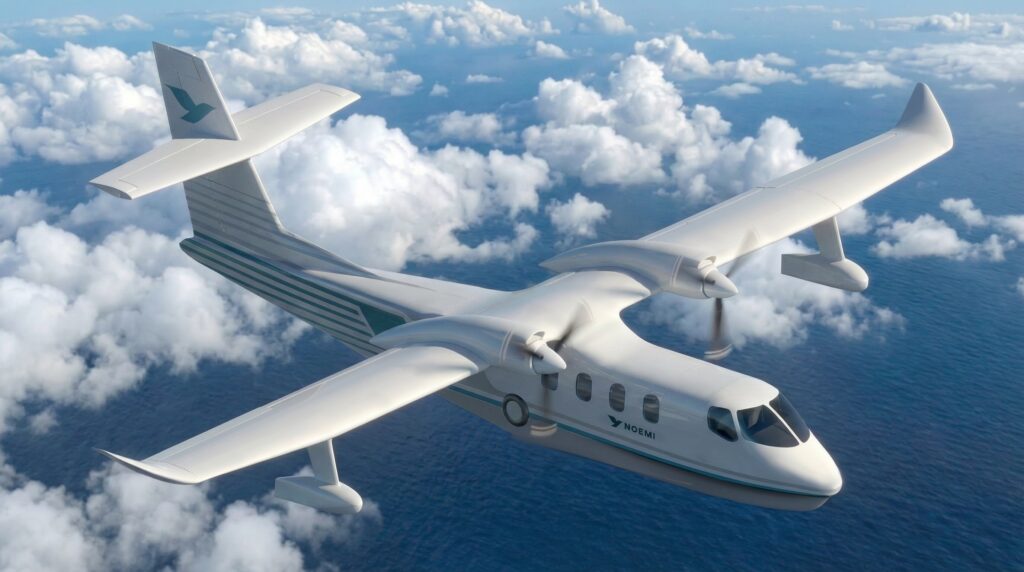
A realistic maximum of nine passengers is likely upon service entry, carried in a wide, bright cabin. Image: NOEMI Aerospace
Electric aircraft proponents are keen on inventing new market niches for their futuristic craft to fill. NOEMI Aerospace has defined such a niche, although its proposal for linking Norwegian fjords separated by steep mountains feels remarkably sensible.
Journeying from one fjord-side settlement to the next can take hours by road or rail but perhaps 30 minutes or less in a seaplane capable of hopping over the mountains. Make that seaplane electric, in a country where almost 100% of electricity generation is renewable, and NOEMI makes undeniable sense.
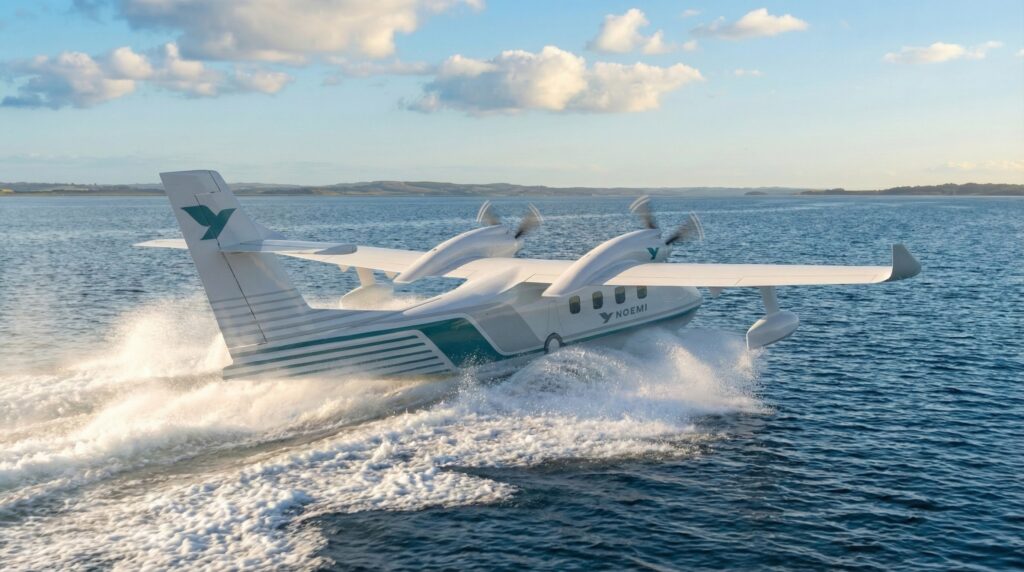
NOEMI Aerospace is working hard to optimize its core aircraft design for amphibious flying boat operations. Image: NOEMI Aerospace
NOEMI Aerospace is also acknowledging the reality that battery-electric is not the only solution for near-future low-emission aircraft propulsion, and that the compromises it entails are untenable for some operators. Under the leadership of new chief engineer and head of design Simon Bendrey, the company is therefore offering a hybrid-electric option and the possibility of combustion power, most likely in the form of twin turboprops.

The promise of greater payload capability and, especially, increased range or extended endurance that these new powerplant options promise, makes NOEMI an intriguing possibility for air arms seeking a multi-mission transport optimized for littoral or inter-island operations; think of the smaller turboprops in the U.S Air Force Special Operations Command service, but with the additional flexibility of an amphibian.
Lithun says conversations with investors and potential operators have led to questions about autonomous operations, but NOEMI Aerospace has no immediate plans in that direction. He is excited to discuss options for a modified hull, however, likely in combination with alternative power, for a firebombing variant.

NOEMI Aerospace believes that powerplant options promising increased payload and endurance could suit a modified NOEMI for firefighting. Image: NOEMI Aerospace
The biggest surprise of Lithun’s update was the revelation that NOEMI Aerospace is seriously considering a NOEMI landplane. It would replace the flying boat hull with a ‘conventional’ lower fuselage and rugged, fixed landing gear. With battery electric, hybrid-electric and turboprop options, the aircraft could be a challenger in the market currently served by the Twin Otter, SkyCourier and similar.
NOEMI Aerospace sees such an aircraft attracting customers in the skydiving market. It has compiled data showing that 500 aircraft were commercially active in this role in the US during 2023, suggesting a reasonable worldwide market.
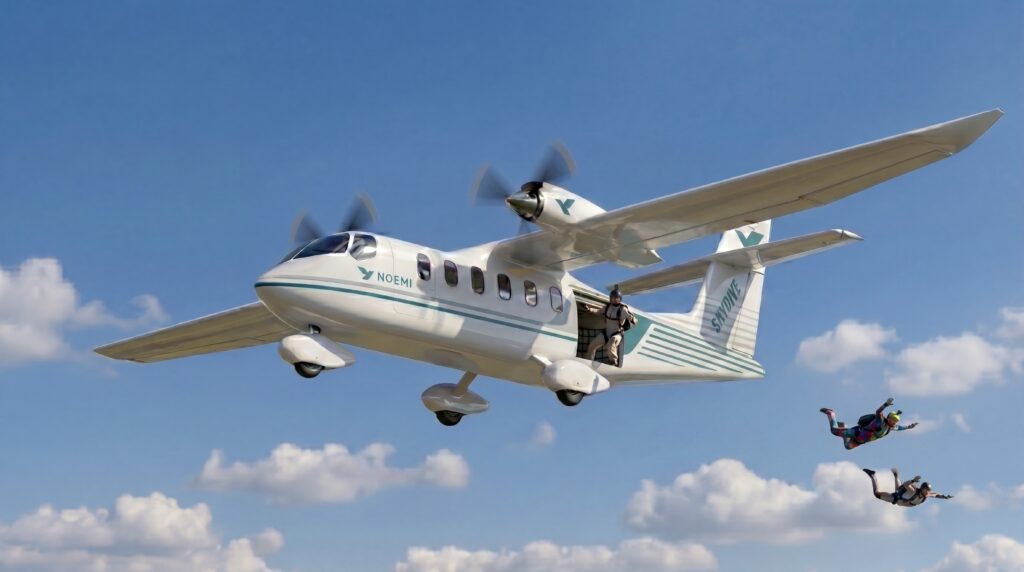
With fixed landing gear and a revised fuselage design, NOEMI Aerospace believes its aircraft could satisfy demand for a next-generation utility transport. It is aiming the type squarely at skydiving operations. Image: NOEMI Aerospace
Interestingly, the company has yet to consider the many military operators using similar aircraft for parachute training to relieve overstretched frontline airlifter fleets.
Aircraft historically have been built for a role and then adapted. As it goes into the preliminary design review stage, NOEMI Aerospace has broken that mold. Its battery-electric amphibious flying boat is now considered the core of an aircraft series, designed for dissimilar powerplant choices and quite dramatic differences in fuselage design.
The result, Lithun hopes, is a next-generation aircraft that will enable operators to make profits while bringing valuable new capability to market.
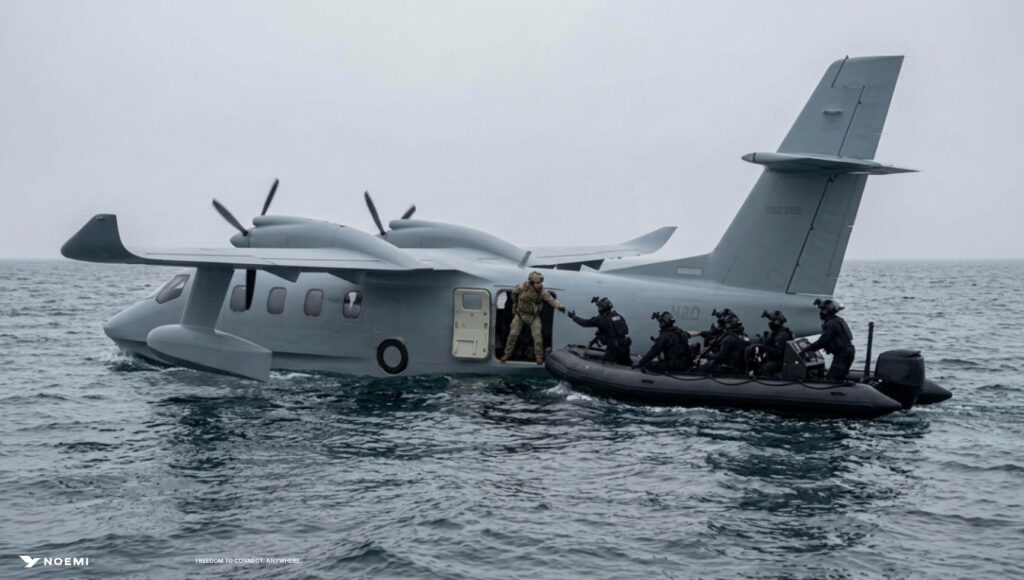
The company hopes to find interest from military special operations outfits. Image: NOEMI Aerospace
Related Articles:
- How Deutsche Aircraft is differentiating with its D328eco strategy
- Sim breakthrough could spark aerial firefighter training revolution
- ZeroAvia edges closer to cert as FAA issues electric engine conditions
- Merlin Labs sees incremental path to pilot-free passenger flights
- EVIO details plan to disrupt regional market with hybrid-electric aircraft
- Elfly chooses batteries for NoEmi flying boat prototype
Featured image credited to NOEMI Aerospace