
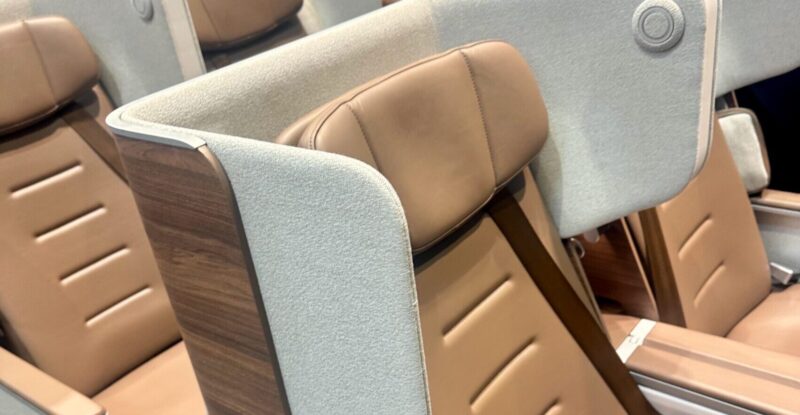

ZIM Aircraft Seating’s latest generation of premium economy seating has attracted a lot of attention for its sustainability pitch.
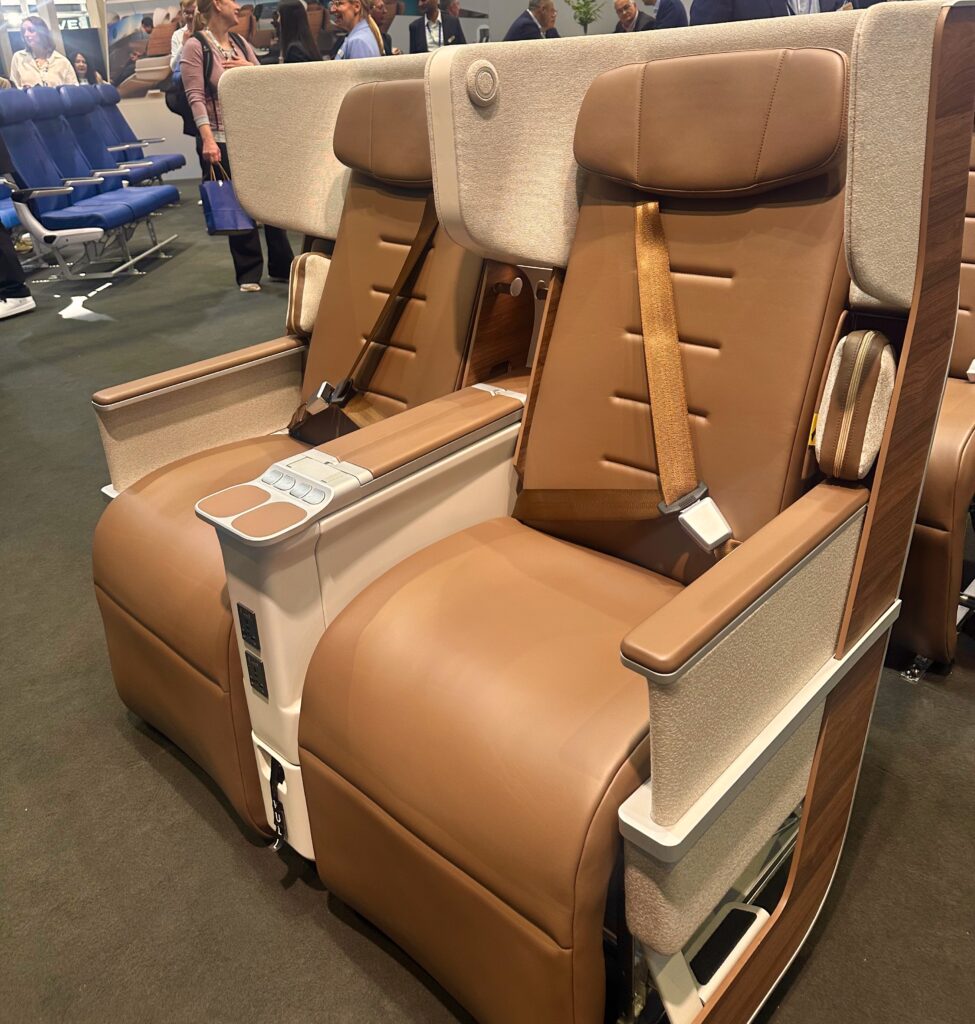
Aptly called The Frame, the platform boasts a unique wooden frame that’s billed as being 15% lighter than comparable products, thereby helping airlines to slash fuel and CO2 emissions — all while enabling “CO2 neutral” recycling at end-of-life.
Shortlisted for a 2026 Crystal Cabin Award in the Sustainable Cabin category, and the winner of a 2026 Red Dot Award for design, The Frame poses interesting questions of an industry accustomed to using thermoplastic surrounds for seats and suites.
In the early days of aviation, wood was used for aircraft interiors. Should seatmakers consider kicking it old school by using more wood elements in their furniture to reduce synthetic materials on board? For its part, ZIM confides it is already eyeing other applications for the laminated beech wood it uses for The Frame, including privacy dividers.
But while airlines ponder the proposition, The Frame as a seating platform is notable for other reasons beyond its sustainability message, as RGN can attest after trying the seat at the Aircraft Interiors Expo (AIX) in Hamburg.
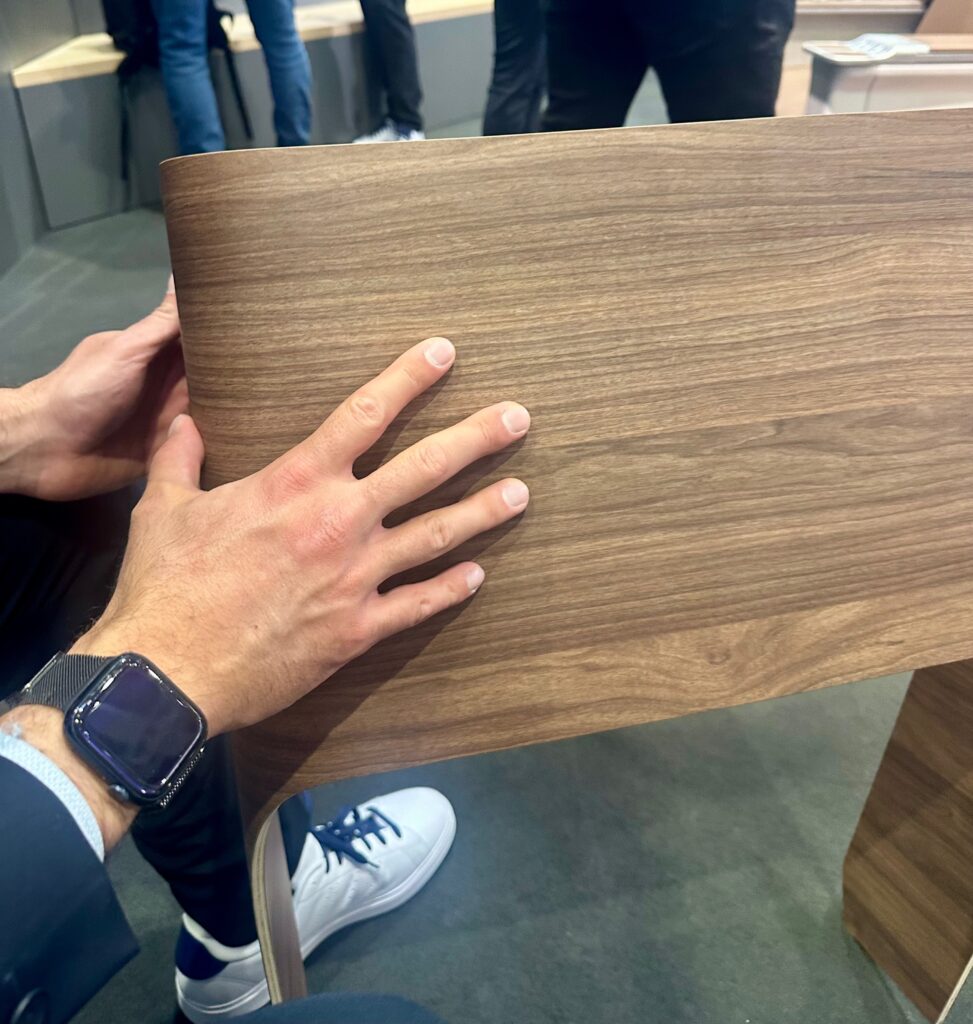
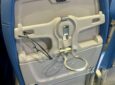
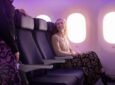
ZIM presented The Frame with molded, laminated, locally-sourced beech wood at AIX 2026. Image: Mary Kirby
Premium Economy seats with fixed back shells, such as those on offer from ZIM and flying across Lufthansa Group carriers’ longhaul fleets, garner mixed reviews. Some guests love the fact that the passenger in front of them cannot recline into their living space. Others bemoan that the slide-forward mechanism of the physical seat is not intuitive or does not enable enough recline.
With The Frame, ZIM’s engineers have iterated on their prior work and improved the design to deliver extremely smooth mechanical seat kinematics that enable the passenger to use their own weight – and very little effort – to move the seat manually into the reclined position.
With a simple push-back, your correspondent was able to recline with ease. The seat doesn’t have a mind of its own, but it effectively guides the passenger into their desired position with an ergonomically optimized motion that almost needs to be felt to be believed.
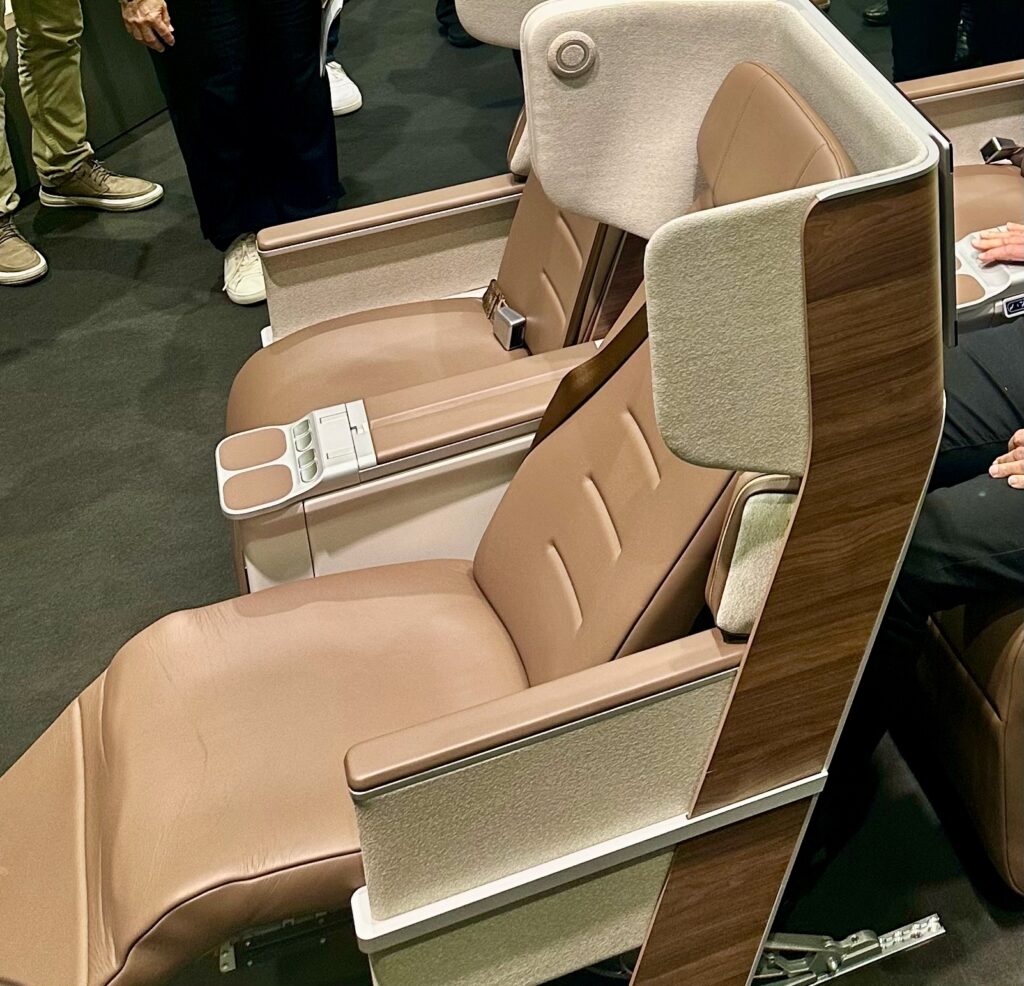
Whereas prior-gen ZIM premium economy seats require the passenger to instinctively know that they need to move their body to move the seat, The Frame is “more self-explaining, and that was the goal for the new kinematics,” company VP global research and product development Uwe Salzer explained to RGN.
Engineers at the German seatmaker spent “a lot of months” perfecting the design, he said. Now, in a bid to further improve passenger comfort, they’re studying how they can remove the three-point harness so that The Frame will only require a lap belt, whilst obviously remaining certifiable.
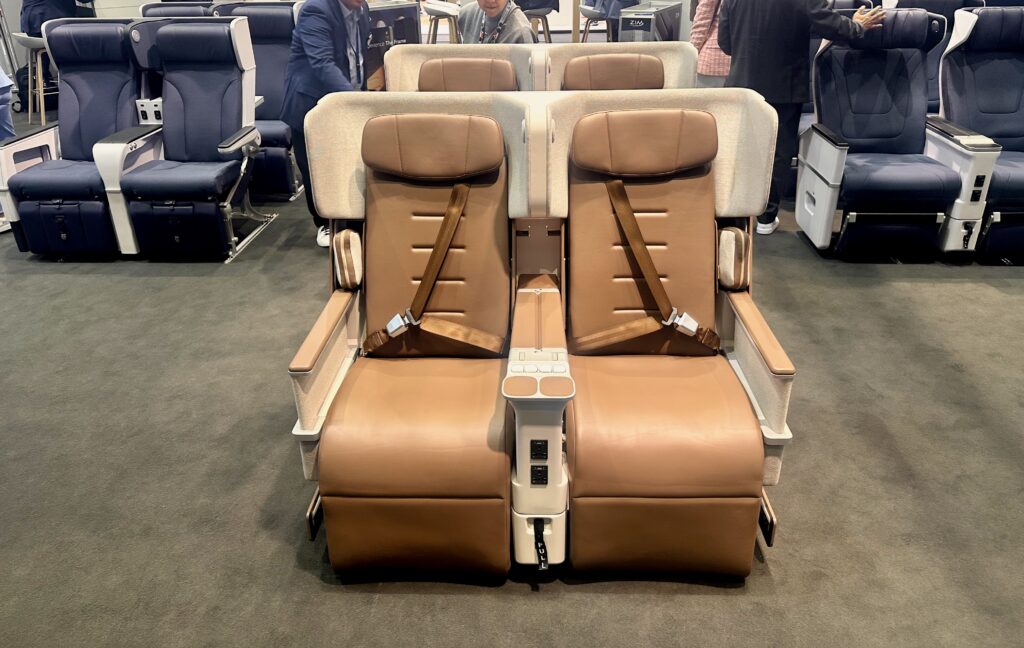
As is so often the case with long-range premium economy products, The Frame can also be utilized for domestic first- or business class-type cabins on single-aisle aircraft, and ZIM, which has been making a comeback since the COVID pandemic, is happy to support either implementation.
Domestic first/business is seen as particularly ripe for offering The Frame with electric actuation, which is an option available to airlines. “If you are cost and weight driven, you will go for the mechanical feature. If you would like to go more luxurious, you go for the electric actuation,” Salzer said.

For longhaul premium economy, ZIM recommends that The Frame be pitched at “at least” 38 inches. But ZIM can adapt it to suit airlines’ varying needs. “If you go for different pitches, maybe you can reduce the leg rest and install a footrest in front. Our products are very modular. You can use every component, every feature from every seat,” Salzer noted.
The Frame is not yet in revenue service. But since its reveal, it has received “very good responses from the airlines, because they know our existing seats. They know the innovation. Now it’s not only innovation in the ergonomics, it’s also innovation in materials and sustainability,” he said.
Outside of Europe, the seatmaker confirms it sees a lot of business opportunities in the Middle East and the United States.
All images credited to the author, Mary Kirby