

Nearly ten years after Qantas first vowed to take on “the final frontier of aviation” by offering ultra-longhaul direct flights from the east coast of Australia to London and New York, the sun is about to rise on Project Sunrise, with the carrier revealing that Sydney-London nonstops are scheduled to take wing in October 2027.
While this new time frame technically represents another delay to the program, as supply chain constraints continue to smart, Qantas has offered a proverbial bone to aviation enthusiasts who are champing at the bit for Sydney-London to launch: it confirms that its workhorse of choice for the route, the Airbus A350-1000ULR, will be the lowest density A350 in the world with just 238 seats.
Helping to accommodate the ultra long range of the twinjet is an extra fuel tank. But it wasn’t always so.
Back in the fall of 2019, Airbus told RGN that while the A350-1000 was the focus of its bid for the Qantas Project Sunrise business, it did not pitch the ULR configuration which would have required an extra fuel tank. At that time, the European airframer believed that a slightly higher maximum takeoff weight (MTOW) and other small changes would facilitate Qantas’ ambitions. (Over the last week, that article has become the focus of much interest for those who are closely tracking the evolution of the program.)
Within short order, by the end of 2019 in fact, the additional fuel tank was back in play. Announcing that it had provisionally selected the A350-1000 as the preferred aircraft for Project Sunrise, Qantas said at the time: “Airbus will add an additional fuel tank and slightly increase the maximum takeoff weight to deliver the performance required for Sunrise routes.” The airline placed a formal order for a dozen of the type in May 2022.
Key modifications
By integrating a Rear Centre Tank (RCT) into the structure of the A350-1000, Airbus has been able to boost fuel capacity by an additional 20,000 litres, which “enhances further the aircraft performance and extends the range of the standard A350-1000 by 1,000 nautical miles, with sufficient provision for diversions at the end of the flight,” the airframer noted early this month after the first A350-1000ULR (MSN 707) took its first-ever flight.
The addition of the RCT ensures that the A350-1000ULR can support Qantas’ nonstop flights from Sydney to London (and later New York) — a distance of almost 10,000 nautical miles with flight times of up to 22 hours. The baseline A350-1000 has been certified for a MTOW of 322 tonnes, but it’s our understanding that Airbus has not yet publicized a separate figure exclusively for the ULR variant.
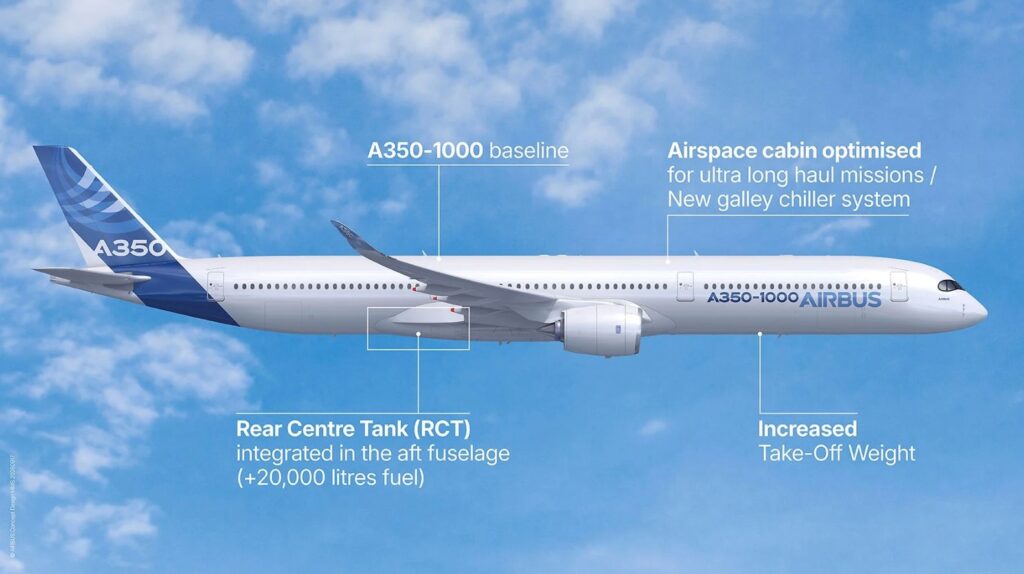
A350-1000ULR Qantas Project Sunrise modifications enable the longest commercial flights in the world. Image: Airbus
To make the math work, Qantas capped seat count on the A350-1000ULR at 238 (down from a typical -1000 capacity of 375), and Airbus further facilitated this low-density, premium-heavy, four-class configuration by optimizing the Airspace cabin on board to ensure passenger comfort.
Protecting the cabin layout during testing of MSN 707, Airbus engineers “installed five tonnes of instrumentation using entirely non-invasive methods. The teams routed thousands of feet of cabling through existing tracks and installed over 1,000 specialized sensors to gather critical data monitoring fuel flow, oxygen concentration and fuel tank performance,” the airframer says.
First, Business, Premium Economy, Economy
Renderings of Qantas’ Project Sunrise interiors were first made available in 2023. But at a time when “first class plus” is having a joyful, post-COVID moment on the -1000, Qantas appears forward-thinking. The A350-1000ULR is set to feature six bespoke, enclosed, Safran-made first class suites in a 1-1-1 configuration.
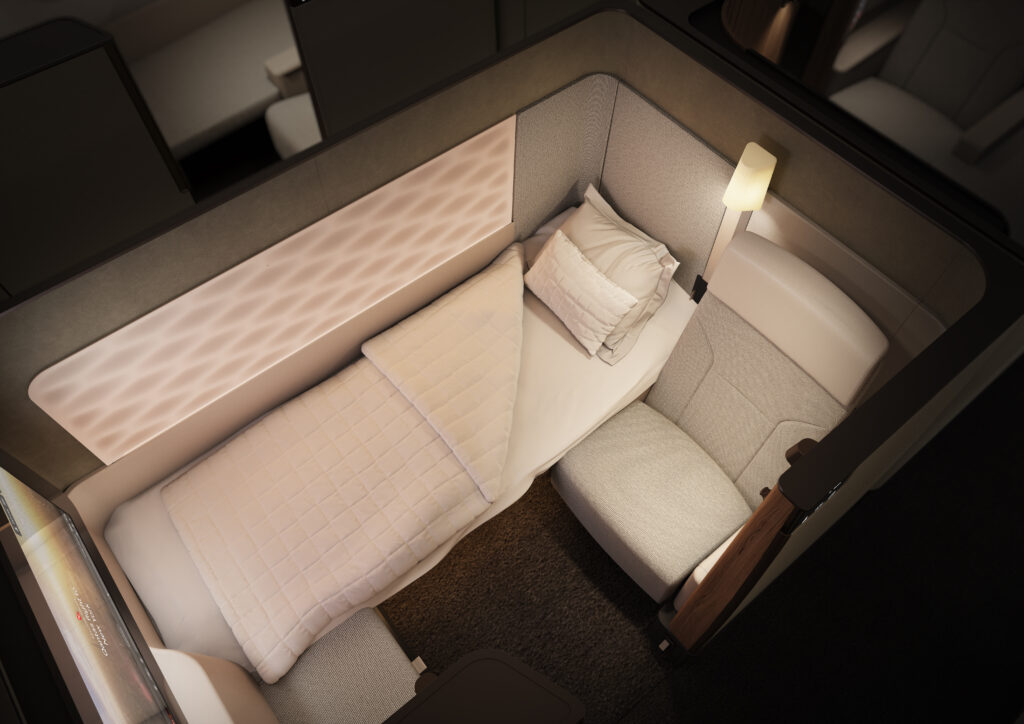
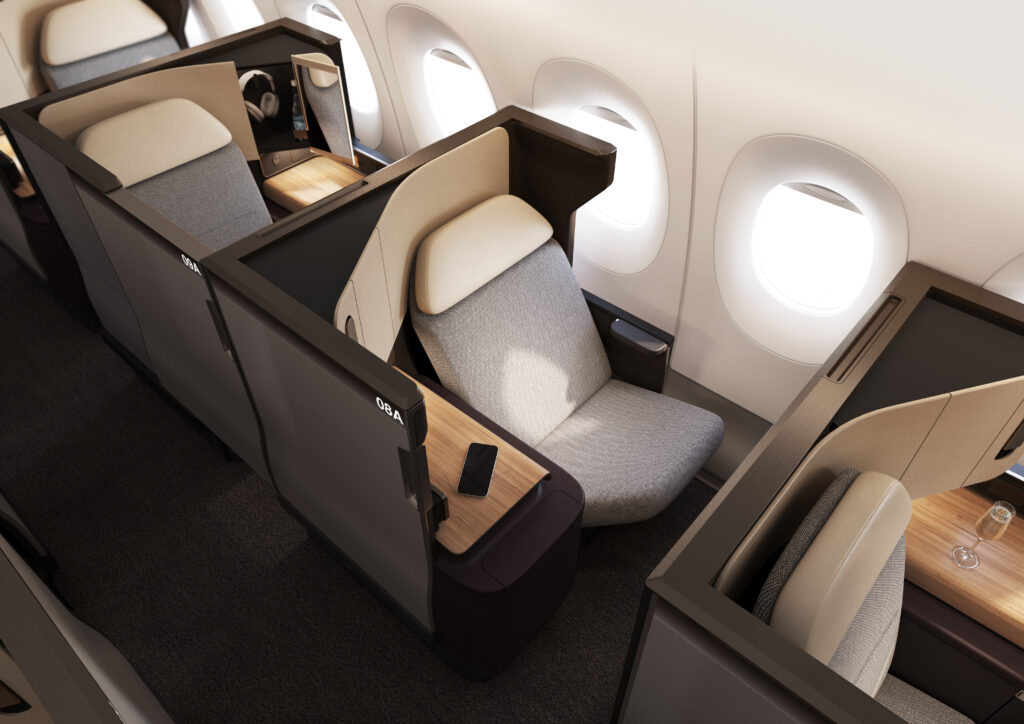
A total of 52 doored business class suites will be configured 1-2-1 on the Qantas A350-1000ULRs. They are based on the Safran Unity platform (which first broke cover at Japan Airlines).
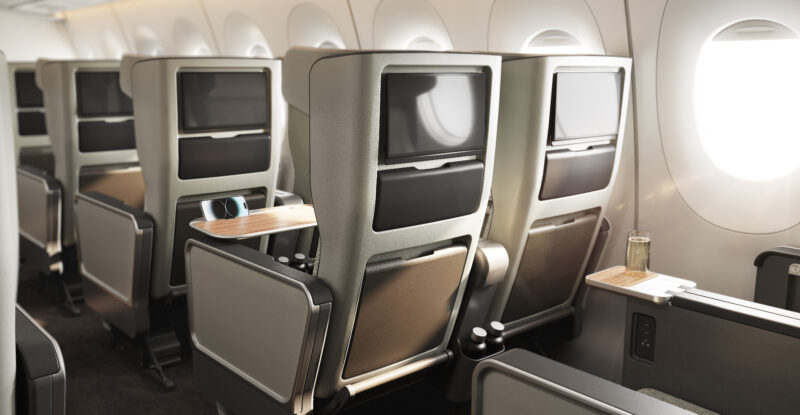
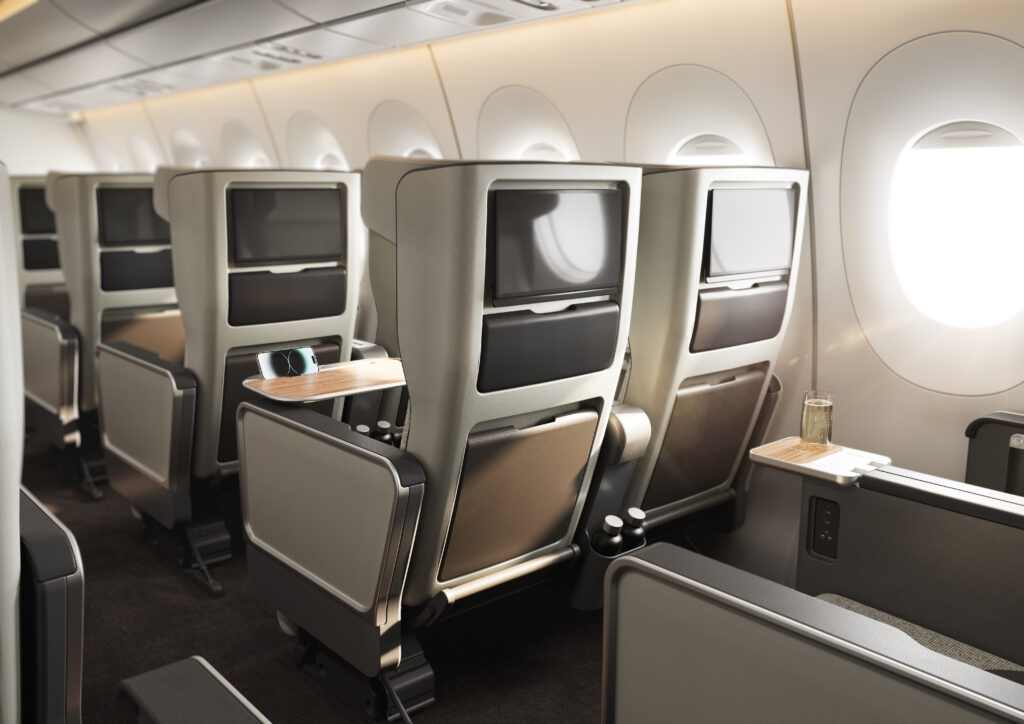
Each of the 40 seats in the 2-4-2-configured premium economy section of the Qantas A350-1000ULR will feature winged privacy and what the airline assures will be “the most generous seat pitch of any Qantas aircraft.”
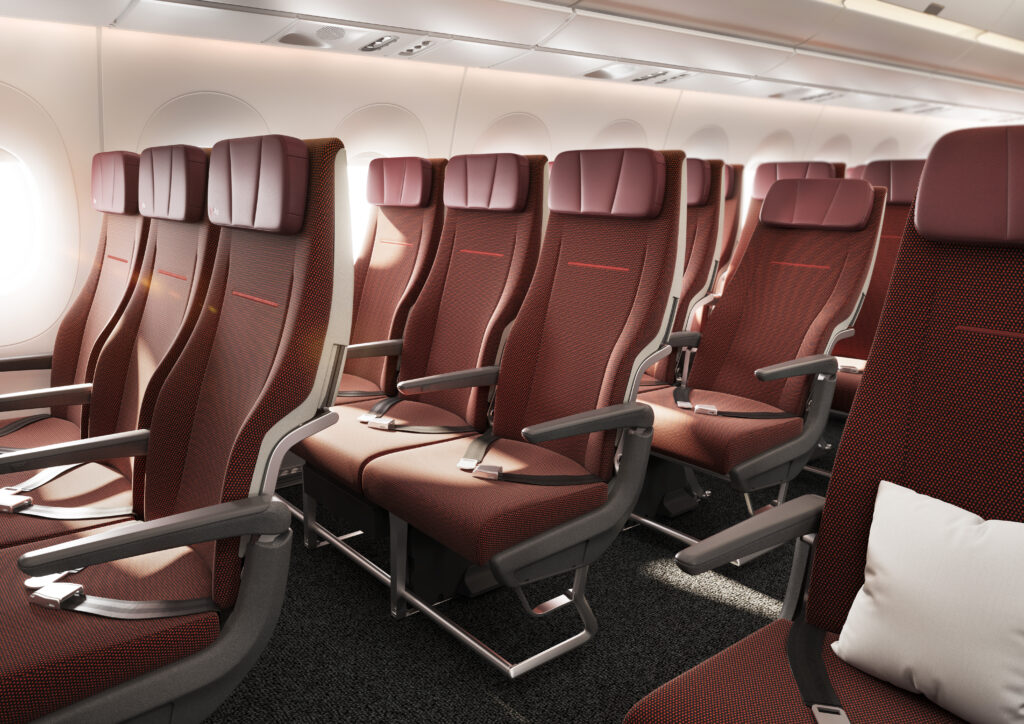
Finally, the economy class cabin is configured 3-3-3, boasts 140 seats and includes an extra-legroom economy section at the front which comprises 42 seats with 34” seat pitch.
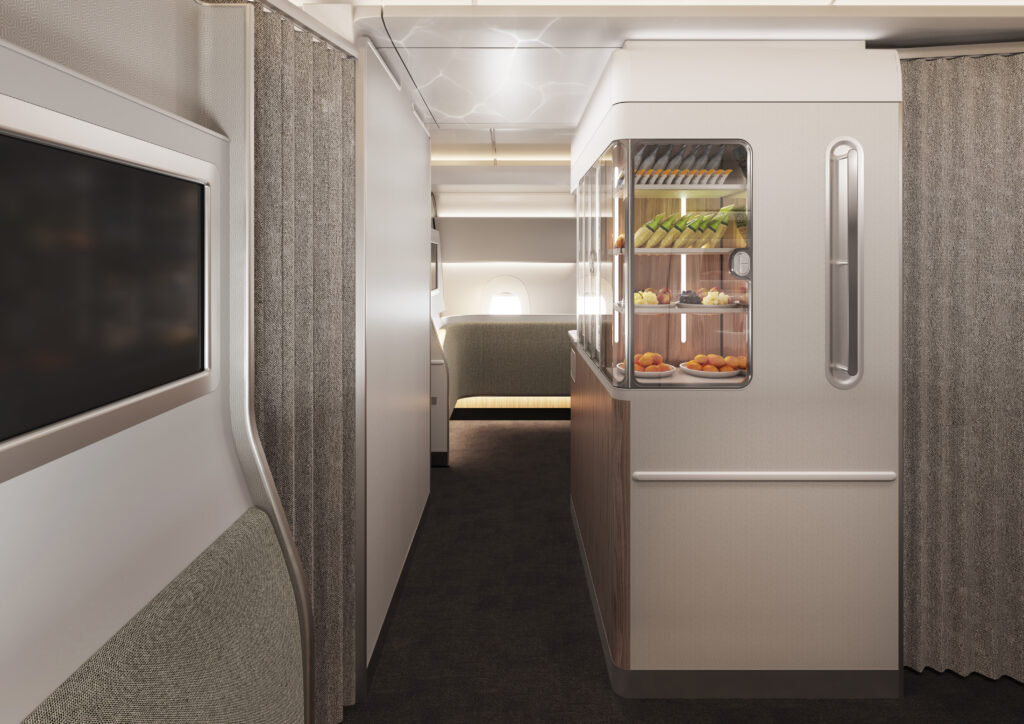
A much-anticipated well-being zone, which was designed by Caon Design Office and built by Diehl Aviation, features sculpted wall panels and integrated stretch handles, a guided on-screen movement program, a hydration station, and a range of premium refreshments.
All passengers will be able to access the well-being zone, Qantas says.
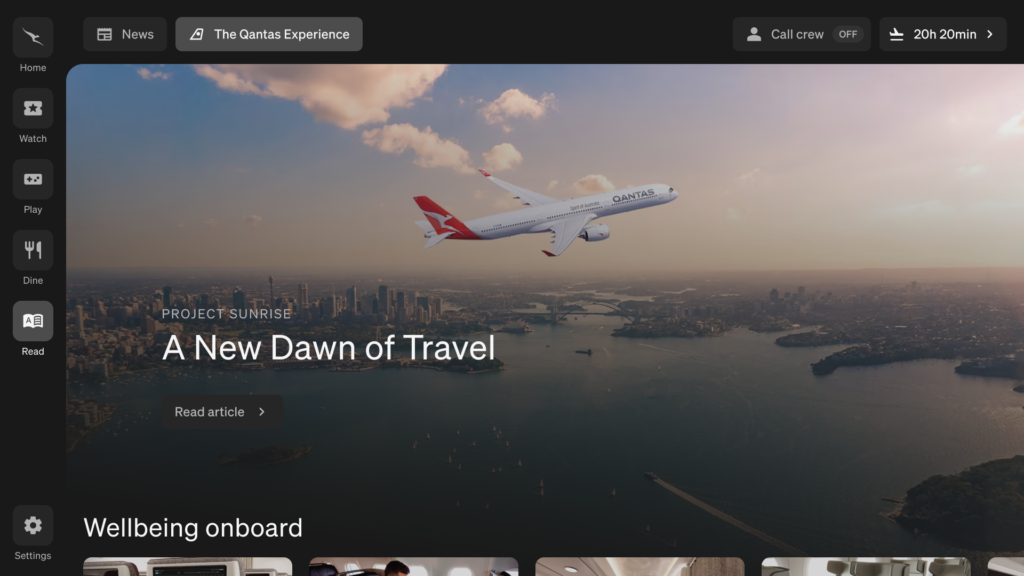
Naturally, the A350-1000ULR will feature seatback IFE from nose to tail, with Qantas having selected Panasonic Avionics’ next-gen 4K OLED-based Astrova IFE system with high fidelity multi-channel spatial audio and full cabin Bluetooth to enable passengers to connect to the system using their personal headphones

“For decades, Qantas and Panasonic Avionics have joined forces to launch game-changing IFE solutions. We immediately understood that these ultra-long-haul routes would bring with them a new set of passenger needs and expectations,” says Panasonic Avionics vice president of product management Andy Masson.
“Working closely with Qantas, our joint mission was to design a system that delivered all the creature comforts of home — everything from cinema grade picture quality to high fidelity audio, and enough power to fast-charge all passenger devices.”
Tickets for Qantas’ A350-1000ULR flights from Sydney to London will go on sale in February 2027.
Images credited to Qantas unless otherwise stated.