

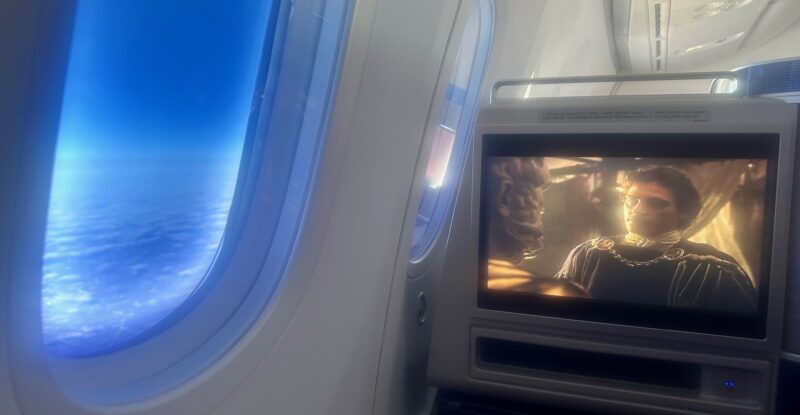

Multi-orbit satellite operator SES is exploring cross-unit content bundles between its media and aero or cruise businesses, as the passenger experience evolves.
The revelation, made by SES senior product executive Blane Boynton during the SATShow conference and exhibition in Washington D.C., comes at a time of rapid change in commercial aviation. Airlines are increasingly turning to low-latency NGSO-based inflight connectivity for onboard Wi-Fi, and many are looking to enable ‘connected seatbacks‘ in the not-too-distant future to drive personalization.
SES, itself, is already advancing a plan to launch a next-generation NGSO network, the Medium Earth Orbit (MEO) satellite-based meoSphere, which together with Low Earth Orbit (LEO) satcom service will power its future multi-orbit IFC.
At present, the Luxembourg-based satellite operator supports IFC on 3,000 tails, including with solutions that pipe geostationary (GEO), hybrid LEO/GEO and hybrid MEO/GEO satcom services to aircraft cabins. But it is also trusted by broadcasters and media companies worldwide to deliver content across a wide variety of markets.
“The aero/media partnership concept is a really interesting one. And we have, let’s call it a billion-euro media business. So, we’re talking internally about — is there a way that we can serve each other? Are there cross business unit bundles that we can look at to perhaps serve aero better or serve maritime better with a media offering,” Boynton told RGN at SATShow.
“So, in the eight months or so that we’ve been one company [combined with Intelsat], we’ve had, I think, a couple substantive workshops and discussions about that and I think industry is watching.”

SES already has many clutch partnerships in media and aero. With the requisite licensing rights, could it bundle media with IFC for compelling IFE? Image: SES
Least-cost routing in aero as connected seatback takes hold
SES is also a major player in the cruise industry with its O3b mPOWER MEO service and a hybrid MEO-LEO service that includes Starlink and, as such, it is well accustomed to operating in a multi-vendor ecosystem in the mobility vertical.
Now, as edge-to-cloud platform Quvia — notably a partner to Delta and JetBlue, which have added Amazon Leo to their roster of aero ISPs – gets more vocal about the benefits of a multi-vendor paradigm where airlines take control of the cabin layer, we asked Boynton for his perspective. Will it happen?
“I think that’ll happen, and I am waiting to see what happens in the IFE revolution,” he replied. “Historically, it’s been local content on airplanes; the airlines pay a lot for it, as you’ve reported, and no one’s meaningfully moved to cloud-based or on-demand content like we have at home… Just to watch TV [at home], I have to open five or six apps over the course of a week.”
He continued, “So, I am inclined to believe that the seatback experience is going to mature and is going to fall along the lines of some of these platforms that we all use every day. And I think whichever team can enable that first will actually have an advantage.”
Related Articles:
- RGN Premium: PAC on why Pax Experience is ‘ready for disruption’
- SES meoSphere will be core to MEO/LEO inflight connectivity
- How United is leveraging Starlink and the cloud to enhance IFE
- Panasonic enjoys rapid IFE growth as connected seatback takes wing
- Connected seatback at the fore as RAVE Aerospace enters new era
- How Quvia helps airlines throw out the IFC playbook and take control