

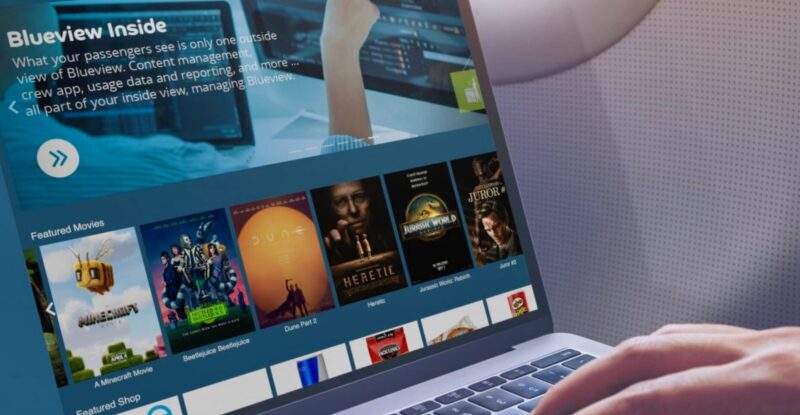

As next-gen inflight connectivity adoption accelerates, it might seem as if there is a diminished need for airline-branded digital portals that facilitate the streaming of DRM-approved movies and TV shows, onboard retail offers, and other content to passengers’ own devices.
However, while high-bandwidth IFC changes the game for airlines, surrendering the inflight passenger experience entirely to an open connectivity pipe carries risk.
“I think one of the early philosophical positions an airline needs to decide is ‘do I want to be in the world of curating that passenger experience or am I going to abdicate that?’” says Kevin Clark, CEO of Bluebox Aviation Systems, which is best known for providing Bluebox Wow portable wireless IFE (W-IFE) to the market.
“To relinquish that is quite a big step,” Clark continues, especially given “the investment they’ve put into all the other touchpoints” including to personalize the experience.
That’s why Bluebox is offering airlines the opportunity to stay fully engaged with their passengers and provide a consistent PaxEx across connected or disconnected aircraft.
In the disconnected realm, Bluebox’s award-winning Blueview digital services platform rides on the server inherent in its Bluebox Wow W-IFE boxes, which can be carried on board by catering employees or cabin crew, and either powered by battery or aircraft power as opposed to being permanently wired to the aircraft.
When acquiring Airbus aircraft, airlines also have the option to order the European airframer’s own embedded wireless IFE solution — part of its optional, linefit Open Software Platform (OSP) — and select one of a handful of Airbus-approved digital partners, including Bluebox, to deliver the software and content, in this instance Blueview. OSP is also available via retrofit.
Enter Blueview Cloud
In what could be seen as a natural evolution, given Airbus’ own move to uncouple W-IFE hardware from the software, Bluebox in 2025 “unboxed” Blueview for the broader connected aircraft ecosystem, calling the solution Blueview Cloud.
Instead of relying on either its own or indeed a third party’s onboard server, Blueview Cloud does as its name suggests, hosting the Blueview software suite on the ground and piping the airline’s branded portal and associated entertainment and e-commerce services to the cabin over inflight connectivity.
Blueview Cloud runs through the airline’s existing connectivity infrastructure, including via new Low Earth Orbit (LEO) and multi-orbit networks.
The creation of Blueview Cloud ensures that Bluebox is taking the necessary steps “to stay relevant in the connected world,” Clark notes. But it also ticks several boxes for airlines, including around return on investment (ROI).
When a digital cabin experience reflects the airline’s brand and is integrated with its loyalty programs and advertising campaigns, the carrier retains a measure of control over the passenger experience and can continue to drive engagement and ancillary revenue.
Order-to-seat retail, duty free sales, destination bookings, premium content bundles, advertising and sponsorships, digital wallet integration and live payments can be facilitated. Bluebox says orders are delivered straight to the crew members’ point-of-sale (POS) devices with seat-specific details.

There is also value in ensuring that passengers can interact with a digital cabin experience that is consistent with what they’re accustomed to experiencing on disconnected aircraft in the airline’s fleet.
For example, if an airline is already carrying Bluebox Wow units on some aircraft, has perhaps selected embedded wireless IFE for new or retrofitted Airbus tails under the OSP program, and has opted to equip some of its aircraft with inflight connectivity, the airline-branded, Blueview-powered offering remains uniform across all aircraft.
“That transition deployment model works for us really well,” Clark says, noting that airlines can easily start with portable or embedded W-IFE and later graduate to Blueview Cloud when their aircraft are fitted with IFC.
An answer to the licensing question?
Today, there is legal uncertainty around whether the terrestrial rights covered in passengers’ streaming subscriptions extend to the onboard environment — most especially when traveling abroad and overseas where geo-restrictions are imposed. And airlines have been advised by major studios and the Airline Passenger Experience Association (APEX) to exercise caution when promoting inflight streaming via OTT platforms.
Bluebox is offering a potential way forward. It is presently going through the process of getting approvals for content streaming over Blueview Cloud which would remove the legal limbo faced by airlines by ensuring that DRM-approved films and TV programs are streamed. Usage data and analytics are also provided.
“Blueview Cloud talks to the market today, but I think it has mass relevance in the future,” Clark says.
Related Articles:
- BBC Studios, Panasonic could offer IFE over-the-top via BBC Player
- Do fast Wi-Fi and the shift in media consumption portend BYOL IFE?
- Studios warn airlines: don’t bypass content rights in flight
- New inflight map Inflight Navigator enters the picture
- #PaxEx Podcast: Bluebox CEO Kevin Clark unpacks business plan
Featured image credited to Bluebox Aviation Systems