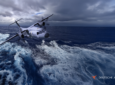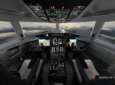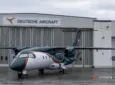



 Deutsche Aircraft aims to differentiate itself from other OEMs by providing customers for its in-development D328eco turboprop with a “seamless, end-to-end” experience throughout the aircraft’s entire lifecycle. It asserts that the extra time afforded by a delayed service-entry date has enabled it to build resilience against the supply chain problems that have plagued the aerospace industry.
The German aircraft developer is now targeting the second half of this year for the D328eco’s first test flight, with certification, deliveries and entry into service planned for the fourth quarter of 2027 — a year later than it had anticipated in 2023. Its final assembly line in Leipzig is scheduled to open in May.
“The additional lead time provided by our revised program schedule has enabled us to strengthen our industrial base,” Deutsche Aircraft’s newly anointed chief commercial officer, Anastasija Visnakova, tells RGN. “Final assembly line development, supplier integration and long-term planning are all aligned to avoid the challenges seen elsewhere in the industry.”
Visnakova was promoted to chief commercial officer earlier this month after three years of vice president of sales and marketing.
“In my new role, our priority is to ensure that every customer benefits from a unified, end-to-end experience — from initial engagement through the full lifecycle of the aircraft,” she says. “We have restructured our commercial organization to bring sales, marketing, aftermarket, customer service and training under one umbrella, ensuring a seamless experience rather than a fragmented one.
“This is a major differentiator from traditional OEM setups.”
For Visnakova, “the ideal customer journey is one where an operator can order their aircraft, follow a transparent production and delivery process, enter service without delays and operate with confidence, thanks to proactive support across the entire lifecycle.”
To achieve this, she says Deutsche Aircraft has designed the customer journey around three pillars: integration; predictability; and readiness from day one. On the latter two points, the manufacturer is implementing “predictive maintenance and global assistance tools” while adopting “customers on the wing from day one” as its mantra.
This means that “the right training, spares, tools and data systems are in place ahead of entry into service,” Visnakova explains.

Deutsche Aircraft has yet to announce any firm orders for the D328eco but says it has signed “around 150” letters of intent for the aircraft and has a “validated global commercial pipeline of approximately 600 units.”
Berlin-based charter operator Private Wings, which already operates a fleet of original Dornier 328 turboprops, is the only publicly disclosed customer so far, having tentatively signed for five D328ecos in May 2023.
“Private Wings remains an important early program partner for us, and we continue to collaborate closely with the potential operators preparing for early D328eco service entry,” says Visnakova, adding that “various other undisclosed operators” have taken nearly all the first year’s slots. Deutsche Aircraft is seeing “growing interest” from operators in Europe, Africa and the Middle East, she notes, and is in talks with “commercial airlines, multi-role operators and government or special-mission users.”

The D328eco is a 40-seat stretched version of the Dornier 328 twin-turboprop. Its Pratt & Whitney PW127XT-S engines are designed to operate on 100% sustainable aviation fuel (SAF), including power-to-liquid (PtL) fuels. However, global SAF volumes remain stubbornly low, and the maximum blend currently permitted is 50% — two facts acknowledged by Visnakova.
“We recognize today’s constraints — limited SAF supply, high cost and blend caps — but we are encouraged by accelerating investment and policy momentum worldwide,” she says, adding: “By the time we enter service, we expect meaningful progress both in production volumes and across regional markets.”
She notes that the D328eco’s next-generation propulsion system, advanced aerodynamics and weight-optimized structure make it “significantly more efficient than earlier turboprops,” the idea being that it can “operate efficiently today on Jet A while seamlessly transitioning into higher SAF blends as supply grows.”
Related Articles:
- EVIO details plan to disrupt regional market with hybrid-electric aircraft
- ATR sees strong U.S. market potential as JSX showcases ATR 42-600
- Eve Air Mobility CCO Megha Bhatia on what sets its eVTOL apart
- Deutsche Aircraft signs D328eco customer, begins assembly line work
- Regional aviation proves big draw for Deutsche Aircraft’s Visnakova
All images credited to Deutsche Aircraft