
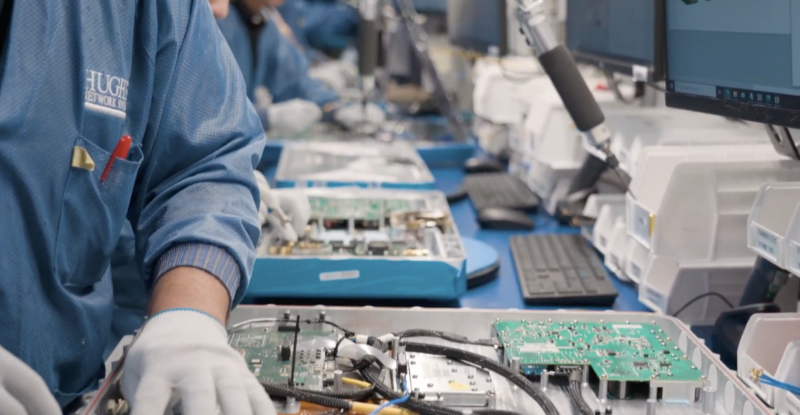

Building electronically steerable antennas in Germantown, Maryland for the aviation market, and supporting inflight connectivity via ESA, double-ESA, mechanically steered phased array and hybrid solutions, Hughes Network Systems has opted to stay flexible in its approach to IFC, offering multiple hardware and service options and eschewing a one-size-fits-all model.
In the last 14 months, the satellite operator, aero ISP and hardware manufacturer has shipped over 700 ESA terminals from its state-of-the-art AS9100-certified factory. Gogo is a key customer in the business aviation space, using Hughes’ half-duplex (HDX) and full-duplex (FDX) ESAs for its Eutelsat OneWeb Ku-band Low Earth Orbit (LEO) satellite-powered Galileo IFC service. By 31 March 2026, Gogo had shipped 410 units of Galileo to operators, and the number of business aircraft online with the service had risen to 111, representing a 50% increase over the fourth quarter of 2025.
But Hughes is also preparing to use its own HL1520-branded ESA for commercial aviation to support both LEO-only IFC as well as multi-network IFC for airlines. Leveraging Hughes’ Fusion software, which aggregates connectivity from multiple networks simultaneously while actively and continuously sorting each IP packet to optimize the overall customer experience, the latter option is notably now offered in two flavors.
Fusion: ESA + VICTS
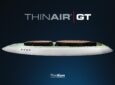
Pairing Hughes’ LEO-only ESA for Eutelsat OneWeb’s Ku-band service with ThinKom Solutions’ popular Ka2517 VICTS mechanically steered phased array antenna for Ka-band geostationary (GEO) satellite service, and offered as separate installs atop the fuselage or as an integrated package, the first Fusion-focused IFC solution ticks four key boxes — it is multi-orbit, multi-band, multi-network and multi-beam.
The kit has already been earmarked by Delta Air Lines for its Boeing 717s (with work progressing) as well as select new A321neos and A350-1000s. Airbus has agreed to factory-fit the Ka2517 portion of the hybrid solution to Delta’s -1000s, as Ka2517 is already linefit offerable under its supplier-furnished HBCplus offering, and the airframer was willing to broker a special deal for the US major.
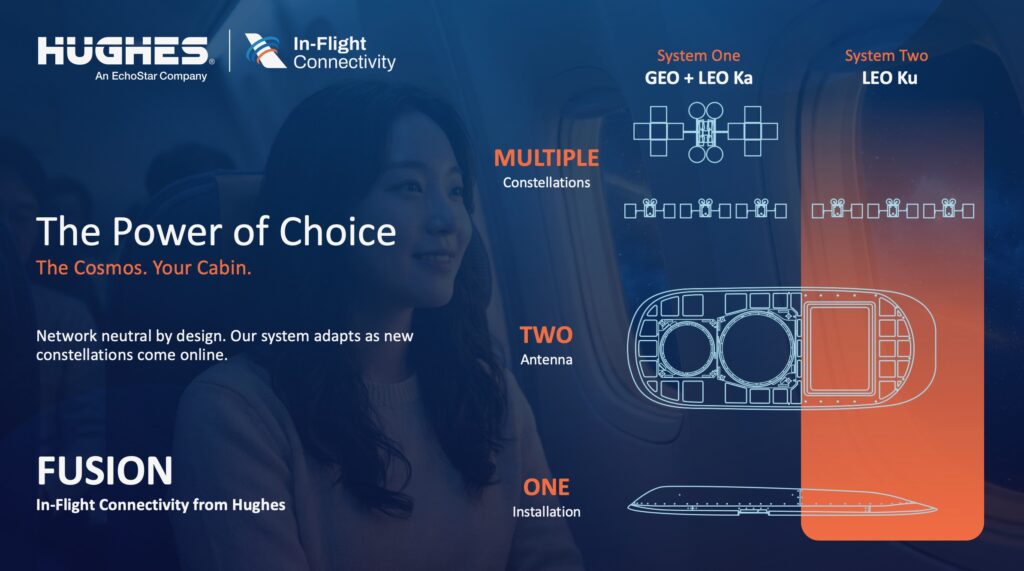
Hughes’ hybrid ESA + VICTS solution is flexible in that the ESA can in time be swapped out for one that supports Eutelsat OneWeb’s Gen 2 LEO network or Telesat’s forthcoming Lightspeed network. And because Ka2517 is also compatible with Lightspeed LEO, airlines could have the option to bring two LEO networks on board, OneWeb and Lightspeed, whilst augmenting with GEO satcom.
Fusion: ESA + ESA
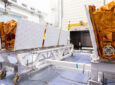
Hughes’ second Fusion-focused offering, announced at the Aircraft Interiors Expo in Hamburg, is a single antenna solution that integrates two low-power-consumption ESAs: Hughes’ own HL1520 Ku-band ESA and a new Ka-band ESA.
While the so-called advanced antenna technology system (AATS) is billed as being “network-agnostic” and is engineered to operate across all Ku- and Ka-band non-geostationary satellite orbit (NGSO) networks, Hughes presently offers network access to its current capacity partners, such as Eutelsat OneWeb, for which it is a service distribution partner in aero, or its long-time GEO capacity partner Telesat, with whom it would presumably ink a formal agreement for Lightspeed LEO service.
The AATS is arriving at a time when multiple new LEO networks are in the process of being built out or are on the cusp of launching their first satellites. Hughes says its AATS is being designed to enable new capacity partners to join the ecosystem, while maintaining a single service level agreement (SLA).
Could Hughes team up with the likes of China’s Spacesail to offer a LEO-LEO offering akin to Panasonic’s arrangement with the Chinese satellite operator? If so, its integrated ESA-ESA solution would be well positioned to facilitate.
While a double-LEO offering holds appeal, the firm’s ability to offer multiple Fusion configurations ensures it can provide ultimate performance and service availability based on location, demand, and network conditions. For example, when a LEO network doesn’t have landing rights in a specific country, GEO satellite capacity can be used via the hybrid ESA-VICTS kit.
For Hughes senior vice president and GM of the Aviation Business Unit, Reza Rasoulian, the firm’s burgeoning IFC portfolio is about providing optionality to airlines.
“Hughes continues to avail multiple, flexible, Fusion options which brings together multiple networks simultaneously at Ku and Ka band. This includes our ESA-ESA solution or the hybrid VICTS and Hughes ESA solution, to airlines depending on the use case and mission requirements. Our mission is simple, provide simultaneous multi-constellation solutions and provide flexibility to our airlines partners,” he tells Runway Girl Network.

Hughes’ AATS disclosure at AIX, meanwhile, is well timed, falling on the heels of Airbus’ own announcement at the show that it will offer a linefit HBCplus modular package that can house multiple ESAs for entry-into-service from 2028, and Boeing’s revelation to RGN that its Boeing Aerodynamic Shroud could ultimately evolve to support a multi-vendor paradigm in the future.
“We value our continued collaboration with the OEMs, and our ESA-ESA solutions will provide ultimate flexibility and optionality for retrofit as well as linefit solutions,” Rasoulian says.
Related Articles:
- Now critical IFC needs resiliency, security: Eutelsat’s Bisgaard
- Airbus open to IFC orchestration should multi-vendor take off
- Boeing stays flexible to support ESA installs for next-gen IFC
- How Airbus is working to facilitate Delta Air Lines’ vision
- Prominent IFC providers welcome ‘least cost routing’
- SES advances work on multi-band ESA for meoSphere + LEO IFC
- Amazon Leo ESA, ThinKom Nexus and new Starlink kit break cover
- Viasat readies for new AERA with ViaSat-3, multi-beam ESA
- Panasonic, Spacesail to launch multi-network LEO IFC in 2027
- Air India taps Hughes multi-orbit primed IFC for tranche of widebodies
Featured image credited to Hughes Network Systems