
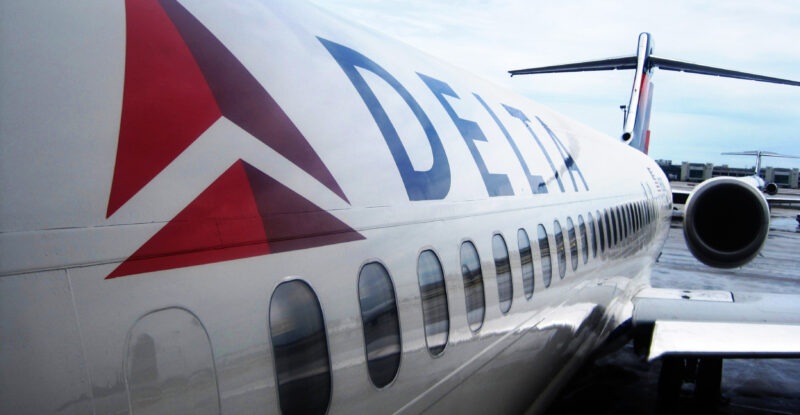

Delta Air Lines has progressed with the installation of Hughes Network Systems’ multi-orbit, multi-band, multi-beam inflight connectivity solution on its Boeing 717s, and now expects to offer free Wi-Fi across its entire fleet in early 2027.
“Early next year, we will offer free Wi-Fi on our entire fleet,” Delta CEO Ed Bastian said in an update to SkyMiles members, who can avail of the complimentary service via their loyalty account credentials.
Dubbed Hughes Fusion, the IFC kit being fitted to Delta’s 717s transmits data over Eutelsat OneWeb’s Ku-band Low Earth Orbit (LEO) satellite network and Hughes’ ultra-high-capacity Ka-band geostationary (GEO) satellites.
The Fusion architecture sees ThinKom Solutions’ petite multi-orbit Ka1717 VICTS mechanically-steered phased array antenna paired with a Hughes Ku-band full-duplex LEO-only electronically steerable antenna (ESA).
But while both antennas can be offered under a single radome, a video of a fitted Delta 717-200 recently broke cover on Instagram, showing that the two systems have been installed separately atop the fuselage. Registered as N939AT, the 717 is the last of the type ever built.
Hughes’ GEO-now focused IFC offering, meanwhile, has been rolling out on Delta’s regional jets. Called Hughes Jupiter In-flight, the Ka1717-based system is replacing legacy air-to-ground IFC hardware on the RJs.
“Streaming-capable connectivity is rolling out across Delta Connection and 717 aircraft, with installations slated for completion by early 2027,” Delta confirms in an online statement.
The SkyTeam alliance member has also tapped Germantown, Maryland-based Hughes to provide Hughes Fusion for 20 new A350-1000s and select new A321neos. Hughes has paired ThinKom’s larger Ka2517 VICTS antenna with its LEO-only ESA for the larger twinjets.
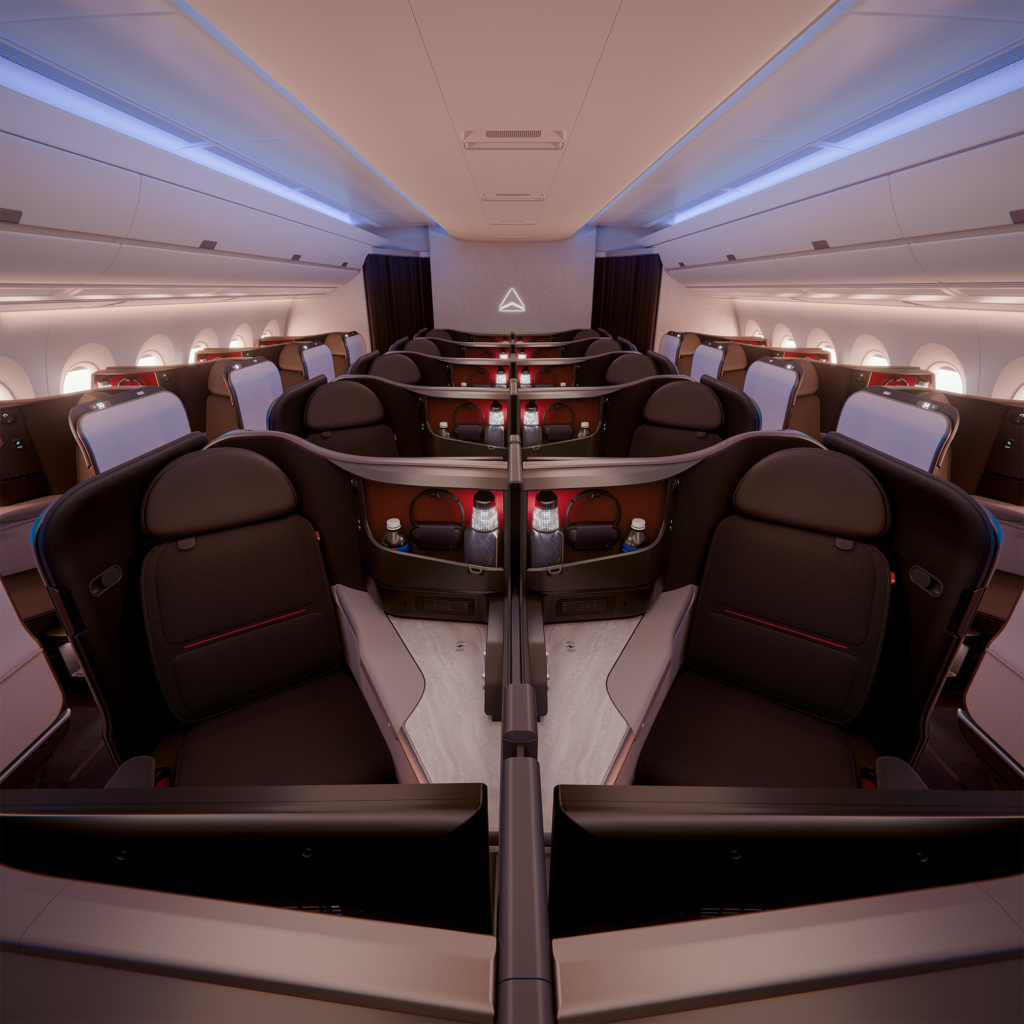
Delta’s A350-1000 deliveries are slated to start in early 2027. The widebodies will arrive with next-gen Delta One suites on board, as well as a portion of the Hughes Fusion kit already installed.
Airbus is notably working with both Delta and Hughes to factory-fit Ka2517 on the -1000s under its linefit, supplier-furnished HBCplus flex inflight connectivity program, whilst also supporting Delta in its post-delivery modifications of the Hughes LEO-only ESA.
Explaining Delta’s decision to adopt Hughes Fusion for the 717s, A350-1000s, and select A321neos, company managing director inflight entertainment and connectivity Glenn Latta previously explained that the platform enables the carrier to pull from LEO and GEO assets simultaneously.
“And by doing that we also have resiliency. So if there is an issue or anomaly on one network, we can pull from the other network and deliver for that always available customer experience,” Latta said.
The U.S. major could ostensibly also offer Telesat’s forthcoming Ka-band Lightspeed LEO service on these birds down the road, and indeed on the RJs, as the agnostic Ka1717 and Ka2517 antennas will be able to talk to Lightspeed when the service comes online.

Also a prominent IFC provider to Delta, Viasat powers free Wi-Fi on the lion’s share of the airline’s mainline fleet, and supports the connected seatback experience, which delivers personalized entertainment and real-time trip updates to passengers, as well as access to a growing ecosystem of partner experiences and offers through Delta Sync.
More than 1,300 aircraft are now fitted with Delta Sync Wi-Fi, representing over 95% of Delta’s fleet. “Last month, we extended coverage to our trans-Pacific routes, bringing Wi-Fi coverage to some of our longest flights,” Bastian notes.
“Early next year, we will offer free Wi-Fi on our entire fleet, and in the meantime, Viasat’s new satellite technology is already boosting Wi-Fi speeds across the Americas.”
Viasat, meanwhile, is poised to add a Lightspeed layer to its IFC offering in the future as its Amara-branded multi-orbit GEO/LEO solution ingests Lightspeed capacity.
Related Articles:
- How Airbus is working to facilitate Delta Air Lines’ IFC vision
- SES eyes 700-plus ESA inflight connectivity installs by year-end
- Viasat: No single orbit will determine IFC market winner
- Viasat says Lightspeed coverage delay doesn’t change plan
- Beyond Starlink: what comes next for inflight connectivity?
- How Delta Sync seatback demonstrably improves PaxEx
- ThinKom eyes Airbus HBCplus modular for Nexus aero antenna
- Hughes stays flexible with ESA, double-ESA and hybrid ESA-VICTS IFC
All images credited to Delta