

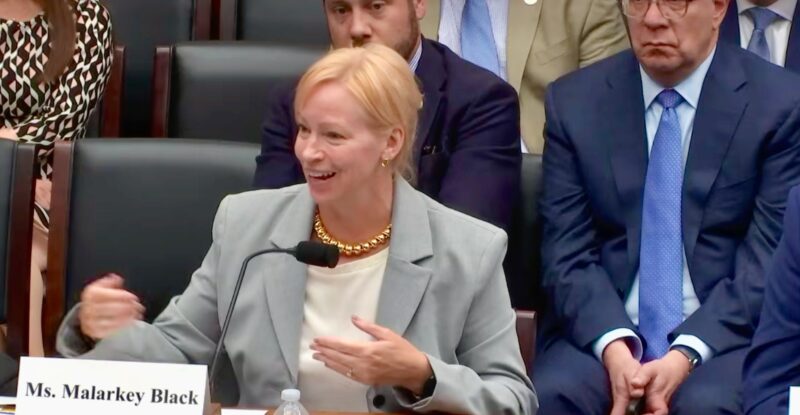
 Regional Airline Association President & CEO Faye Malarkey Black testified at today’s House Aviation Subcommittee, urging Congress to strengthen rural air service, invest in small-airport safety, and address the workforce and aircraft constraints affecting small-community connectivity.
Malarkey Black told lawmakers that rural communities still lack the air service connectivity they need. While aggregate air service has improved, 193 airports still had less service in May 2026 than in May 2019, with losses averaging 31 percent. Ninety airports lost at least a quarter of their flights, 35 lost more than half, and 14 lost service entirely.
“Passengers don’t experience air service in the aggregate,” Malarkey Black said. “They experience whether their own airport still has the schedules and destinations that make it useful.”
Safety beyond the largest airports
Calling safety the foundation of everything RAA members do, Malarkey Black said the focus on Reagan National is right and necessary, and that the same vigilance belongs everywhere regional airlines fly, into smaller airports, contract towers, and non-towered fields.
She urged Congress to take three safety steps: extend risk-based reviews to mixed-traffic airports, equip contract towers with digital tools so controllers are not separating traffic by sight alone, and require radio communication near non-towered and limited-service airports with commercial traffic.

On collision avoidance, Malarkey Black thanked the Committee for embracing ACAS-X and supported both it and the ADS-B In technology it depends on.
She cautioned against the assumption that ADS-B In is ready fleet-wide while ACAS-X alone carries a long lead time — noting both require aircraft-specific certification, installation, and supply chains that carriers do not control.
In the near term, she urged delivering ADS-B In through the Electronic Flight Bag, the mounted tablet pilots already use on every flight. “We should not wait years for safety benefits we can put in the flight deck today,” she said.
Workforce, aircraft, and air service programs
Malarkey Black said pilot supply is more stable than at its peak, but the underlying shortage is not resolved. Mainline hiring again outpaced new certifications in early 2026, with massive mandatory retirements ahead.
A central barrier is cost: flight training is far more expensive than ordinary college, and federal student loans fall about $80,000 short on average. She urged Congress to align federal student aid with the real cost of accredited flight training, update GI Bill eligibility for the first phase of training, and raise the pilot retirement age to 67.
She also emphasized the need for right-sized aircraft for small-community markets, encouraging attention to scope-clause limits, and for continued support for federal air service supports. Essential Air Service, she noted, generated about $2.3 billion in economic activity and supported more than 17,000 jobs before the pandemic.
“The choices you make in the next FAA Reauthorization will determine whether rural communities can regain and sustain meaningful service,” Malarkey Black told the subcommittee. “We hope you’ll see us as a partner in the work ahead.”
Read the full statement here and watch the hearing here.
About RAA:
The Regional Airline Association (RAA) provides a unified voice of advocacy for North American regional airlines aimed at promoting a safe, reliable, and strong regional airline industry. RAA serves as an important support network connecting regional airlines and industry business partners. Regional airlines operate 32% of U.S. scheduled passenger flights and provide the only source of scheduled air service to 64% of the nation’s airports. Regional airlines provide more than 70% of the air service in West Virginia (92%), Alaska (85%), North Dakota (80%), Kansas (75%), Arkansas (75%), Alabama (75%), and Vermont (74%). Regional airlines provide more than half of the air service in Mississippi (68%), South Dakota (68%), Maine (67%), Idaho (67%), Wyoming (66%), New Hampshire (63%), Montana (63%), Wisconsin (53%), Iowa (53%), Virginia (52%), Kentucky (51%), and Indiana (51%).