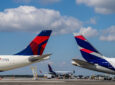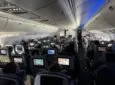


Viasat’s new ultra-high-capacity ViaSat-3 F3 satellite has entered service, making capacity available for its government, maritime, and airline customers operating in Asia-Pacific, including Delta Air Lines and Qantas.
Expected to deliver more than one terabit per second of throughput, the satellite has been hotly anticipated by airlines for years, as it plugs a key gap in Viasat’s near-global, three-satellite ViaSat-3 constellation, and enables them to offer gate-to-gate service, including over Asia-Pacific. Download speeds are expected to be north of 100 Mbps.
“ViaSat-3 F3’s advanced technology, including its ability to maximize regional capacity density on demand within premium mobility markets, will drive growth and improved blended average yield and incremental cash economics across our portfolio,” Viasat chairman and CEO Mark Dankberg said in a statement confirming that the asset’s revenue-generating operations have begun.
“Asia-Pacific presents a unique challenge for satellite connectivity, with demand concentrated in specific corridors and markets across a vast geography. ViaSat-3 F3 gives us the flexibility to direct high operating leverage capacity where demand and opportunity are greatest.”
In civil aviation, Viasat has faced stiff competition from SpaceX’s Starlink Aviation, and has seen a raft of high-profile customers defect to the Low Earth Orbit (LEO) satellite-powered inflight connectivity service. Viasat also faces growing competition from new multi-orbit IFC solutions, such as the LEO/GEO offering from SES, as well as from Amazon Leo, the Ka-band LEO-based IFC service that’s expected to debut in aviation in 2027. Two major Viasat customers, Delta and JetBLue, have earmarked a portion of their fleets to Amazon Leo.
But Viasat management continues to see strong opportunities in the aero market, both for its here-and-now GEO-specific IFC and its forthcoming multi-orbit solution, which will add a Telesat Lightspeed LEO layer.
ViaSat-3 F3 is expected to provide “competitive bandwidth economics” and drive new growth opportunities, the Carlsbad, California-based firm said today.

ViaSat-3 F3 is now in service, providing high-capacity Ka-band service over Asia-Pacific. Image: Viasat
During Viasat’s recent earnings conference call, Dankberg shared color around some of those growth opportunities:
The aviation market is still relatively lightly penetrated, maybe in the range of 30-ish percent I think on a global basis. Some of the market segments that are lower penetrated are going to be more challenging, but I think that the addition of more satellites, more capacity, is going to help address those.
Notably, while Viasat is seeing lower unit costs of bandwidth in civil aviation, this is being “overtaken by much larger growth in consumption on a per-unit basis; that’s what we call ARPA, average revenue per aircraft in the aviation market,” the Viasat chief continued.
“We’re seeing the same effects in the maritime market, where consumption is growing because of new applications.”

Viasat is also barreling towards a go-live date for F3’s sister satellite, ViaSat-3 F2, which is in the final stages of in-orbit testing and will bolster the company’s Ka-band capacity over the Americas. This, in turn, will benefit a variety of customers including American Airlines, JetBlue Airways, Delta, Southwest and — whilst its pivoting fleet-wide to Starlink — United Airlines.
“With ViaSat-3 F1 in service since 2024, ViaSat-3 F3’s service entry brings the company’s next-generation ViaSat-3 fleet to two high throughput satellites. ViaSat-3 F2, which will serve the Americas, is in the final stages of in-orbit testing and expected to enter service soon, at which point the company’s next-generation constellation will be complete,” Viasat said.
Related Articles:
- Amazon LEO to launch service this year, make aviation debut in 2027
- How Airbus is working to facilitate Delta Air Lines’ IFC vision
- Viasat hits key milestones with F2 and F3 satellites as EIS nears
- LATAM taps SES for multi-orbit IFC on 60 Airbus and Embraer jets
- Airbus open to IFC orchestration should multi-vendor take off
- American pivots to Starlink for 500 narrowbodies
- Viasat sees future opportunities to reengage with Starlink adopters
- Amazon to serve as launchpad for more Delta brand experiences
- Press Release: United accelerates Starlink rollout as fitted 777 takes off
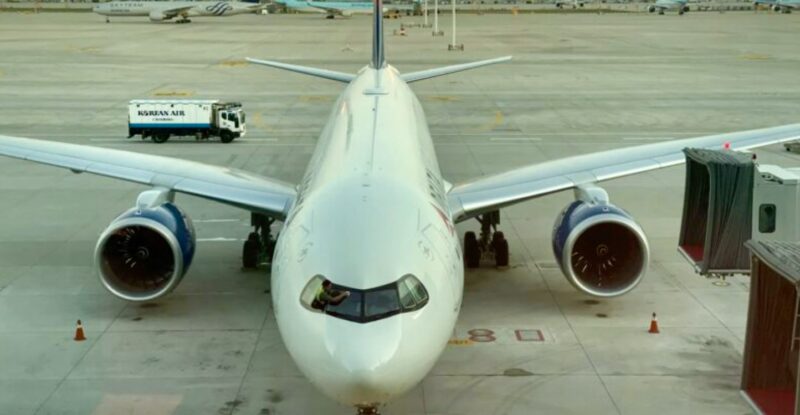
Featured image credited to Jason Rabinowitz. Embedded image credited to Viasat.