

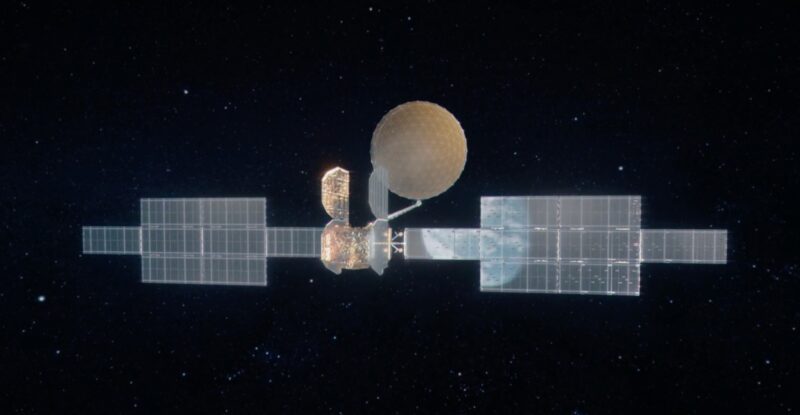

Viasat is in the home stretch to offering inflight connectivity over its new ultra-high-capacity Ka-band geostationary satellites, ViaSat-3 Flight 2 and ViaSat-3 Flight 3.
Successfully launched in November 2025 and April 2026, respectively, Flight 2 for the Americas and Flight 3 for Asia-Pacific have been hotly anticipated by the aviation market for years. The wait is nearly over.
Carlsbad, California-based Viasat reveals that all deployments for the Flight 2 satellite “have been completed” and that “this includes reflectors and boom deployments, with service entry pending FCC authorization.”
With over 1 Tbps of network capacity, Flight 2 more than doubles Viasat’s total fleet capacity. Management is convinced that the spacecraft’s capabilities are going to knock passengers’ socks off, and be a game-changer for inflight connectivity.
Meanwhile, since the successful 29 April launch of Flight 3, “radiator and solar array deployments have been successfully completed, and the satellite has now reached its slot in geostationary orbit,” Viasat confirms.
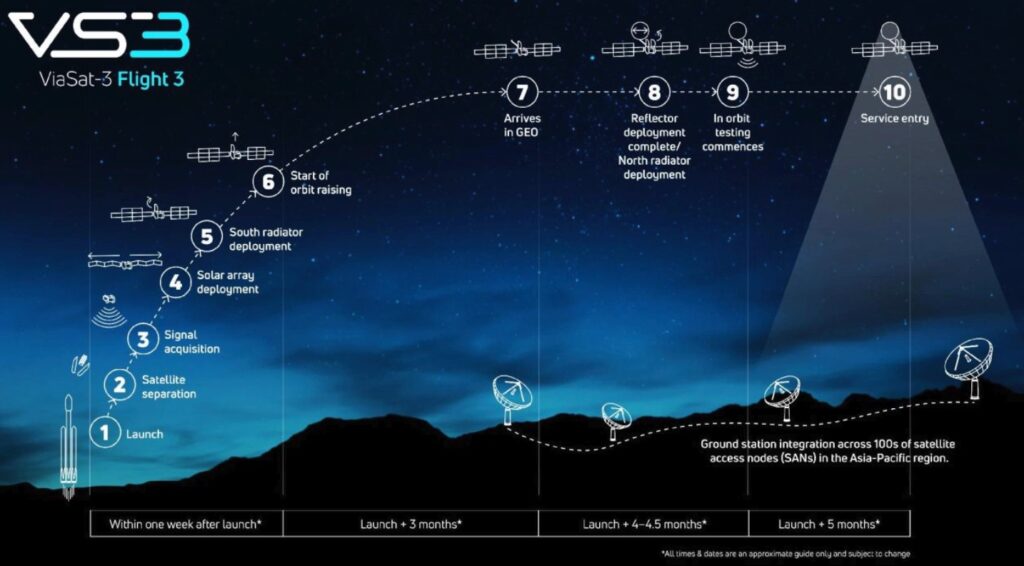
Next steps include reflector deployment, in-orbit testing followed by handover and terrestrial network integration. Image: Viasat
“Flight 3 is expected to cover the Asia-Pacific region with service entry expected in August or September of this calendar year,” a Viasat spokesperson reveals to Runway Girl Network.
That’s welcome news for major Viasat customers like Delta Air Lines and Qantas — and indeed their passengers. Both carriers have fitted international long-haul aircraft with Viasat’s IFC hardware in anticipation of offering gate-to-gate service once the Asia-Pacific coverage gap is plugged. Download speeds are expected to be north of 100 Mbps.
The Flight 2 and Flight 3 assets round out the three-satellite ViaSat-3 constellation, which includes the reduced-throughput F1 satellite that’s powering IFC on flights from the U.S. mainland to Hawaii. They work in concert with other high-capacity satellites in Viasat’s fleet, including ViaSat-1 and ViaSat-2 over North America, and the KA-SAT satellite over Europe.

Even as it bolsters its high-capacity Ka-band inflight connectivity proposition with the Flight 2 and Flight 3 satellites, Viasat is gearing up to support multi-orbit IFC using its GEO assets and Telesat’s forthcoming Lightspeed LEO service.
Viasat’s aim is to enhance resiliency and to route traffic intelligently over the most efficient pipe (with latency-sensitive applications ferried over LEO), whilst ensuring it can operate around the globe including over the poles and over China, which has strict regulatory conditions.
Telesat expects the go-live date for offering global commercial Lightspeed service to be in the first quarter of 2028. That’s in line with Viasat’s expected timeline for offering multi-orbit GEO/LEO IFC.
Viasat’s current GM-40 gimbaled antenna can support the multi-orbit service, but the firm has been developing a purpose-built, dual-beam electronically steerable antenna (ESA) which can transmit and receive data over both Ka-band GEO and Lightspeed LEO at the same time. Viasat says the ESA kit will “reduce weight, cut drag and enable airlines to capture operational efficiencies while delivering next-generation connectivity.”
Related Articles:
- Viasat readies for new AERA with ViaSat-3, multi-beam ESA
- Boeing stays flexible to support ESA installs for next-gen IFC
- Viasat sees runway for EAN in EC’s 2GHz MSS decision
- How Airbus is working to facilitate Delta’s IFC vision
- Prominent IFC providers welcome ‘least cost routing’
- Viasat sees future opportunities to reengage with Starlink adopters