

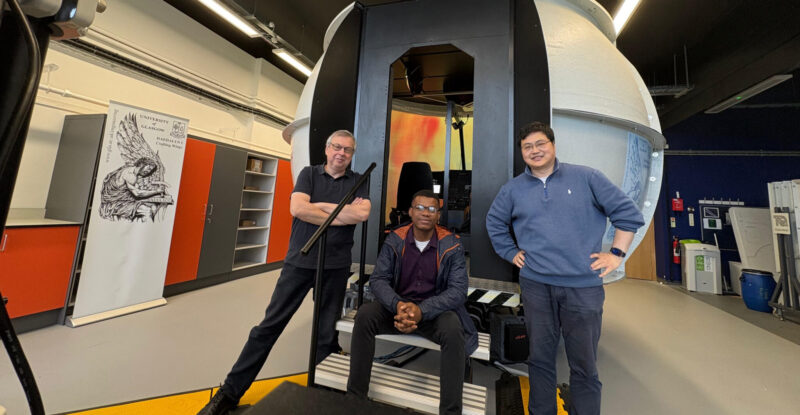

A team at the University of Glasgow’s James Watt School of Engineering has developed complex simulation software which, for the first time, accurately models the real-time interaction between an aircraft and the wildfire it is fighting.
The University of Glasgow’s Professor George Barakos, Dr. Tao Zhang, and postgraduate student Oyedoyin Dada, along with Dr. Lu You of China’s Guizhou University, recently published their game-changing work in A framework for aerial firefighting simulation, a paper published in the CEAS Aeronautical Journal.
Barakos has a special interest in the numerical and physical simulation of flows, especially in terms of rotary wings, including helicopter and eVTOL rotors, tiltrotors, and wind turbines. Meanwhile, the James Watt School of Engineering boasts a generic flight simulator, known as Daedalus I. Combined with Barakos’ vivid experience of wildfires in his native Greece, he found the prospect of modelling helicopter interactions with fires an attractive challenge.
Mounted on a six-degrees-of-freedom motion platform, Daedalus I includes a dome for 270-degree visuals and replica helicopter controls. Dada explained its versatility from the erstwhile instructor’s station: “The system is fully integrated and as we develop the program, we can simply switch the flight model and controls to suit different aircraft, including fixed-wing.”
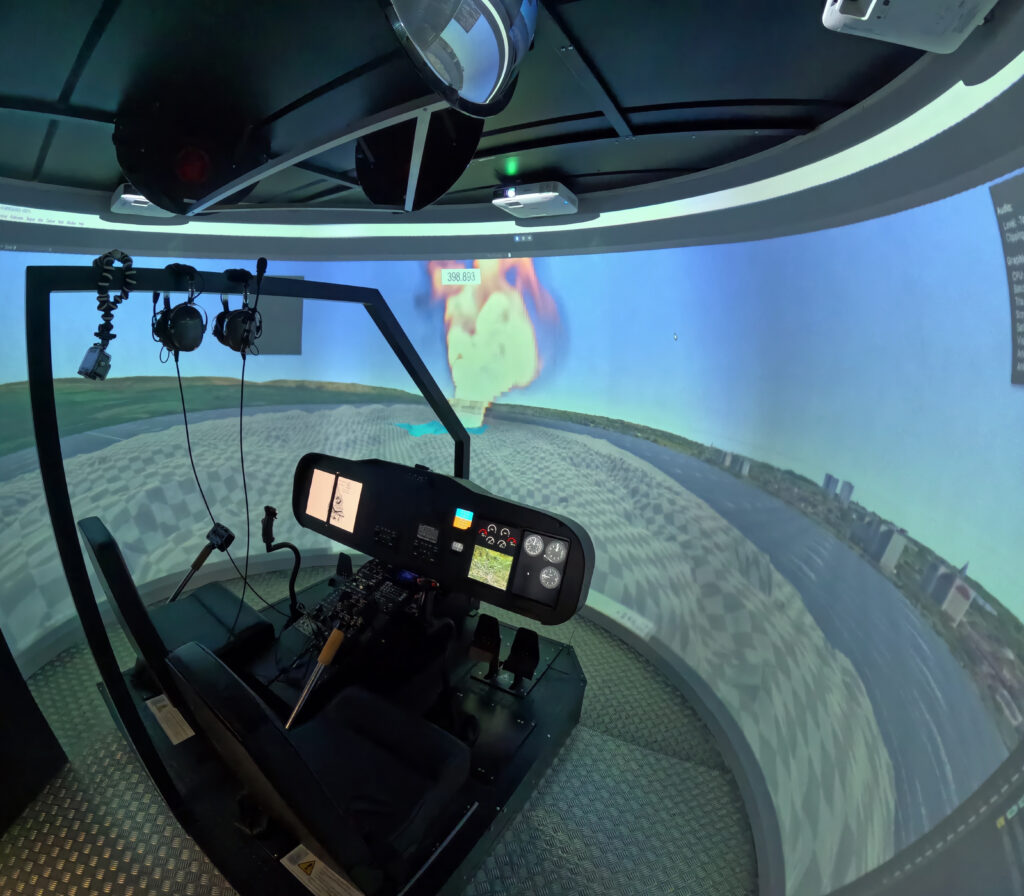
Inside Daedalus I, with the fire simulation running. Image: Oyedoyin Dada
The fire simulation element currently sits alongside Daedalus I, running on a separate computer and essentially inserting graphics and flight behavior into the ‘regular’ simulation. Mindful that high costs could be a barrier to widescale introduction, the Glasgow team runs its software using the Nvidia RTX 4090 graphics card of a commercially available gaming PC.
Barakos says complex interaction between helicopter and fire was never previously modeled because the physics is so complicated. “Now, we’ve developed physics describing what the fire is doing to the atmosphere around it, how the helicopter’s downwash and wake influence the fire, and the flow of the water or retardant the helicopter releases.
“All of this happens in a closed, coupled system. It’s never been done before because we didn’t have the mathematics capable of running in real time to describe these interactions.”
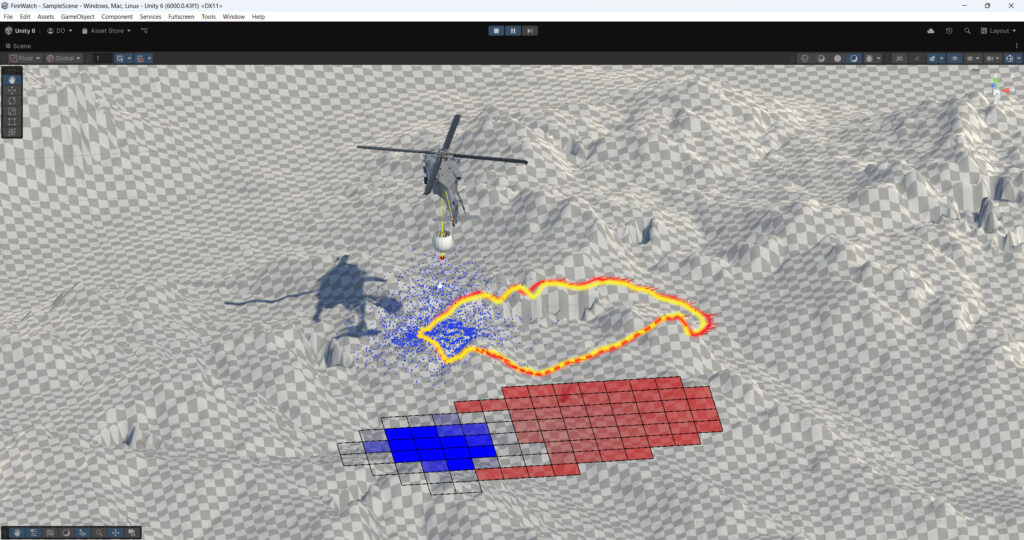
A basic depiction of a Bambi Bucket-equipped S-70 helicopter dropping water or retardant upon a wildfire. The aircraft, landscape, flight model, and other visuals are all easily changed — the crucial element is how the fire is modeled. Image: Oyedoyin Dada
Barakos acknowledges that should it gain certification as an approved training device, the software could play an important role in pilot training. But he sees its greatest value elsewhere. “It allows the exploration of strategies, decisions on which fixed-wing aircraft or helicopter, and which techniques, are best. It also enables us to train the next generation of uncrewed vehicles, taking pilots out of that harsh environment.”
The team’s initial work is based on Sikorsky’s S-70 FireHawk, but Barakos says an accurate flight model for any aircraft could be used. The fire-modelling element then adapts to it.
The concept is somewhat mind-blowing, especially when Zhang reveals: “The calculations for the effect of the helicopter on the fire run faster than real time because pilot inputs move the helicopter, which influences the fire and affects the helicopter. For the pilot in the simulator to feel that effect in real time, the fire model must calculate ahead of the real-time movement or visual change so that Daedalus I can enact it.”
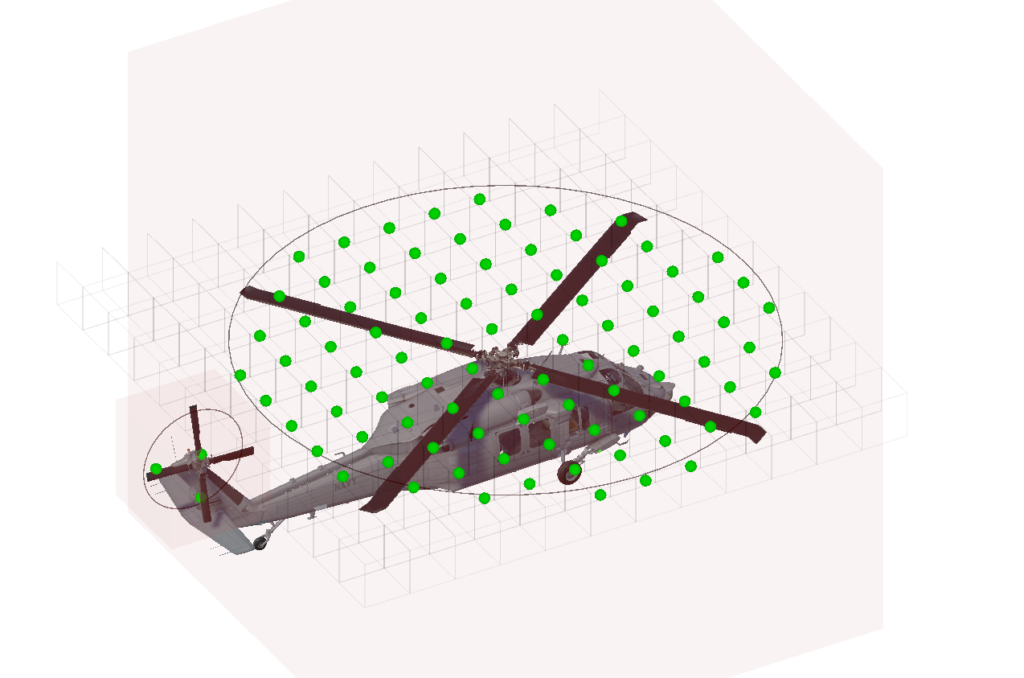
The S-70 has been accurately simulated. Image: Oyedoyin Dada
Stepping into the simulator, Zhang demonstrates the real-time interaction while Dada places a fire immediately ahead of the S-70. At this stage the visuals are still relatively simple, yet the view through the windshield is terrifying.

Dada also shows how the system can display the fire in different ways, revealing the smoke and flame the eye sees, but also how environmental factors, including helicopter downwash, change its thermal signature in the air and on the ground. The ability to see how the aircraft influences the fire will surely lead to improved firefighting capability.
Barakos says the software is ready and now the team wants to see it in the hands of industry experts and especially experienced firefighting helicopter pilots.
“We want to take it to the next level so that it can become a commercial product and we’re seeing a lot of interest from the autonomous market too. We’ve provided the missing link, the correct physics, to model the atmosphere, the aircraft and retardant drop together. Before it was too much, too cumbersome,” he says.
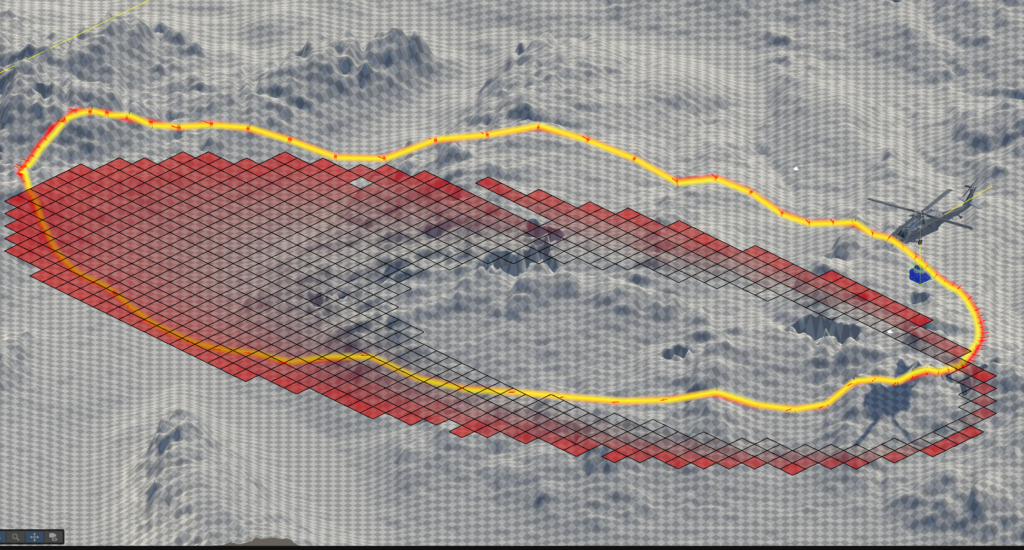
The team has developed mathematics that enable fires to be modeled and displayed in various modes and significant detail. Here the ground and vertical extent of a fire are shown, with a helicopter approaching for a retardant drop. The fire’s characteristics change as the helicopter and retardant interact with it, and vice versa. Image: Oyedoyin Dada
Related Articles:
- Pterosaur bones could lead to revolutionary new aerospace materials
- Jennifer Draughon of Neptune Aviation on aerial firefighting careers
- What to expect on a buzz flight aboard an Airbus H135
The Glasgow team, is pictured in the featured image from left to right: Professor George Barakos, Oyedoyin Dada, and Dr Tao Zhang. Image credit: Oyedoyin Dada