


As the inflight connectivity market rapidly evolves to facilitate new NGSO constellations, and airframers shape their IFC catalogs to accommodate them, Gilat Satellite Networks is optimistic that its electronically steerable antenna (ESA) hardware will gain linefit offerability at Airbus.
“I think we will have a linefit [option] for Airbus. I think I told you that last time. That will come down the road, and not too far down the road,” Ron Levin, president of the Gilat Commercial Division told Runway Girl Network at SATShow in Washington D.C., just three weeks before Airbus announced at the Aircraft Interiors Expo (AIX) in Hamburg that it will bolster its linefit, supplier-furnished HBCplus IFC program by offering a modular antenna architecture that can accommodate two ESAs in the Ku- and/or Ka-band.
HBCplus modular doesn’t quite bring airlines into the sort of multi-vendor model utilized today in the cruise industry, as aided by orchestrator Quvia and posited for commercial aviation by the Crystal Cabin Award winner and other stakeholders. After all, even if two totally disparate networks are selected and facilitated under HBCplus, a single managed service provider (MSP) must be selected by the airline, at least in the early days of the program, Airbus VP, head of connected aircraft program Tim Sommer explained to RGN at AIX. But from a technical standpoint, HBCplus modular can facilitate a multi-vendor model, Sommer noted. And, in keeping with one of the key value propositions of HBCplus, vendors can be swapped out in an overnight retrofit.
Levin’s view is in alignment; he reckons that the European airframer’s modular offer ably sets the stage for a multi-pipe ‘least cost routing’ approach in aero should industry ultimately graduate to that model.
A strong position
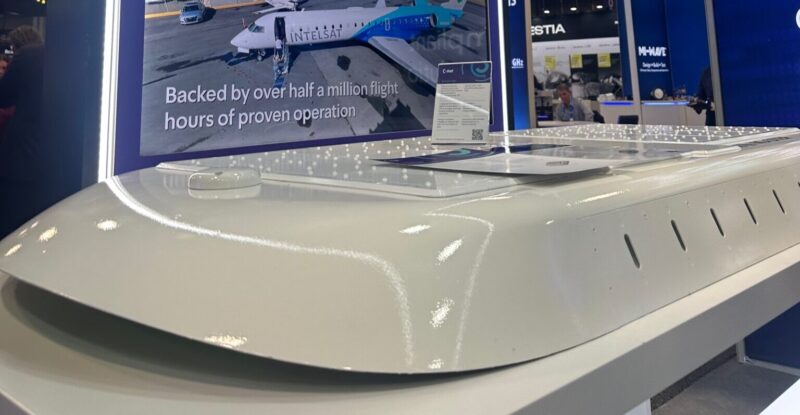
Meanwhile, as Airbus builds out the HBCplus modular ecosystem in advance of its 2028 debut — with Amazon Leo expected to be the first NGSO service facilitated (possibly for Delta) — Gilat’s portfolio of hardware is clearly a very strong contender for offerability. The Israeli firm’s Stellar Blu multi-orbit ESA, pictured above on Gilat’s stand at SATShow, is already in revenue service with airline customers of SES and Panasonic Avionics.
And, as announced at AIX, Japan Airlines will bring the satellite operator and aero ISP’s ESA-based multi-orbit solution to 20 Airbus A350-900s via the Airbus linefit process.
Did SES let the Gilat Stellar Blu ESA linefit offerability cat out of the bag with its announcement?
According to SES (formerly Intelsat) director of program management Rob Baird:
That’s a BFE program. That’s not an SFE program. So that’s the antenna that’s outside. That’s not an Airbus-applied antenna. That is our antenna. So that’s obviously exciting for us. We’ve got linefit positions with Airbus on A350. But we’re very much working with Airbus on the next generation of HBCplus. I think it’s quite embryonic…
In bolstering its BFE catalog with the multi-orbit ESA, Airbus is showing a new level of flexibility (as it previously expressed disinterest in meaningfully expanding BFE as it focuses on SFE-based HBCplus.)

The Gilat Stellar Blu ESA is, meanwhile, also fielding very positive reviews in the market.
“We’re actually very happy with the performance of it,” John Wade, VP of connectivity at Panasonic Avionics told RGN after Air Arabia went live with the firm’s multi-orbit IFC solution, which is powered by geostationary (GEO) satcom and Eutelsat OneWeb LEO service and uses the Gilat Stellar Blu ESA.
“Because of all the regulatory stuff that’s going on in that part of the world, we’re doing a combination of both GEO and LEO,” Wade noted of the Air Arabia implementation. “It’s the Gilat ESA. As we’ve talked about in the past, we prefer LEO over GEO. But, for example, an area where we don’t have regulatory approval yet with OneWeb would be India. So, whenever Air Arabia flies into India, we switch to GEO. The system is working very reliably. The passengers are very happy with the service they’re getting, and we’re extremely happy with the product launch so far.”
Gilat can easily support LEO-only IFC, including over the multi-orbit Stellar Blu ESA or indeed via its in-house ESR 2030Ku LEO-specific ESA, which is being used by Gogo both in BizAv and notably to support Immfly’s scrappy new Eutelsat OneWeb-powered IFC service for commercial aviation (Volotea has signed on as a trial customer).
In short, it’s clear that Gilat is sitting on viable and flexible options for HBCplus modular.
Importantly, SES and Panasonic also happen to be managed service providers (MSPs) on the Airbus HBCplus program.

Gilat’s ESR 2030Ku LEO-only ESA was also on display at SATShow. Image: Mary Kirby
Panasonic is also pursuing LEO-only IFC business and a future LEO-LEO offering with China’s Spacesail using Intellian’s LEO-only ESA hardware.
LEO-only rival or opportunity, or both?
Regarding Panasonic, Levin noted:
They see a LEO-LEO future, and I believe they’re right, but the question is, what’s the timeframe for them? Even they, you know, are developing a LEO-only antenna that will augment their GEO antenna. They’re not ripping off the GEO yet.
“It’s a competitor to our LEO-only solution obviously,” he said of Intellian’s ESA. “But on the other hand, with Stellar Blu’s capabilities, we’re not a technology provider anymore. We are a terminal provider. So we could actually cooperate with these guys to package it, to put some Gilat components inside, to do qual, STC, things like that, we have the capabilities in-house for that.”
Cost-wise, Gilat knows what the market is demanding. “We know the whole market needs to get the price points down on the equipment. And the other one is to get to the right form factor.”
Boeing linefit
Over on Boeing’s buyer furnished equipment (BFE) IFC program, the Gilat Stellar Blu ESA is going through offerability and will in time be fully factory-fit to Boeing aircraft using the Boeing Aerodynamic Shroud, which accommodates a variety of ESAs.
But whilst the US airframer readies for those linefit installs, it has reached an agreement with SES to allow its customers to receive new Boeing twinjets with the onboard network in place and IFC service available immediately after delivery through a Boeing-provided modification.
“Through this collaboration, Boeing will install the SES in-cabin hardware network on production aircraft during factory production, the first key milestone toward offering its multi-orbit system as a fully linefit connectivity solution across all Boeing commercial programs,” SES explained in a statement published at AIX. “As part of this solution, Boeing will install the complete in-cabin network and manage coordination of the external equipment installation. Initial offerability will be on the Boeing 737 followed by 787 airplanes.”
Japan Airlines and Skymark are among SES’s linefit customers for its ESA-based multi-orbit IFC solution on Boeing aircraft.
meoSphere + LEO IFC
SES also recently outlined a plan for bringing a next-gen meoSphere MEO-plus-LEO-powered IFC offering to commercial aviation from 2030. Levin reckons that Gilat is well positioned to give its longtime partner something to chew on as it defines that next-gen solution.
While the Gilat executive doesn’t envisage a need for a single-band, multi-beam ESA in the market, “I do envision a multi-beam but a Ku-Ka multi-band ESA. That’s going to be the magic solution. If that could work, I think it would be great for everyone.”
And he thinks it can happen in under five years.
- Panasonic, Spacesail to launch multi-network LEO IFC in 2027
- How Airbus is working to facilitate Delta Air Lines’ IFC vision
- SES meoSphere will be core to new MEO/LEO inflight connectivity
- Air Arabia debuts Panasonic Avionics multi-orbit IFC
- Air Canada extols virtues of SES multi-orbit IFC
- How Quvia helps airlines throw out the IFC playbook and take control
- Gilat pleased with ESA take-up as airlines roll out multi-orbit IFC
- How Boeing Global Services is supporting Starlink installs on 787s
- Intellian advances ESA for Panasonic, reveals further aero aspirations
- Do fast Wi-Fi and the shift in media consumption portend BYOL IFE?
- Press Release: Airbus reveals HBCplus modular antenna option
- Press Release: SES, Boeing reach offerability milestone for multi-orbit IFC