


Eutelsat used the occasion of the International Space Summit in Paris to announce several key agreements that will ensure it can both replenish and expand its existing OneWeb Low Earth Orbit (LEO) satellite network, and support the LEO portion of Europe’s forthcoming sovereign IRIS² multi-orbit constellation.
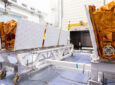
The Paris-based satellite operator said it will procure a further 229 OneWeb LEO satellites from Airbus Defence and Space, bringing the total number of new OneWeb satellites contracted with Airbus for the Gen 2 network to 669.
An ‘authorization to proceed’ contract signed by the two firms will enable Airbus to begin initial industrial activities at its Toulouse manufacturing facility to fulfill this follow-on order.
Airbus has meanwhile progressed in its work to build the 440 previously-contracted OneWeb satellites.
“With the first satellites from the existing order expected to be delivered next quarter, the additional 229 satellites will enable Eutelsat to continue progressively replenishing and expanding OneWeb through 2034, securing continuity of service while unlocking additional capacity and capabilities for existing and new customers,” Eutelsat said.
New launch contract with Arianespace
Eutelsat will utilize a variety of launch service providers to begin ferrying OneWeb replenishment satellites into space — and that lineup now includes Arianespace.
Under a new contract announced in Paris, satellites will be carried via two dedicated launches aboard Arianespace’s powerful Ariane 64 rockets in 2027 and 2028 from Europe’s Spaceport in French Guiana.
Eutelsat’s OneWeb aero partners
Aviation is among the sectors served by Eutelsat’s existing OneWeb constellation of 648 LEO satellites and this domain will continue to be supported by its future Gen 2 network. and indeed IRIS² in time.
Several stakeholders have already built aero products around OneWeb, including service distribution partners SES and Panasonic Avionics, which are using it as part of their respective multi-orbit inflight connectivity solutions for airlines.
Hughes Network Systems is working to bring both LEO-specific and LEO/GEO IFC to airlines, while Gogo uses OneWeb to power its Galileo IFC offering in business aviation.
IRIS², the sovereign, multi-orbit constellation
Handily, Eutelsat’s OneWeb replenishment satellites are expected to be aligned with the ultra-secure architecture required for Europe’s future IRIS² multi-orbit constellation, for which Eutelsat — Europe’s only operator with an operational LEO constellation — is the LEO-lead on the program as part of the SpaceRise consortium.
SpaceRise also includes SES, which is responsible for the 18-satellite Medium Earth Orbit (MEO) portion of the IRIS² network, and Hipasat, with responsibility for the ground segment as well as a low LEO sublayer.
In August, the European Commission (EC) concluded negotiations with SpaceRise, moving IRIS² from planning to full-scale deployment. As part of that agreement, and in response to a changing security environment, a further 66 satellites in Low Earth Orbit were added to the IRIS² program, bringing the main constellation to 348 satellites.
These 348 satellites will boast optical inter-satellite links. And additional optional elements may be added to support specific missions.
Thales to provide IRIS² government payloads across the LEO network
Eutelsat has since tapped Thales Alenia Space — the joint venture between Thales (67%) and Leonardo (33%) — to provide the governmental payloads dedicated to the 330 LEO satellite portion of IRIS² (66 Ka-only satellites and 264 dual Ku/Ka satellites).
“This order represents a tranche of approximately 500 million euros out of a global IRIS² contract size for Thales Alenia Space which is set to exceed 3 billion euros overall,” Thales Alenia Space said in announcing the new contract in Paris.
Airbus Defense and Space to build the first LEO layer of IRIS²
Airbus Defense and Space has been chosen by Eutelsat to design and build the first layer of 66 LEO satellites, which is considered “the sovereign pillar” of the IRIS² project, delivering military Ka-band connectivity to future European users. This work will be done at the same Airbus plant in Toulouse where OneWeb Gen 2 satellites are being built for Eutelsat.
“It is a privilege to contribute to this strategic programme, which will strengthen Europe’s digital sovereignty and strategic autonomy,” Alain Fauré, head of space systems at Airbus Defence and Space, said of IRIS².
“Leveraging our proven, industry-leading experience in the production of large-scale LEO constellations, we are fully committed to delivering this critical first layer.”
Belgium’s Aerospacelab selected for the remaining 264 LEO satellites
End-to-end satellite manufacturing firm Aerospacelab will also play an important role in the buildout of IRIS².
Following what it described as “a rigorous competitive dialogue conducted with Eutelsat,” the Belgian space company was selected to build the remaining 264 satellite platforms for IRIS².
“The selection of Aerospacelab for IRIS² reflects a deliberate industrial choice, a defining moment for Europe as a whole. Institutions are now also placing their trust in a new generation of space manufacturers: companies like Aerospacelab, built from the ground up to deliver satellite infrastructure at scale and speed,” Aerospacelab CEO Benoît Deper said.
“At the heart of Europe, we have designed and are now completing our Megafactory: an industrial tool whose scale was built precisely for programmes of this magnitude. Waking up knowing that we are building Europe’s strategic future is a rare privilege.”
IRIS² is expected to progressively deliver operational connectivity services from 2029 onwards.
Related Articles:
- Germany’s Isar Aerospace makes history in Europe
- Now critical, IFC needs resiliency, security: Eutelsat’s Bisgaard
- SES meoSphere will be core to new MEO/LEO inflight connectivity
- Rocket Lab CEO vows commitment to aero as firm buys Iridium
- Viasat sees runway for EAN in EC’s 2GHz MSS decision
- Rise in sovereign satcom presents GEO-capable hardware opportunity
- IRIS² laser links will benefit PaxEx but you probably won’t notice
Featured image credited to istock/MikeMareen