

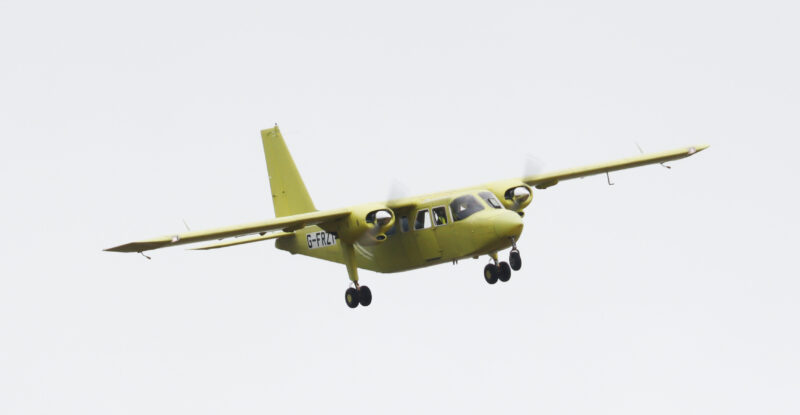

A Britten-Norman BN2B-26 Islander bearing serial number 2317 flew for the first time on September 3, 2026.
After more than 60 years in production, the program has witnessed over 1,200 maiden flights, but 2317 is notable because it was entirely assembled in the UK from detail component level, marking the most significant milestone yet in what Britten-Norman terms its ‘reshoring’ process.
Islander production began at the company’s Bembridge, Isle of Wight facility in the 1960s, but soon shifted to Romania, with only completion handled in the UK. The Romanian connection persisted through financial challenges and ownership changes as assembly moved to Belgium, and then partly back to the Isle of Wight. In 1999, a resurgent Britten-Norman purchased the Romanian assets and in 2023 the reshoring process began.
“Our plan is to build four aircraft in 2027 and eight per year by 2029, moving to a continuous production cadence rather than building to order,” says Britten-Norman business development director Lara Harrison. “The work of the last three years has been standing the line back up, and 2317 flying is the proof that it is running.”
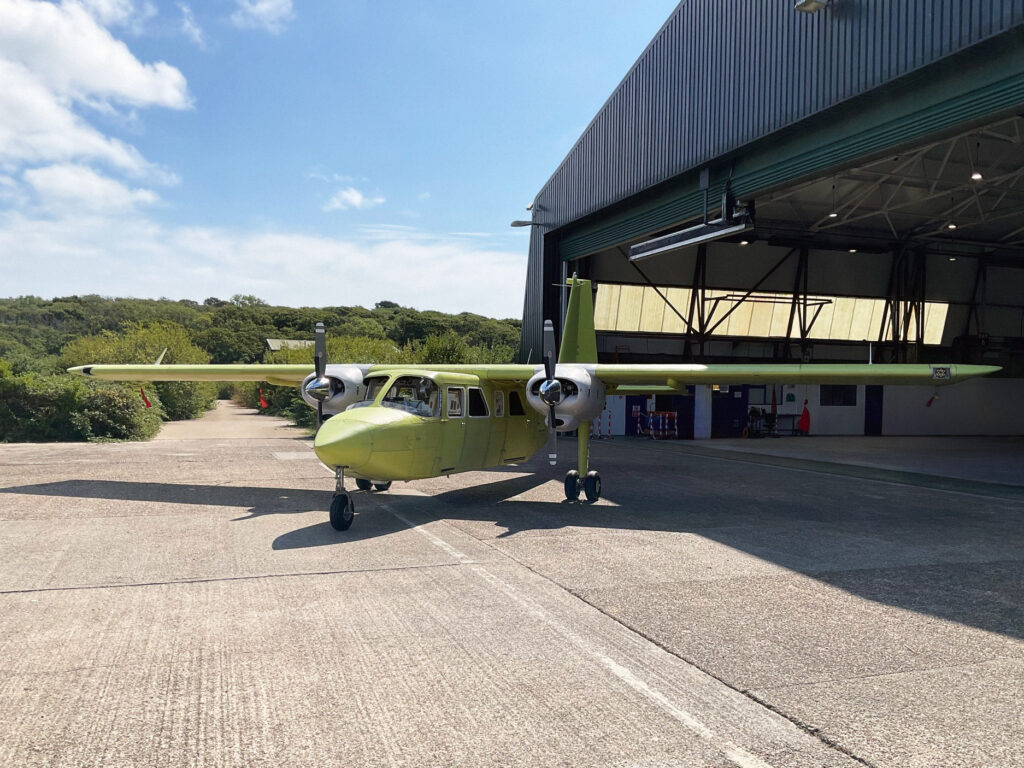
Aircraft 2317, the first Islander built from the detail component level on the new Britten-Norman assembly line on the Isle of Wight, flew for the first time on September 3. Image: Britten-Norman
But there is more to reshoring than building airplanes again. While 2317 looks almost identical to the prototype turboprop that appeared at the Paris Air Show in 1965, it reflects hundreds of design and technological improvements incorporated since. Now, Britten-Norman is bringing the Islander into the digital era.
“All new design work is now modelled in 3D CAD, and we’re steadily digitizing the legacy drawing set as we go,” says Harrison. “The BN2B is defined across more than 10,000 drawings, so bringing that data into the CAD system properly means working through decades of paper and film, drawing by drawing, rather than a quick, bulk conversion.”

The work is critical to the future, since the digital model drives the new shop floor, feeding the CNC (computer numerical control) tooling machines. It means detail parts on 2317 were cut to a digital definition rather than hand-finished to a drawing, and the same CAD model is used to program the CMM (coordinate measuring machine) for inspection.
Harrison explains: “It means the part that’s designed, cut, and checked traces back to one digital definition rather than three separate interpretations of a drawing. Repeatability between airframes improves as a direct result, and that matters as much for the operator ordering spares in ten years as it does for the aircraft coming down the line behind this one.”
A second airframe is already progressing through the line and components for the third are in manufacture. “We hold letters of intent with operators, and first flight was the milestone those operators have been waiting for. Taking those conversations to contract is where our focus goes next,” says Harrison.
Aircraft 2317 is scheduled to arrive with its customer, the Falkland Islands Government Aviation Service (FIGAS), an Islander operator since 1979, in October. Essentially a domestic airline, FIGAS operates one maritime patrol-configured Islander, but the five-aircraft fleet is primarily used for passenger transport.
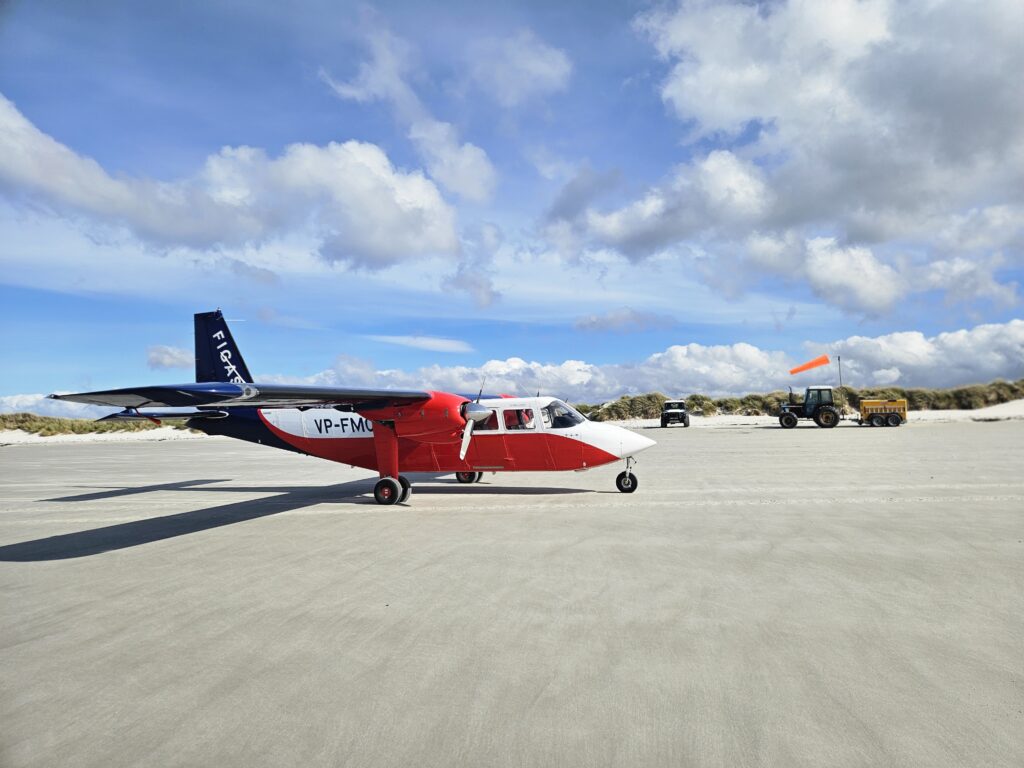
FIGAS Islander on Keppel Island beach, Falkland Islands. Image: FIGAS
Chief Pilot Troyd Bowles explains: “During the summer season most of our passengers are land-based tourists, many of them wildlife photographers and enthusiasts. We also offer scenic flights to visiting cruise ships, and we have a full medevac kit that can be fitted inside the aircraft in 15 minutes.”
Bowles says FIGAS has yet to identify a more suitable aircraft: “The Islander has proven itself in the sometimes harsh and unforgiving Falklands environment,” he says.
“We have over 30 airstrips all around the Falklands, of which the vast majority have grass surfaces, along with several clay/shingle airstrips and a couple of sand beaches. The combination of STOL, the ability to operate from rough surfaces and its crosswind capability mean the Islander is still ahead of its competitors for our unique operation.”
Related Articles:
- De Havilland Aircraft of Canada looks to resurrect rugged Sherpa
- Norwegian electric flying boat developer NOEMI reveals wider scope
- Eyeing hydrogen power iconic Islander returns to UK production
- New England Airlines brings the AvGeek fun on Britten-Norman Islander
Featured image credited to Britten-Norman