

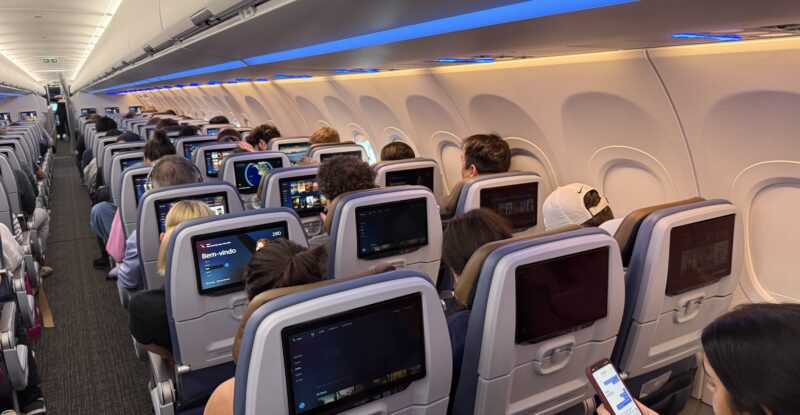

With an estimated forty-four airlines now committed to SpaceX’s Starlink Low Earth Orbit (LEO) satellite-powered inflight connectivity, and hybrid multi-orbit IFC solutions gaining traction in the market, more passengers than ever before are streaming content, engaging in online gaming, and browsing social media in the manner in which they’re accustomed to on the ground — without encountering major video buffering and lagging.
The volume of data being consumed in flight is staggering. In a statement published by Emirates on 2 July, the airline revealed that more than a Petabyte of data had been used by its guests on the 36 widebodies fitted with Starlink as of that date, and in the seven months since the service debuted. Feedback, it said, “has been exemplary — with many commenting that the Wi-Fi is ‘better than at home.’”
However, as data consumption grows exponentially and passenger expectations rise, the demand for satellite capacity increases commensurately. According to a new Novaspace report, capacity leased for IFC services is projected to increase nineteen-fold over the next ten years. By the end of this period, it expects non-geostationary satellite orbit (NGSO)-based solutions to account for 89% of total leased capacity.
“As you start doing the math, and you start connecting everyone on an aircraft and they want to do something like stream, or do something that they do on the ground, that adds up, and you’re going to need all the capacity you can,” said Kurt Weidemeyer, who serves as vice-president, product management for Inflyt Experience at Thales.
That’s among the reasons why Thales, a major player in the increasingly-connected seatback IFE space, is remaining “agnostic on connectivity” and why Weidemeyer reckons that the industry will need “all solutions” including hybrid multi-orbit IFC.

Having long supported geostationary (GEO) satellite-based inflight connectivity, Thales is certainly no stranger to the ecosystem. In the early years of cabin connectivity, Thales’ technology roadmap tracked closely with Inmarsat’s roadmap by first supporting lower-bandwidth L-band IFC and later broadband Global Xpress Ka-band IFC as a value-added reseller.
When Viasat started rolling out its first generation high-capacity Ka GEO service in the United States, Thales acted as aero ISP for its longtime IFE customers JetBlue and United Airlines. More recently, Thales offered its own high-capacity Ka GEO IFC solution in partnership with SES. Spirit Airlines was a customer before shuttering operations in May.
A former SVP of technology at Inmarsat, which was acquired by Viasat in 2023, Thales’ Weidemeyer is an admitted “connectivity person by heart.” He’s rightfully impressed by what LEO can accomplish, having recently seen “one of the fastest rollouts I’ve ever witnessed” as Qatar Airways adopted Starlink and Thales, a prominent provider of seatback IFE to the airline, connected to it.
But Thales is able and willing to connect its seatback IFE to virtually any pipe — and augment it with its cloud-based FlytEDGE edge caching and 360Stream live television and near-live TV offerings to ensure an overall better passenger experience. “We connect to GEO, LEO. We’ve connected to the Viasat-previously-Inmarsat network. We’re connected there as well. We are fully agnostic,” Weidemeyer noted.
“The game changer with LEO,” he said, “is the low latency, so that when you hit a request to go to a website, you get a response that’s so fast you feel like you’re on the ground. But once you start streaming, as an example, you don’t need the low latency.” Rather, in those instances, the traffic can be moved to GEO.
“You almost start the session with LEO, so you get the great user experience, and the revenue starts streaming. You can transfer that to GEO, where you’ve got the high capacity in different areas, and the end passenger doesn’t even know the difference,” he told RGN, pointing to multi-orbit solutions available from Hughes, SES and even IFE rival Panasonic Avionics.
In keeping with its agnostic approach, Thales does not take a position on what connectivity pipes should be adopted by airlines, “but more the better” given the current market realities, Weidemeyer noted. “Knowing the math, you need all solutions.”
Underscoring its flexibility in the market, and the type of collaborative approach that airlines increasingly require of their vendors, Thales recently equipped 69 United Airlines aircraft with its web-enabled 360Stream live TV application to support the US major’s broader initiative to bring live streaming TV channels from DIRECTV to Starlink-enabled United seatback screens through 20 July. Viasat is also supporting the initiative on other aircraft with its Viasat Live TV application.
An Over-The-Top (OTT) technology, 360Stream features a variety of industry-first capabilities. A Dynamic Channels feature ensures only channels with active content are displayed, optimizing bandwidth use and creating a smoother viewing experience. And near-real time highlights and recaps are wirelessly delivered to the aircraft when they are most relevant.
Thales confirms to RGN that it is delivering a mix of both live and near-live content for United’s passengers.
This high-demand period for live sports is the perfect window to demonstrate the value of 360Stream. But for Thales, it also showcases its ability to deliver agile digital solutions that give airlines ultimate flexibility over the passenger experience.
Related Articles:
- Thales’ new Tandem OLED-based FlytEDGE Aura shines bright
- Prominent IFC suppliers welcome ‘least cost routing’
- Connected seatback at the fore as RAVE Aerospace enters new era
- Panasonic enjoys rapid IFE growth as connected seatback takes wing
- Thales talks event-based 360Stream and near-live highlights
- Qatar Airways becomes first in the world to bring Starlink to 787s
- How United is leveraging Starlink and the cloud to enhance IFE
- RAVE nixes proprietary antenna work as LEO shapes IFC
- Thales takes IFE innovation to the edge with edge caching and cloud
- Now critical, IFC needs resiliency, security: Eutelsat’s Bisgaard
Featured image credited to Chris Sloan