

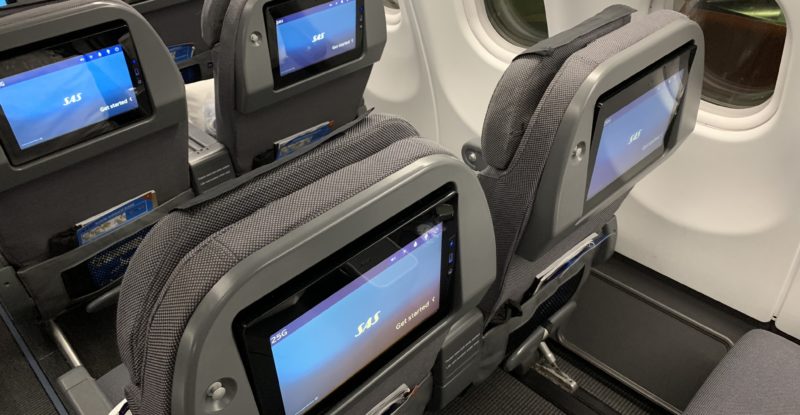

Amid a changing landscape that sees Low Earth Orbit (LEO) satcom coloring the passenger experience, RAVE Aerospace, newly renamed following its acquisition by private equity firm Kingswood Capital Management, has stopped “internal development of any new proprietary inflight connectivity antenna technology,” Runway Girl Network can reveal.
Though it has never acted as an IFC service provider, the integrator and embedded IFE firm formally known as Safran Passenger Innovations (SPI) has long provided terminal hardware to the market, firstly in support of Inmarsat-now-Viasat’s Global Xpress service using Honeywell’s JetWave Ka-band gimbaled antenna and later via Thinkom Solutions’ Ka2517 VICTS antenna; the hardware is linefit offerable at Boeing and Airbus, with VICTS being part of the European airframer’s supplier-furnished HBCplus program.
In 2019, before the Covid pandemic, SPI’s then-parent Safran committed to invest heavily in the Brea, California-based unit’s development of an electronically steerable antenna (ESA) in cooperation with JetTalk — the JV between SatixFy and ST Engineering. (MDA Space later acquired JetTalk.) Notably, SPI last year forged a “strategic partnership” with metasurfaces specialist Greenerwave to develop a next-generation Ka-band aero satcom terminal.
Changing IFC landscape
But as Kingswood completed its acquisition of SPI from Safran earlier this month, rebranded the business and vowed to invest in the connected seatback experience, RAVE Aerospace provided additional details about its plans for supporting the IFC market, specifically, going forward.
The company told RGN in a statement:
We continue supporting all existing IFC customers and our Ka2517 (ThinKom) linefit terminal on Airbus and Boeing platforms. We recognize that different solutions are better suited to different customer profiles and operational requirements. We are committed to supporting those needs as the market evolves and as next generation solutions become available.
With that said, IFC is entering a new phase. As LEO constellations accelerate, hardware is becoming commoditized. Differentiation has shifted to the constellation and network layers, which are areas more suitably addressed by service providers.
Recognizing this trend, RAVE Aerospace stopped internal development of any new proprietary IFC antenna technology.
Instead, our strategy is:
- Invest in the connected seatback experience;
- Expand the digital layer;
- Deliver seamless IFE–IFC integration, and;
- Ensure our customers retain full choice.
RAVE Aerospace added: “We work with all connectivity service providers LEO, MEO, GEO and hybrid, so airlines never get locked into a single stack. The role of RAVE Aerospace is to integrate cleanly with whichever partner our customers choose.”
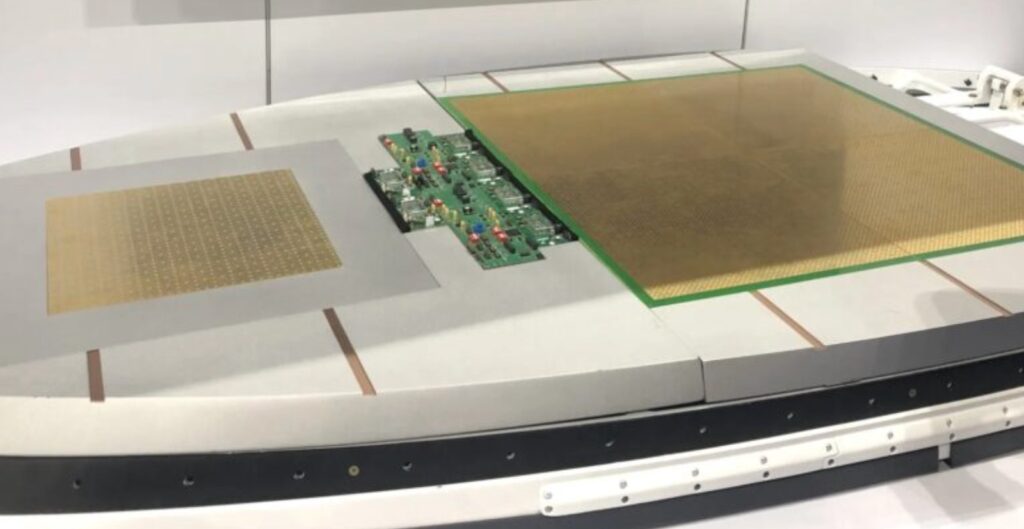
SPI’s former parent Safran once committed to invest heavily in IFC antenna technology. SPI, which is now owned by Kingswood and named RAVE Aerospace, is not pursuing further “proprietary” antenna work. Image: Mary Kirby
Focus on connected seatback
A challenger in the embedded IFE space to Panasonic Avionics and Thales, RAVE Aerospace does not lay claim to a specific share of the seatback market. “[E]xact percentages vary by methodology, but RAVE Aerospace continues to hold a meaningful and expanding share,” said the firm, which boasts over 100 airline customers.
“We don’t manage to a numeric target; we manage to customer outcomes. Market share follows when you deliver reliability, integration simplicity, lowest total cost of ownership (TCO), modern IFE experiences, and strong support.”
Some of RAVE Aerospace’s prominent airline customers, such as SAS and Lufthansa, are in the process of bringing SpaceX’s Starlink LEO-powered IFC to their fleets. Little wonder then, why the firm intends to be a power player in the seamless integration of IFE and IFC in support of the connected seatback.
To that end, RAVE Aerospace will employ its edge caching, PED casting and next-gen processing architectures, whilst ensuring its RAVE IFE systems can, as it says, “integrate cleanly with whichever IFC service partner” its customers choose.
 Private equity ownership + select acquisitions
Some industry stakeholders worry that private‑equity ownership prioritizes cost‑cutting over passenger experience. Before Kingswood’s acquisition of SPI, Platinum Equity acquired Anuvu. How does Kingswood address this concern, we asked?
“We are aware of that sentiment, but our experience with Kingswood demonstrated a completely different approach,” RAVE Aerospace says. “Their thesis is centered on growth, acceleration, and investment, not austerity. Kingswood invested in us because of the reliability and reputation of RAVE, our customer relationships, and our leadership team, which was deliberately kept in place to ensure continuity.
“Customer commitment remains at the center of everything we do. With Kingswood’s backing, RAVE Aerospace is strengthening engineering, scaling digital capability, expanding support, and executing our Lean, Fit & Agile transformation. This is how we grow even stronger.”
Notably, Kingswood foresees expanding RAVE Aerospace through additional acquisitions, but it notes it will do so “selectively.”
“We’re evaluating opportunities in digital platforms, global support expansion, complementary cabin technologies, and operational intelligence,” the company reveals.
“The filter is simple: Does it create more value for our customers? RAVE Aerospace will pursue partnerships or acquisitions that elevate the cabin experience without compromising openness or customer choice.”
Related Articles:
- Optimism abounds as Amazon eyes more open ecosystem for LEO
- Connected seatback at the fore as RAVE Aerospace enters new era
- #PaxEx Podcast: IdeaNova and the bright ideas shaping IFEC
- Eutelsat reports ‘strong progress’ in IFC as LEO revenues take off
- Viasat sees future opportunities to reengage with Starlink adopters
- How Telesat plans to differentiate in LEO with Lightspeed
- RAVE new world: Safran pairs PED casting with edge caching for IFE
Featured image credited to Jason Rabinowitz