

 Packing more passengers into the most fuel-efficient aircraft and eliminating premium seating could reduce global aviation emissions by as much as three-quarters, a new study has suggested.
The study, which was co-led by the University of Oxford and published in Nature Communications Earth & Environment on January 7, analyzed data from almost 30 million commercial flights in 2023 and found “enormous variability” in per-passenger carbon-dioxide emissions.
Based on the data used, the report’s authors determined that global aviation emissions averaged out at 84.4g of CO2 per kilometer for each paying passenger in 2023. For some routes this figure was close to 900g of CO2 per passenger-kilometer while for others it was as low as 30g, prompting the researchers to examine the factors behind this variation.
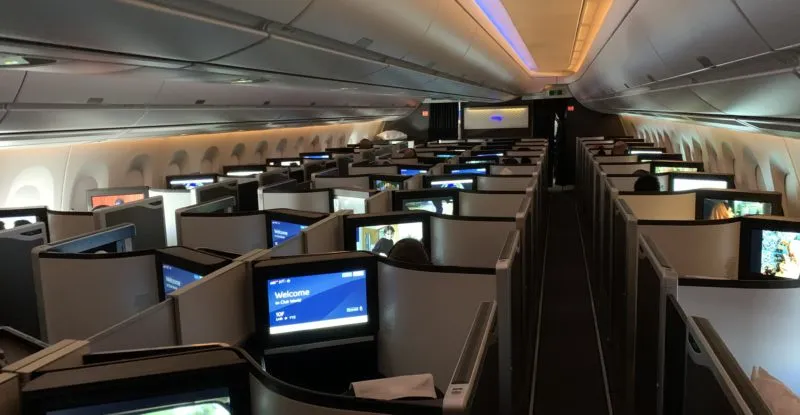
The study’s authors identified three key measures which, they argue, could reduce aviation emissions by 50-75%, if implemented in conjunction. These three levers include solely operating the most fuel-efficient aircraft; switching to an all-economy layout by removing premium-class seating; and increasing passenger load factors to 95% from an average of 79%.
Replacing all aircraft with the two most efficient models — identified in the study as being the Boeing 787-9 and the Airbus A321neo — would result in fuel savings of 25-28%, the authors suggest. Configuring these aircraft with entirely economy-class seating would further reduce emissions by 22-57%, the study notes, while increasing load factors to 95% could cut emissions by another 16%. (Passengers’ accessibility needs were not factored into the calculations.)
Airlines’ efforts to modernize their fleets with more efficient aircraft are, however, being hampered by ongoing aerospace supply-chain issues. In December, the International Air Transport Association (IATA) said that sustainability gains were being delayed by a “severe shortage” of new aircraft. The trade association does not expect the “structural mismatch” between airline requirements and aircraft production capacity to normalize before 2031.
Responding to the conclusions of the study, IATA senior vice-president sustainability and chief economist Marie Owens Thomsen says: “Airlines have a strong self-interest to reduce fuel burn and maximize load factors — the latter is now at a record 84%. However, supply-chain failures have caused an aircraft order backlog of over 5,000 planes, stalling habitual annual fuel-efficiency gains.”
She adds that “real progress lies in building new energy markets, as the world did regarding wind and solar, and in deploying SAF [sustainable aviation fuel], CORSIA (ICAO’s Carbon Offsetting and Reduction Scheme for International Aviation] and airspace modernization, to meet our decarbonization aims.”

Airlines have committed through IATA to achieve net-zero carbon emissions by 2050 through a combination of measures — chief of which involves switching to alternative fuels. The industry body envisions that 65% of emissions savings will come from SAF, with new technology accounting for a 13% savings. Offsets and carbon capture will account for almost a fifth of the intended emissions reduction, with the remainder coming from infrastructure and operational efficiencies.
But some environmental groups are losing patience with what they see as slow progress on the aviation industry’s part to reduce its emissions. Germany-based non-profit group Atmosfair, for instance, said late last year that rapidly growing passenger numbers and slow efficiency gains are preventing the airline sector from meeting its climate targets. It is calling for the introduction of a tax on business and first-class passengers, arguing that premium travelers are “disproportionately responsible” for the climate impact of air transport.
“A levy on these flight classes would be socially acceptable, affordable for passengers and in line with the polluter pays principle,” says Atmosfair managing director Dr Dietrich Brockhagen. He adds that “even after decades of assurances from the industry, there is still no sign of a turnaround in climate protection in aviation”.
A growing number of airlines now allow passengers to buy CO2 offsetting packages for their flights. Lufthansa, for instance, awards miles and points for more sustainable flying.
Related Articles:
- Lufthansa Technik to bring AeroSHARK to A330ceo family
- Air France-KLM to help EASA optimize EU Flight Emissions Label
- Airbus hones hydrogen plan, showcases nextgen narrowbody tech
Featured image credited to John Walton